It's harvest season in November in Nigeria, and local farmer Stephen bends over to reap rice ears in a demonstration field on the outskirts of Abuja, the capital. The variety he's harvesting—GAWAL-R1—is no ordinary crop: it's a Chinese-developed super rice, tailor-made for Nigeria after 11 years of adaptation, promotion and trust-building.
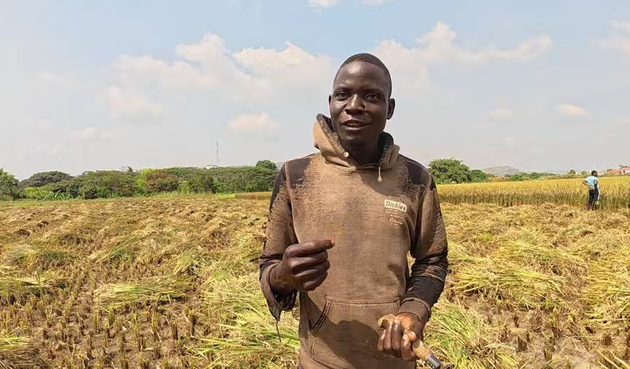
Stephen, a Nigerian farmer, harvesting GAWAL-R1 super rice. Photo/Zheng Yuhang (NBD)
"I will say the best thing about this Chinese rice seed is its reliability—it gives farmers exactly what they expect at harvest," Stephen said, wiping sweat from his brow.
Back in 2014, Xu Guoxin, then 25 years old, arrived in Nigeria as part of China's Green Super Rice Project—a joint initiative launched in 2008 by the Chinese government and the Gates Foundation launched to reduce hunger and increase the farmer income in developing Asian and African countries. He never expected to stay for over a decade.
Initial attempts to replicate China's hybrid rice success hit major obstacles. "Chinese hybrid seeds cost $5-$6 per kilogram, while local conventional seeds cost just $1," recalled Xu Guoxin, now Deputy General Manager of Green Agriculture West Africa under CGCOC Group. "Local farmers were used to saving seeds for generations—they couldn't understand why they needed to buy new ones yearly." Compounding the challenge was Nigeria's poor agricultural infrastructure, including limited irrigation and scarce farm machinery, which made high-maintenance hybrid rice unworkable.

Xu Guoxin in his office at the Green Agriculture West Africa Company headquarters in Abuja. Photo/Zheng Yuhang (NBD)
The team decided to shift focus from "the best technology" to "the most suitable solution". They tested over 40 rice varieties from the Chinese Academy of Agricultural Sciences, and eventually developed GAWAL-R1. By 2017, the variety—yielding 8.0 tons per hectare (far above the 5.6 tons of the local staple FARO44) with stronger disease and lodging resistance—became the first Chinese-developed rice certified by Nigerian authorities. It was even recommended to 14 other member countries of the Economic Community of West African States (ECOWAS).
Market access became another challenge. Early reliance on Nigerian government subsidy orders made the company vulnerable when oil prices (a key component of Nigeria’s economy) plummeted in 2018, wiping out agricultural subsidies and orders. The team then turned directly to rural farmers. Traveling 200 km from Abuja to Bida could take 15 hours round-trip due to potholed roads and safety risks.
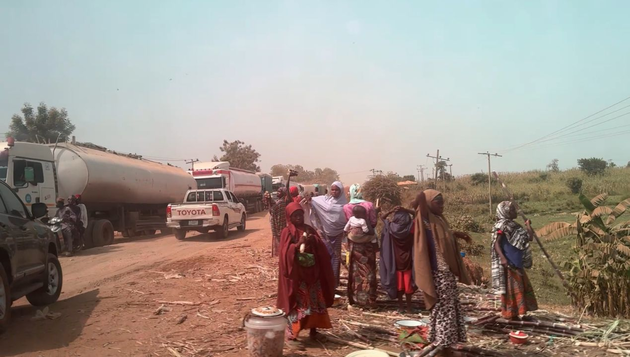
Nigeria's challenging traffic conditions. Photo/Zheng Yuhang (NBD)
In 2023, the team launched a local distribution network by partnering with trusted Nigerian dealers, offering favorable prices, and sharing profits to activate the supply chain. Today, the network covers one third of Nigeria's states, with 88% of GAWAL-R1 sales going to smallholder farmers. The company not only became profitable but also built a sustainable market presence.
Winning over conservative farmers required more than sales. "No matter how well you explain, they trust what they've grown themselves," said Dr. Bolaji Salihu of Nigeria's National Cereals Research Institute. The team set up side-by-side test fields—planting GAWAL-R1 next to local varieties—which were open to villagers throughout the growing season. At harvest, the clear visual contrast—plump GAWAL-R1 ears versus thin local ones—was convincing.
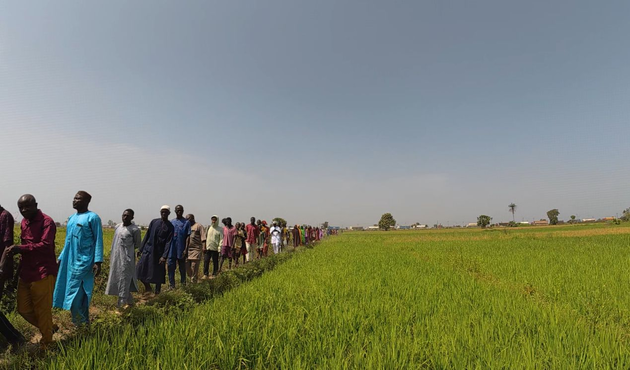
Nigerian farmlands and farmers Photo/Zheng Yuhang (NBD)
Xu Guoxin calculated that growing GAWAL-R1 added about 10,000 yuan ($1,370) per hectare yearly, enough to change lives in a country where 139 million people live below the poverty line. Surveys by Dr. Salihu confirmed its success: nearly all farmers who tried GAWAL-R1 continued using it.
Beyond yields, emotional bonds deepened trust. Xu Guoxin persuaded his Nigerian driver to send his child to school, even offering tuition support—changing the driver's belief that "school won't help the child leave the village". Today, the child is in junior high school, and the driver continues to support his family by growing GAWAL-R1. A 17-year employee of the Chinese company has even built a house in Abuja and started a family.
Xu Jianlong, a recipient of the First Prize of the National Science and Technology Progress Award and Senior Scientist at the Institute of Crop Sciences, Chinese Academy of Agricultural Sciences, He told *National Business Daily* that Africa faces pressing food security issues. "Take Nigeria as an example: it relies on imports for about 60% of its rice annually, consuming a large amount of foreign exchange. Africa urgently needs to establish localized variety breeding and promotion systems."
He emphasized that the key to China's agricultural technology assistance in Africa lies in shifting from simply "providing technology" to systematic "joint growth". "China's agricultural technology going global is transitioning from single-variety export to systematic empowerment covering ‘good seeds, good methods, and good fields'. To achieve breakthroughs, it's crucial for Chinese enterprises and research institutions to take root in Africa for the long term and integrate deeply with the local ecosystem, research teams and enterprises."
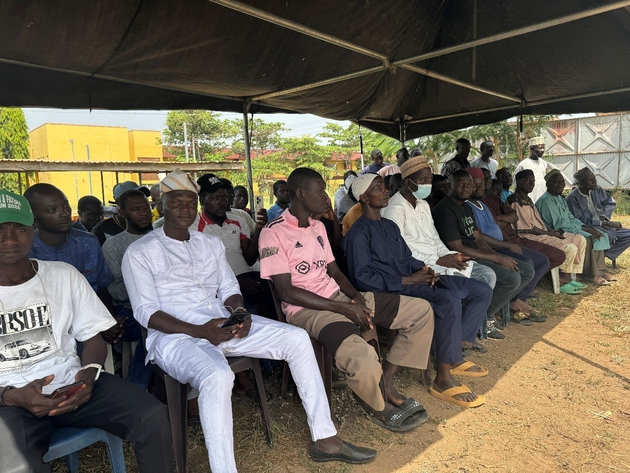
Nigerian farmers receiving guidance from Chinese experts. Photo/Zheng Yuhang (NBD)
Zhu Qinghua, Deputy Director of the China Office of the Gates Foundation, explained Africa's agricultural challenges. "Africa has 60% of the world's cultivable land, yet it struggles to feed about 20% of the global population," he said. "In terms of hardware, Africa's agricultural infrastructure is severely inadequate, especially irrigation. Only 15%-20% of local farmland has irrigation capabilities, yet it contributes 70%-80% of grain output. Remaining 70%-80% of farmland accounts for less than 20% of output. This ‘weather-dependent’ pattern seriously restricts yield growth."
He noted that improving agriculture in Africa requires two key efforts: developing better rice varieties and cultivation techniques to boost rice productivity, and establishing a robust agricultural promotion system to bring innovative products and technologies to Africa's smallholder farmers. "China has rich experience to share," Zhu added.
GAWAL-R1 is more than an agricultural success; it's a model of China's people-centered international cooperation. From adapting technology to local needs to empowering communities, it shows how Chinese solutions can address global challenges like food security—with respect and empathy.
Looking ahead, Xu Guoxin aims to expand the distribution network to cover two-thirds of Nigeria's states within five years. "This network will also bring quality Chinese farm machinery and fertilizers to locals." For Nigeria and Africa as a whole, this small rice seed carries big promise for shared growth and improved food security.


 川公网安备 51019002001991号