In 2025, the Narodowy Bank Polski (NBP) became the world’s largest official buyer of gold for the second consecutive year, acquiring approximately 100 tons to reach a total reserve of 550 tons—surpassing the United Kingdom.
In early 2026, the bank announced a further 150-ton expansion goal, aiming for a historic 700-ton stockpile.
National Business Daily (NBD) had an exclusive interview with Artur Soboń, a member of the NBP Management Board, to discuss the geopolitical and financial philosophy driving this massive accumulation.

Artur Soboń Photo/Poland government website
The Decade-Long Strategy: Targeting the Global Top 10
The NBP’s aggressive gold pivot began in 2016 under Governor Adam Glapiński. At that time, Poland held a mere 103 tons, representing only 3.32% of its foreign exchange reserves.
2018–2019: Initial large-scale purchases of 125.7 tons.
2023: Added 130 tons, ranking as the world’s second-largest buyer.
2024–2025: Secured the top spot globally, pushing gold’s share of total reserves toward a 30% target.
2026 Goal: With a planned 150-ton increase, Poland aims to reach 700 tons and join the ranks of the world's top 10 gold-holding central banks.
NBD: What is the core strategic driver behind becoming the world's leading gold buyer?
Artur Soboń: NBP’s increased gold purchases reflect a strategic decision to strengthen the resilience and credibility of Poland’s foreign reserves.
From that perspective 2025 was nothing special – we have taken a course to enhance the long-term robustness of our foreign exchange reserves portfolio by partially diversifying away from fiat currencies and providing more protection in periods of heightened financial or geopolitical stress.
Our recent purchases should not be seen as tactical but as a reflection of a long-term strategic reorientation that has been in play for several years now.
NBD: NBP aims to increase gold’s share of foreign reserves to 30%. What specific risk appetite and diversification goals does this reflect?
Artur Soboń: The share of gold in our official reserves fluctuates based on changes in the price of gold, fluctuation of foreign exchange rates, as well as the inflows to and outflows from our foreign exchange reserves portfolio.
Thus, unlike with our more traditional financial investments, we are not looking to attain a given fixed percentage allocation to gold – rather, we are gradually building up our stock of LBMA-compliant gold bars with a view to ultimately reach 700 tons.
Such allocation to gold roughly balances out our overall exposure to USD – which is the most volatile FX cross affecting our day-to-day P&L - reduces credit and concentration risk and enhances the resilience of our balance sheet in stress scenarios.

File photo/NBD
Historical Memory: From the Sahara to Modern Security
Poland’s attitude with physical gold is rooted in its history. Prior to World War II, 75.5 tons of Polish gold were evacuated across Romania, Turkey, and Lebanon, eventually reaching France and then being hidden in the Sahara Desert (Fort Kayes) to avoid seizure.
It took years of post-war legal battles in New York to reclaim the treasure.
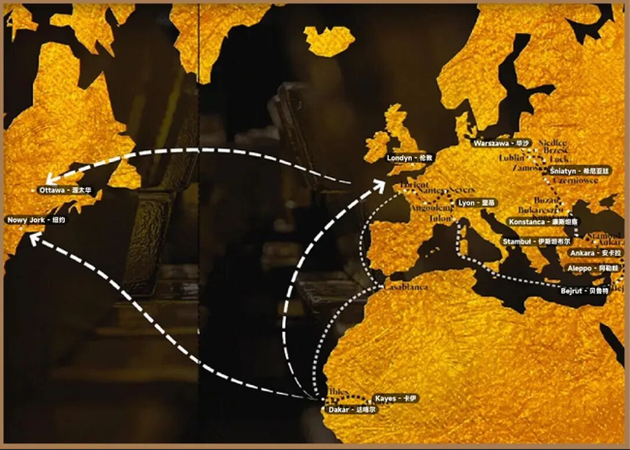
Photo/Bankoteka, Polskie Rezerwy Złota, September 2021
NBD: How do historical events shape current policy?
Artur Soboń: Although the primary motivations for increasing our gold reserves are rooted in economic considerations, Poland’s historical experiences have certainly partially informed our thinking as well.
The daring evacuation of Polish pre-World War II gold reserves following the invasion of the Nazis in 1939 – which took them through Romania, Lebanon, France, the Sahel and ultimately to the UK, US and Canada – is still vividly, if painfully, remembered since the entire stock saved from the war was shortly thereafter completely spent by the newly established authorities.
Thus, NBP emerged in the early 1990s with virtually no gold reserves. A small stock of roughly 15 tons had been maintained throughout the 1990s, until eventually a decision was made that the FX reserves portfolio had become large enough to allow a build-up of gold holdings.
NBD: What were the primary drivers behind the decision to repatriate a portion of Poland’s gold?
Artur Soboń: The decision to move part of Poland’s gold holdings to Poland was guided by considerations of security, operational resilience, and strategic autonomy. Currently, roughly 20% of our gold stock is held internally, and NBP maintains diversified storage arrangements to ensure liquidity and access to international markets.
The "Zero Credit Risk" Asset in a Volatile World
As U.S. national debt surpasses $38 trillion and gold prices experience extreme volatility (swinging between $4,400 and $5,500/oz in early 2026), the NBP views gold as the ultimate hedge against the US Dollar.
NBD: Does NBP view gold as a core reserve asset for the next ten years? If so, what factors drive this conviction?
Artur Soboń: Yes, NBP views gold as a core component of its reserves over the long term. This assessment is driven by gold’s role as a liquid, globally recognized asset with no credit risk, and a long history of serving as a monetary anchor. All these features support reserve stability under a wide range of macroeconomic and financial scenarios.
Our recent purchases are not tactical, but strategic in nature. That being said, the current geopolitical environment, including elevated regional and global tensions, underscores the need to have some exposure to a truly diversifying asset, one that is independent from political or economic decisions of any one country.
NBD: Will recent price volatility change your buying pace?
Artur Soboń: NBP’s gold strategy is not driven by short-term price movements but by long-term strategic objectives. Future purchases will depend largely on the progress toward strategic reserve targets, market liquidity, and prevailing risk conditions rather than any specific price level.
What we do believe, is that gold will be a permanent pillar of our national financial security and crisis preparedness. Its role – alongside all other investments -is to support confidence in Poland’s reserves, strengthen balance-sheet resilience, and provide stability in periods of severe global uncertainty.


 川公网安备 51019002001991号