Peter Schiff's prediction that gold prices will break through $5,000 has once again been validated by the market. The "Dr. Doom", famous for accurately predicting the 2008 subprime mortgage crisis, has recently issued a stark warning: a compound crisis far more severe than 2008 is brewing.
As a firm believer in the Austrian School of Economics, Peter Schiff has long advocated hedging dollar risks with precious metals and overseas assets.
Peter Schiff has over 30 years of experience on Wall Street. He earned a degree in Finance and Accounting from the University of California, Berkeley in 1987, and began his career at Shearson Lehman Brothers. In 1996, he joined Euro Pacific Capital as President and later became CEO. In 2008, due to his accurate judgment of the financial crisis, he served as an economic advisor to Ron Paul's presidential campaign.
Peter Schiff recently sat down with National Business Daily (NBD) for an exclusive interview, detailing the logic behind the crisis he foresees, as well as hot topics such as the new Federal Reserve chairman and cryptocurrencies.
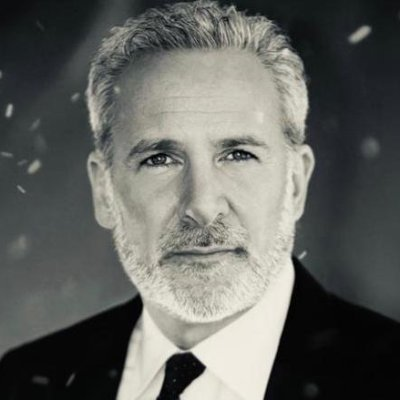
Peter Schiff (Image/Peter Schiff's X account)
On Gold Price: Expected to Surge to $7,000, Will Replace the Dollar as the New Anchor Asset
NBD: Gold has performed exceptionally well from 2025 to this year, hitting a record high of over $5,500 an ounce at one stage. Could you break down the key drivers behind this gold rally in detail?
Peter Schiff: I think the primary driver has been the move from central banks to replace dollars with gold. So you've seen pretty consistent central bank buying of dollars throughout 2024 and 2025. I mean buyers of gold. And that was the major driver.
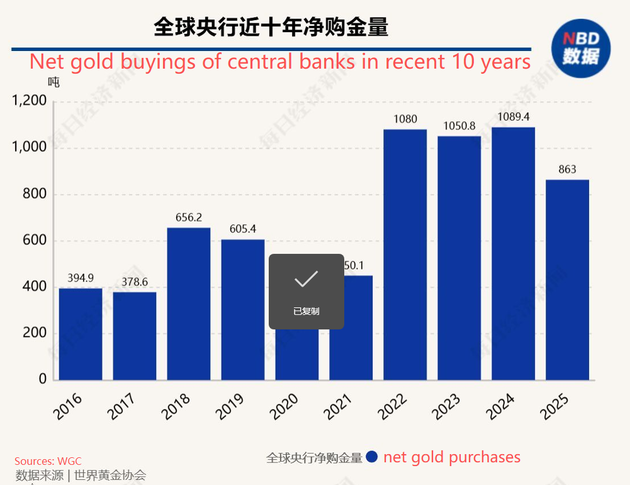
I think more recently, you started to see some private investment demand pick up to supplement what's been happening with central bank. That's probably particularly important in the silver market, where silver just started to move much more recently than gold. I mean, gold had been moving and silver had been pretty much stagnating, which was atypical. Normally they move together.
But the big drivers are the exploding deficits in the United States, the election of Donald Trump and the realization that Trump is not going to or the Republicans are not going to do anything about reducing the size of our deficits, that they are going to spiral out of control, you know, as far as the eye can see. So that's going to lead to a lot of inflation and dollar devaluation. And central banks want out. Foreign governments don't want to be left holding the bag, and they also don't like being pushed around.
You know, the Biden administration used sanctions and weaponized the dollar. Trump doubled down on that and even is now threatening to invade our allies with, you know. And so I think we've really antagonized the world. The tariffs are also another big part of it, but just all the rhetoric coming out of Washington about how the world rips us off and takes advantage of us, that's not going over well with the countries that are effectively supporting us because Trump has it backwards. You know, the world doesn't take advantage of us. We've been taking advantage of the world.
NBD: Do you think this gold rally is already fully priced in, or is it just getting started? Some predict that gold prices will hit $6,000 this year. What's your view?
Peter Schiff: Well, I think that the rally is going to continue for many, many years. So I think we're repricing gold to replace the dollar and become the new anchor for the global monetary system. The one where the dollar is the reserve currency does not work. I think it's done a lot of damage and it's going to be much better for the world to use real money instead of U.S. dollars. So I think when gold is the basis of the monetary system, it will be a lot more fair of a system and it will be a lot more effective of a system.
Well, it's certainly a reasonable possibility. In fact, it can go higher. I mean, we're at 5,000 now, so that's only a 20% increase. I mean, last year, gold was up, you know, like 65%. So that would be a much smaller increase than the one we had last year. So it's certainly within the realm of possibility. And in fact, gold could go to 7,000. I mean, it could go higher.
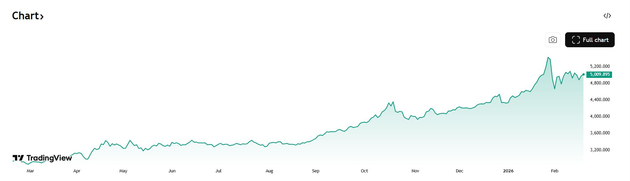
Gold prices in recent year
NBD: You just mentioned that gold will gradually replace the dollar. How long will this process take?
Peter Schiff: I don't know. I mean, I think it's a transition. It's underway now. I don't know. And it depends on, you know, what happens with other countries, you know, China in particular. You know, I think it would be in the country's interest to have its currency backed by gold, have it redeemable and convertible into gold, and, you know, or at least the world can transact in gold. It could have tokenized gold or have another way of settling cross-border payments in units of gold rather than, you know, fiat currency.
Well, gold isn't a currency. Gold is actually money. And I think that gold has already eclipsed U.S. Treasuries. I don't think it's eclipsed U.S. dollars in total, but I think it's going to do that very soon.
And its share of global reserves is going to continue to grow, not only because central banks will keep buying gold, but because the gold that they own will be a lot more valuable. And so as gold prices go up, that automatically means gold represents a bigger share of reserves because the dollar is static.
On the Crisis: Soaring Gold Prices Are a Prelude to a New U.S. Crisis, Far More Dangerous Than 2008
NBD: You previously warned that the U.S. might face a financial crisis in 2026, far more dangerous than 2008. Why do you think so?
Peter Schiff: Well, I said it could be this year, it could be next year. It's hard to say exactly, but I think it's going to be a U.S. dollar crisis and a sovereign debt crisis, which, of course, is way worse than what we had in 2008. But I think the big signal of that coming is the big increase in the price of gold. I think that's foreshadowing a crisis in the dollar.
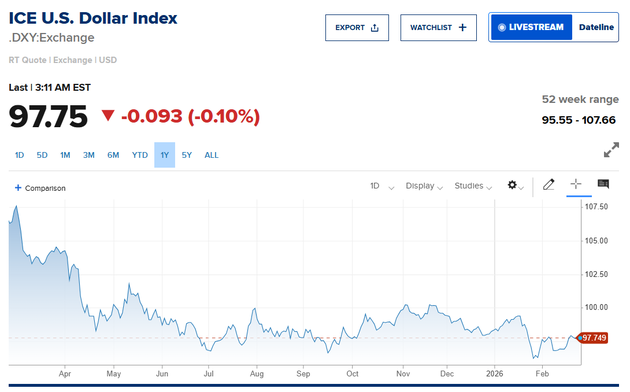
And so we've got to watch the foreign exchange markets. The dollar recently fell to a four-year low, dollar index, an all-time record low against the Swiss franc. And so if we start to see more pronounced weakness in the dollar, I think that will also spill over into the Treasury market.
NBD: Could you elaborate on the differences between the coming crisis and the one in 2008?
Peter Schiff: I mean, we're in a lot worse financial shape now than we were back then. We certainly have a lot more debt now. The economy is a lot more screwed up because of all the mistakes that have been made since then. But again, if we're talking about a sovereign crisis, a Treasury bond crisis, and a dollar crisis, that's on a whole new level from a mortgage crisis. This is a loss of confidence in the government itself, in the U.S. government, in our fiscal responsibility, in our ability to legitimately repay our debts without resorting to inflation. And so that's a much bigger crisis, and it's a crisis from which the government cannot bail us out.
The reason the government was able to bail out the banks and a lot of people after 2008 was because people still wanted the dollar. They still wanted U.S. Treasuries, and the U.S. was able to sell those Treasuries around the world. But if people don't want Treasuries anymore, if that's where the loss of confidence is, then the government can't do anything. And so, we end up with the full impact of the crisis. It's not shielded by a government bailout.
NBD: What will happen then?
Peter Schiff: It will get a lot harder. I think what gonna happen in America is things are going to get a lot more expensive. There's gonna be a lot of empty shelves and high prices, and interest rates are gonna go up. Well, I don't think that's happening. I think that's more just hype. I don't see a lot of factories coming back to the United States. They talk about it, but I don't think it's actually happening.
On the Federal Reserve: Kevin Warsh Is Not an Inflation Fighter, Will Become Trump's Puppet
NBD: In late January, Trump nominated former Fed Governor Kevin Warsh as the next Fed chair. What is the most critical reason Warsh won Trump's favor?
Peter Schiff: Well, I mean, I'm sure he's going to be a puppet of Trump. I don't believe the media hype or the spin from the administration that he's some kind of, you know, inflation hawk who's going to come in hot with tight money. That's so unlikely given everything that Trump has been saying. Trump wants a money printer. Trump wants a rate cutter. He doesn't want an inflation fighter.
Because I'm sure that Trump is convinced that Warsh will do what Trump wants him to do. That's, I think, why he has the job. I think they have a handshake and Trump trusts him. The main job is to make Trump look good.
Trump pointed Jerome Powell was very unhappy that Powell did not do what he wanted. So he's corrected what he perceived as a mistake, I'm sure. Now, of course, Warsh is under no, you know, legal liability to honor his word, but maybe Trump has confidence that he will.
NBD: Compared with Powell, in what areas might Warsh bring about a policy shift?
Peter Schiff: I mean, look, I think they're trying to lay the foundation to be able to create some kind of false credibility for the Fed that when Walsh starts cutting rates, so that the markets won't think it's politically motivated. They'll think, well, I guess this was his independent judgment, and these rate cuts are economically warranted and not politically motivated.
On Cryptocurrency: "Ponzi Scheme"! Tolerating It Will Eventually Devastate the U.S. Economy
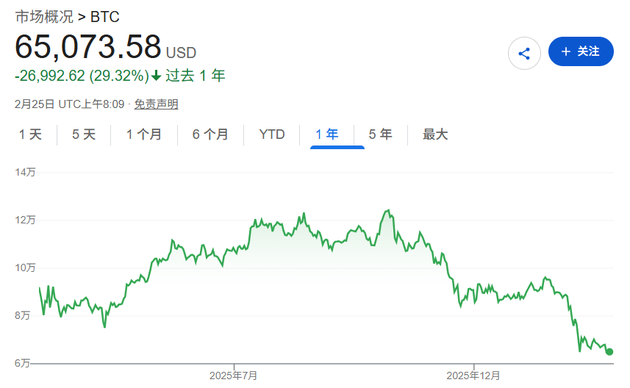
NBD: Recently, the global cryptocurrency market has experienced sharp volatility, with Bitcoin even approaching the key support level of $60,000. A former Goldman Sachs executive believes Bitcoin's drop will last until late February and then bounce back quickly. What's your take on that?
Peter Schiff: Well, I don't put much stock in what Wall Street investment banks say. They have so many conflicts of interest. They have a lot of clients that are in crypto. They have a vested interest in doing banking deals, and so they want to try to prop up crypto prices by making these forecasts. But, you know, the whole thing is just a gigantic bubble. There's no real substance behind any of it. It's a decentralized Ponzi scheme, pyramid, a blockchain letter.
It really is a shame that the U.S. government has embraced this and has encouraged so much misallocation of resources and capital into this industry. This is all going to hurt the U.S. economy.
Disclaimer: This article is for reference purposes only and does not constitute investment advice. Please verify accordingly before acting. All risks are assumed by the user.


 川公网安备 51019002001991号