In March, OpenAI pulled the plug on Sora after spending billions of dollars on the project, without ever making the economics of AI video generation work at scale.The shutdown came as skepticism around the sector was mounting. Video models were becoming increasingly expensive to train and run, while the path from impressive demos to sustainable commercial products remained uncertain.
Against that backdrop, Spain-based Magnific stood out for a very different set of numbers: $230 million in annual recurring revenue, more than 1 million paying subscribers, and sustained profitability, all without relying on Silicon Valley venture capital.
Magnific, formerly known as Freepik, builds generative AI tools for visual creation. But unlike OpenAI, Anthropic and other foundation-model companies, it does not train a large model of its own. Instead, Magnific integrates models built by third parties, adds workflow, editing and control layers on top of them, and turns those capabilities into products for creators in industries such as film and advertising. Its business is largely subscription-based.
National Business Daily (NBD) learned through interviews with the company that Magnific now integrates more than 40 AI models. Chinese models form an important part of that stack, including Kuaishou’s Kling AI, ByteDance’s Seedance, MiniMax and models from Alibaba. For some Chinese model providers, Magnific has also become a major overseas customer.
That creates an intriguing contrast. On one side are foundation-model companies pouring billions of dollars into research, computing power and infrastructure. On the other is an application-layer company that does not build its own foundation model, yet has already reached profitability.
As models become more capable and increasingly interchangeable, where will the economic value of AI video ultimately accrue? Will it remain with the companies building the models, or shift toward the applications that turn them into usable products?
Does avoiding model development allow a company like Magnific to sidestep an expensive arms race, or does it leave the company dependent on suppliers it cannot control?
And for Chinese AI companies now trying to move beyond technical showcases and prove their commercial value, could platforms like Magnific offer a practical route into global markets?
To explore these questions, NBD recently spoke exclusively with Claire Xue, Magnific’s Global Head of AI Ecosystem, and Jose Florido, the company’s China head.
Magnific Doesn’t Build the Models but Orchestrates Them
“Magnific, formerly Freepik, has been profitable ever since we started 15 or 16 years ago,” Xue told NBD.
Magnific, one of Kling AI’s major overseas customers, now has more than 1 million paying subscribers, around 100 million monthly visits and annual recurring revenue of roughly $230 million.
That stands in sharp contrast to the capital-intensive economics of foundation-model development, where leading companies such as OpenAI and Anthropic have spent billions of dollars on computing infrastructure and model training.
In March, Silicon Valley venture capital firm Andreessen Horowitz, or a16z, published the sixth edition of its ranking of the world’s leading consumer generative AI applications. Freepik, now Magnific, ranked No. 11 among the Top 50 web products and was the highest-ranked European AI application on the list.
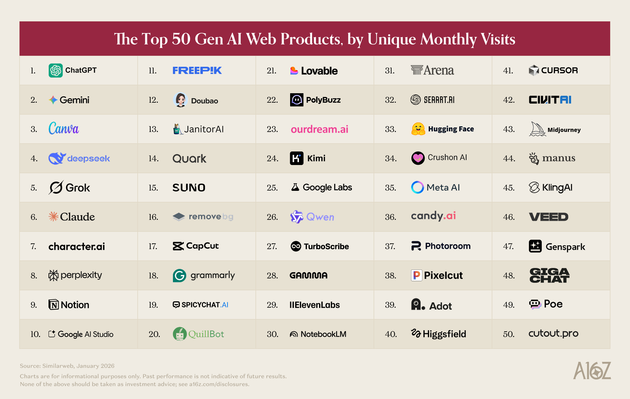
Freepik was founded in Spain in 2010. It began as a search engine for design resources before building a large library of images, vectors, icons and templates. Free content helped attract users, while paid memberships drove revenue.
Then came generative AI. Freepik quickly added AI image-generation tools and later acquired Magnific, a fast-growing AI image enhancement startup. The company eventually adopted Magnific as the name of the entire business.
Yet amid an industry-wide rush to build bigger and more powerful models, Magnific chose not to join the foundation-model race. Instead, it has positioned itself as a model-agnostic orchestration layer for visual creation.
Xue said Magnific connects to models from different providers while building workflow, editing, control and personalization capabilities on top of them. She compares the relationship to cooking.
“Foundation models provide the raw generated content. They are like the ingredients for a dish,” Xue said. “Even if you have the best ingredients, you still need a good chef to decide how they should be combined and seasoned. That is where our value lies. We orchestrate outputs from different foundation models and turn them into the final product.”
Magnific is betting that a gap remains between what foundation models can generate and what professional creators actually need.
Florido pointed to short-form drama production as an example. The strongest model for storyboarding may not be the best one for character performance or final visual effects. Even when the underlying models are already highly capable, the application layer still has to manage workflows, editing, customization and the handoff between different tools.
“The more we optimize the application layer, the better the experience we can ultimately deliver to users,” Florido said.
Magnific has previously said it has never relied on outside venture funding and has remained profitable. Still, Florido acknowledged that competitive pressure across the AI industry is intensifying.
“The pace of change in artificial intelligence is extremely fast, and that puts pressure on companies at every level,” he said. “We will continue to grow quickly and explore new avenues for expansion.”
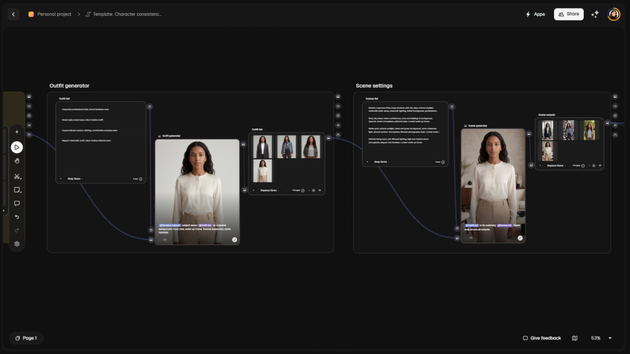
Magnific website Photo/ provided to NBD
More Than 40 Models Integrated, Chinese Models Are Becoming a Core Part of Magnific’s AI Stack
Over the course of the more than hour-long interview, NBD learned that Magnific currently integrates more than 40 AI models, with Chinese video-generation models playing an important role.
“We work with many of the leading video-model providers globally,” Xue said. “If users want a model, in most cases we will have it on the platform.”
She cited Kuaishou’s Kling AI, ByteDance’s Seedance, MiniMax and Alibaba among the Chinese providers available through Magnific. “Chinese AI model providers already account for a significant share,” Xue said. Kling is one example of how deep some of those relationships have become.
“We started working with Kling almost as soon as it launched,” Xue said. “Kling is one of the larger model suppliers on our platform.”
Why are Chinese video models gaining traction among global creators? In the early stages of generative video, the criteria were relatively straightforward: Did the output look realistic? Was the image quality good? As the technology has improved, professional users have become more demanding. They now care about whether characters and products remain consistent across shots, whether camera movement and motion can be controlled precisely, whether multiple reference images, videos or audio clips can be used, and whether the generated content can be edited afterward.
In other words, the competition is shifting from simply producing impressive clips to making AI video usable in real production workflows.
Xue sees Chinese models as particularly competitive in this transition. She pointed to their high output quality, rapid iteration and ability to respond quickly to real-world production needs. Those characteristics, she said, make them particularly well suited to short-form video and advertising. Cost-performance is another advantage she sees in the Chinese ecosystem.
Industry data suggest the trend extends well beyond Magnific. In its latest ranking of consumer generative AI applications, a16z highlighted Chinese video products including Kling AI, Hailuo and PixVerse, noting that they had already built meaningful user traction.
Data from independent AI benchmarking platform Artificial Analysis also point to the growing strength of Chinese developers. As of September 29, eight of the Top 10 models on its text-to-video ranking with audio were developed by Chinese teams.
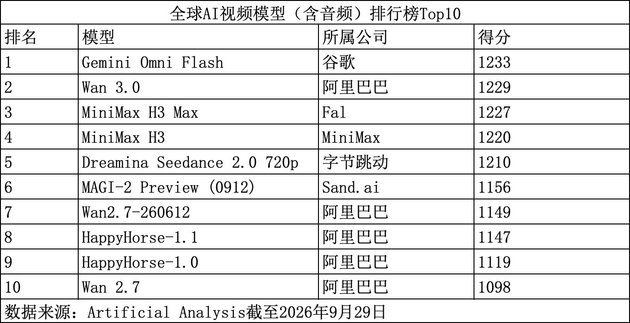
That is notable because the AI video market is entering a different phase. The first wave was dominated by dramatic technical demonstrations. The next phase is increasingly being judged by reliability, production readiness and commercial execution.
Earlier this year, OpenAI shut down Sora’s video-generation service. At the same time, competition among Chinese players including ByteDance’s Seedance, Kuaishou’s Kling AI and Alibaba’s HappyHorse has intensified.
The question is no longer simply who can produce the most eye-catching demo. It is increasingly about who can deliver a product that creators and enterprises are willing to use repeatedly and pay for.
Florido said China’s importance to Magnific goes beyond its size as a market. “Generative AI is extremely competitive globally,” he said. “In China, we see many competitors, but we also see very strong partners.”
Being closer to model providers and AI research labs was one of the reasons Magnific decided to expand in China, he added. “Although our business in China is still at an early stage, it is growing quickly.”
Xue, meanwhile, sees competition among model providers as healthy for the broader ecosystem. “If only one model dominates the entire market, the ecosystem cannot remain healthy and sustainable,” she said. “We want to see more globally competitive models emerge and build an ecosystem that genuinely benefits all participants.”
She remains bullish on the longer-term opportunity. “I think the overall market still has tremendous room to grow,” Xue said. “More users and companies will adopt generative media technologies. The pie is getting bigger, and China has enormous potential in this field.”
When Visual Quality Is No Longer Scarce, What Becomes Valuable?
“In the past, you needed a team, a studio and a traditional visual-effects pipeline. Now a single creator can potentially go from script to finished video in three weeks.” For Xue, AI is doing more than replacing isolated tasks. It is changing the economics of film and advertising production.
Traditional film and commercial production has long been both capital-intensive and labor-intensive. A single commercial may involve directors, cinematographers, lighting crews, art departments, editors and visual-effects teams. Budgets determine what can be filmed, how much can be produced and how many times a creative team can afford to experiment.
AI is beginning to change that equation. As scenes, characters and post-production elements become increasingly generatable or editable through models, content production is moving toward a system in which creative ideas can be generated, tested and reused at far lower marginal cost.
According to a report by LeadLeo Research Institute, the global AI video-generation market reached approximately $8.68 billion in 2025 and is projected to grow to $51.93 billion by 2030.
Enterprise customers currently account for around 65% to 70% of demand, while advertising, marketing, film and entertainment together contribute more than 70% of the market.
Xue stressed that the shift is not limited to individual creators. Large film studios are also beginning to use AI, but usually as part of existing production pipelines rather than by handing an entire project to one person.
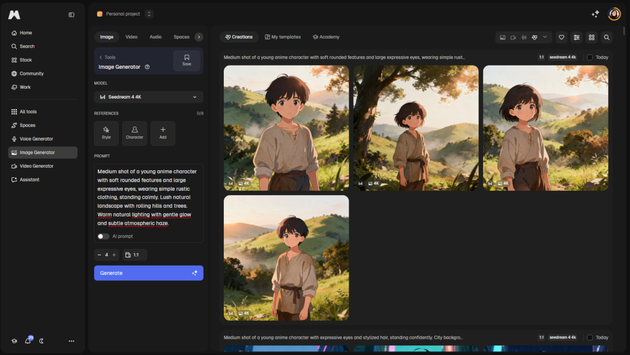
Magnific website Photo/ provided to NBD
Studios still rely on their existing infrastructure and teams, while using AI to improve specific stages of production.
In some workflows, for example, a small number of actors can shoot against a green screen while generative models are used later to enhance environments, backgrounds and other visual elements.
Florido sees a similar change taking place inside brands and marketing departments. “Every marketing team and every brand is increasingly becoming a production studio,” he said.
“In the past, budget constraints might have limited a brand to producing a 20-second commercial. Now they can go much further and create at a scale that would once have been impossible.”
“Companies are beginning to produce all kinds of content, including short-form dramas built around their own products, because the tools are no longer the limiting factor. For creative professionals, this is an incredibly exciting time.”
But there is another side to the rise of the “one-person studio.” As content supply explodes, differentiation becomes harder.
AI lowers the barrier to creating something that looks polished. At the same time, it raises the bar for producing something people actually want to watch.
“We are seeing an enormous explosion in content creation, but competition is also becoming much more intense,” Florido said.
“Today, almost anyone can use AI to make a video. That does not mean everyone can make something worth watching.” In Xue’s words, AI is becoming an equalizer.
As high visual quality becomes widely accessible, she argues, curation, taste, aesthetics and storytelling become more important.
When the market is flooded with visually polished but increasingly similar AI-generated videos, differentiation shifts toward style, judgment and creative direction.
Developments across the industry point in the same direction. Adobe is embedding brand intelligence into its GenStudio content supply chain, while ByteDance’s Seedance 2.0 can work across text, image, audio and video inputs to support more sophisticated forms of video generation.
The competitive frontier is gradually moving beyond the quality of a single generated clip toward controllable, repeatable and scalable production workflows.
A Magnific co-founder has described the broader shift as the rise of a No-Collar Economy. “AI is creating an entirely new no-collar creative class,” he said, “In the future, making a film could become more like writing a book: one person, equipped with vision and the right tools, could complete the entire process.”


 川公网安备 51019002001991号