On September 11, 25 Fields Medalists issued an emergency statement titled "A Severe Misalignment of AI in Mathematics," directly criticizing AI giants for their attempts to use artificial intelligence (AI) to solve difficult mathematical problems.
The statement said that AI companies' use of mathematical problem-solving as a benchmark for model capabilities is damaging to mathematics itself and to the mathematical community, and represents a significant divergence from the mathematical community's fundamental goal of pursuing conceptual understanding.
The statement came shortly after OpenAI claimed that an unreleased internal AI model had solved the existence and smoothness problem for the Navier-Stokes equations in 88 hours.
One of the 25 signatories, Efim Zelmanov, told National Business Daily (NBD) in an exclusive interview that OpenAI recently behaved as "predators" and was intended to generate publicity ahead of its IPO.
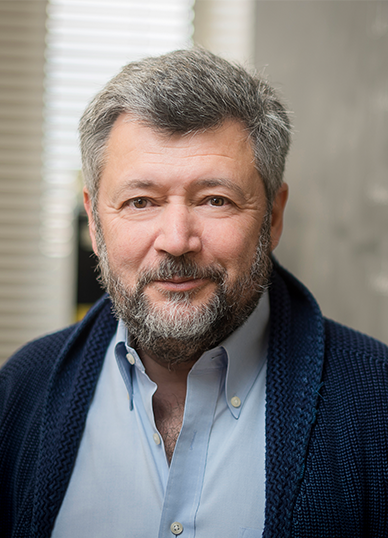
Efim Zelmanov (Photo/Academic Divisions of the Chinese Academy of Sciences)
Zelmanov received the Fields Medal in 1994 for resolving a central problem in 20th-century group theory—the restricted Burnside problem. In addition, the coordinate theorem for Lie algebras proved by Zelmanov and Benkart is regarded as a cornerstone for dealing with infinite-dimensional Lie theory. In 2001, Zelmanov was elected to the U.S. National Academy of Sciences, and in 2021 he was elected a foreign member of the Chinese Academy of Sciences.
Responding to calls for a slowdown in AI development from AI industry leaders including Anthropic CEO Dario Amodei, SpaceX CEO Elon Musk and OpenAI CEO Sam Altman, Zelmanov said bluntly that it was "some publicity" designed to tell the public what some people wanted to hear and that it probably meant nothing.
"OpenAI recently behaved as ‘predators’, their purpose is to generate publicity before IPO"
NBD: The declaration was drafted and released within just a few days. Was there a particular development that made you think we need to speak something now?
Efim Zelmanov: Humans need to be in command of mathematics. To rely only on AI would be a way to disaster. Humans need to be in charge.
AI companies have unlimited money, which means that they can deploy tens of thousands of these agents. What do these agents do? They know everything, and well, they built on what humans did without giving proper attribution.
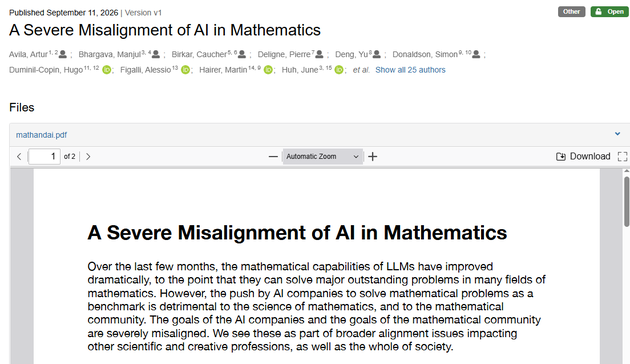
The statement entitled "A Severe Misalignment of AI in Mathematics"
NBD: Recently, OpenAI says one of its models had made progress on Navier-Stokes problem. How do you view that kind of development?
Efim Zelmanov: Well, I told you that it is entirely based on new ideas recently found by humans.
I don't have a proof, but human mathematicians working on it, they used OpenAI, other agents of OpenAI have access to their work. It's like two competing groups, and one of them looks over the shoulder of the other group, and the agents can work day and night, unlike human mathmatics. So they jumped ahead and made an announcement.
You know, imagine mathematicians work on some problems, imagine them as a group of bicyclists that are approaching the finish. In the Girsanov equation, there was a new approach invented by Spanish mathematician. And AI can watch how they move because they use AI. Then at the end, when they are close to finish, AI brought in 10000 agents, input more than $20 million, jumped ahead and reached finish, and said we were the first.
Recently OpenAI behaved as predators. If a human did such a thing, he wouldn't make any friends because in a way, it is piracy.
NBD: Could you tell us why AI companies are so keen on solving famous mathematical problem?
Efim Zelmanov: Because it gives them publicity and because these people are former mathematicians. It's kind of self interest, they grew up in this atmosphere of making progress, search for solutions. That is saying something to their teachers.
"The aim of mathematical community is to train the next generation of mathematicians, while AI companies' goal is to generate publicity"
Photo/NBD Media Asset Library
NBD: The statement talks about a severe misalignment between AI companies and mathematic community. So what exactly does misalignment mean?
Efim Zelmanov: The aim of mathematical community is to develop conceptual understanding and to train new generation. The aim of AI companies is to make publicity, to generate publicity before IPO. These are different aims. We don't care about their publicity. We care about the next generation and the continuity of mathematical research.
Over several hundred years, the following system emerged: Young people join graduate school, we invent some problems of medium range, and they solve these problems, publish, get jobs, and so on.
Most problems are formulated just not only because they are interesting, some problems are interested by themselves, but mostly because it is assumed that in order to solve this problem, we need to build an infrastructure to develop conceptual understanding of the area and then develop mathematics. Also, that would educate new people, new generation.
But now to solve a medium range problem, one apparently needs only to push the button, and that disrupts the whole system. It's an existential threat. And we get a solution that absolutely does not offer any conceptual understanding and does not give anything to the next generation.
AI is a powerful instrument, it's wonderful. You cannot put the genie back in the bottle. But there should be some ethical constraints. I'm against hostile takeover when they intentionally blow out the entire land.
NBD: If an AI produces a correct proof, what might be still be missing? What's the difference between being correct and actually understanding why something is true?
Efim Zelmanov: It's subtle question. Usually, all the mathematical knowledge and all correct solutions can be traced to several big ideas, and conceptual understanding is the search for these ideas, because that is the key to further develop.
If the proof is just correct, but no more than that, then what? It does not open any doors. What's next?
The whole mathematics is about understanding. For mathematicians. It's not enough to know that something is correct or not correct. They need to understand why it is correct or not. That is the essence of mathematics for several thousand years.
NBD: What kind of situation will young mathematicians face if this continues?
Efim Zelmanov: To put it simply, it will put all young mathematicians out of jobs. If they (AI) solve all medium level problems, how will young mathematicians grow? Usually a mathematician goes from simple problem to more difficult problem, a more difficult problem, and so on.
We need to train human mathematicians who have conceptual understanding of what is going on, who will carry on the mathematics.
"‘AI slowdown’ is another form of publicity; I don't think anyone will actually slow down"
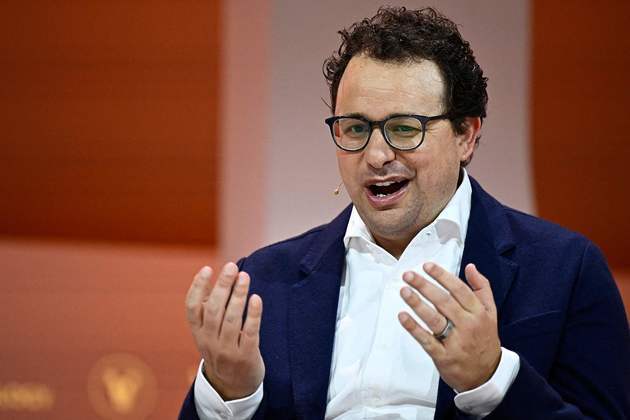
Anthropic CEO Dario Amodei (Photo/VCG111645486173)
NBD: Recently, Anthropic CEO Dario Amodei, OpenAI CEO Sam Altman, SpaceX CEO Elon Musk and some other AI leaders have called for slowing down frontier AI development. Do you think AI development should actually be slow down?
Efim Zelmanov: Frankly speaking, I don't completely understand what do they mean, maybe it's another publicity.
I think that it's not clear what do they even mean by slowing down. There is some backlash against data centers. So they probably thought that what some public wants to hear and that probably means nothing. We shouldn't give too much attention to it.
These are just words. I don't think that anybody is going to slow down.
"The most distinctive value of mathematicians is creativity: ‘No mathematics, no AI’"
NBD: When AI grows increasingly mature, which part of mathematician's job do you think AI will change first?
Efim Zelmanov: Well, first of all, this is a very big if. So far, there are no reasons to believe that it will happen soon because as I said before, everything that they (AI) do is essentially builds on a work of human mathematicians. If there is no this work, then no AI more.
Mathematicians are still looking for new ideas, doing their research. We should not overestimate it and blow it out of proportion.
NBD: You are also teaching at the Southern University of Science and Technology. What do you think mathematics students should still learn in the age of AI?
Efim Zelmanov: They should still learn what they learn now, fundamental mathematics, because all these developments are based on fundamental mathematics and fundamental ideas what people achieved in the past several hundred years, they need to be in command of conceptual understanding.
I will give you one example, it's cryptography, coding theory. Old ways for secret message exchanging did not work nowadays. Then mathematicians came up with a new, brilliant idea that was entirely based on the works of Evariste Galois, a French teenager of the beginning of 19th century. These people went to good universities. They knew the works of Galois, though for 150 years, they were absolutely useless outside of mathematics. They still knew it and they used it.
NBD: Looking 10 years ahead, if AI could solve many problems that have resisted mathematicians for decades, but humans can’t fully understand some of the proofs, would you consider that a major advance in mathematics?
Efim Zelmanov: It's a big if. Well, so far their solutions are not so complicated. The most complicated, the solutions are still given by humans. So I don't think that it will happen.
But if they say that they solved, but humans disagree, then I would rather believe humans. You know, it's a human centric position. I care about humans, not about AI agents.
NBD: What is the one thing you would least want to see AI take away from mathematicians?
Efim Zelmanov: Well, I will say that the divine sparkle, the creativity. Also mathematicians look maybe wider, they take into account possible applications, the sense of beauty.
When Galois developed his theory, he absolutely did not care about applications that came 150 years later. He cared about beauty. For mathematicians, it is art, I don't think the AI real excel in art.
Of course, never say never. But then it will be a different world, where we will have to worry about mankind.
Email: lansuying@nbd.com.cn


 川公网安备 51019002001991号