Christie’s held a preview for its Hong Kong Asian Art Week in Chengdu on September 17 and 18, 2026, bringing works from its Indian, Himalayan and Southeast Asian Art category to the city for the first time.
The event came as Christie’s marked its 260th anniversary globally and 40 years in Asia.
During the preview, in an exclusive interview with National Business Daily (NBD), Edward Wilkinson, Global Head of Classical Indian, Himalayan and Southeast Asian Art at Christie’s, shared his views on why Christie’s chose Chengdu, how Chinese collectors are evolving, and what younger collectors should keep in mind when entering the market.
Wilkinson, a veteran specialist in the field, joined Christie’s in 2025 and has good relations with collectors and dealers in Chengdu for nearly two decades.
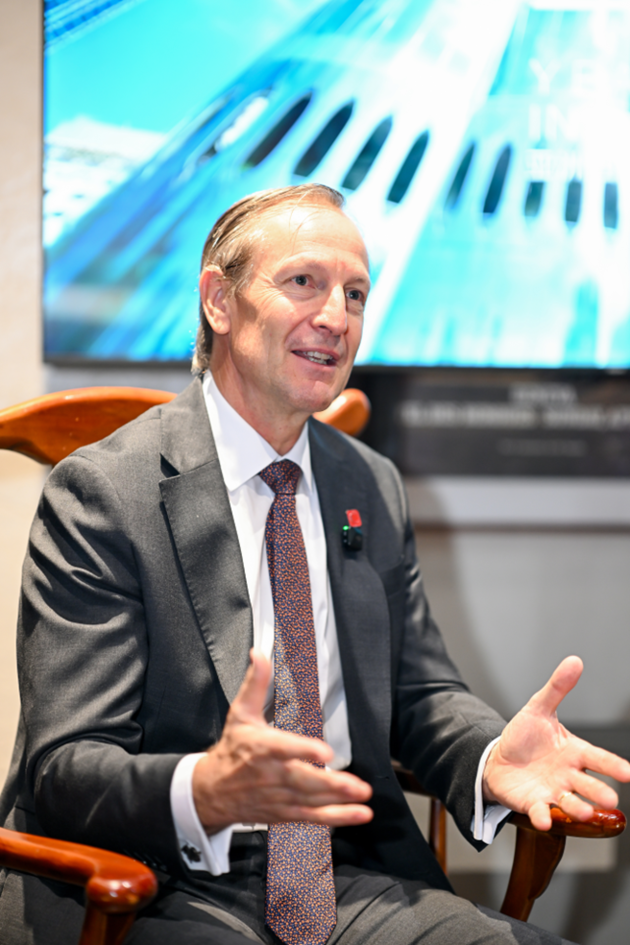
Edward Wilkinson speaks with National Business Daily at the Chengdu preview.
Photo courtesy of CHRISTIE’S IMAGES LTD.
Chinese Collectors Are Expanding Beyond Traditional Categories
NBD: What role do Chinese collectors play in this category? What characteristics do you see among them?
Wilkinson: One of the remarkable things about Chinese collectors is that there is such a long history and tradition of collecting in China. In a way, collecting is in the cultural DNA. The literati tradition goes back thousands of years, and there has always been a strong appreciation of the arts.
What we are seeing now is an expansion into a much broader range of categories than in the past.
There are already many well-established collectors of Himalayan art and Buddhist art in China, and that number is growing. I think people are increasingly recognizing the diversity and depth of this material, whether it comes from the Himalayan region, India, Thailand or Indonesia.
Chinese collectors have very good taste and a very keen eye for quality. They also bring a perspective that is not simply imported from the West. It is something that is home-grown, and I really appreciate the enthusiasm and confidence with which they collect.
NBD: Are you also seeing changes in the way younger collectors enter the market?
Wilkinson: Younger collectors today have access to an enormous amount of information almost instantly.
In the past, the main way to develop an understanding of quality was to go to libraries, visit museums and read books. Today, people can go online, look at collections in the UK or Asia, find scans of old publications, study museum collections and check auction records. All of that information is available within a few clicks.
That gives younger collectors more confidence to research a particular period, painting or sculpture and then make a decision about what they would like to buy.
Why Chengdu? Among the Strongest in Asia, If Not the World
NBD: We noticed that Christie’s has traditionally had a stronger presence in Beijing and Shanghai, but this is the first time this category has been brought to Chengdu for a preview. Why did Christie’s choose Chengdu? What makes the city special for this category?
Wilkinson: My interest in coming to Chengdu is based on long-term relationships I have built with collectors and dealers here over nearly 20 years. I have visited Chengdu many times, and I also brought an exhibition here before, which was very successful.
What impressed me was how strongly the works resonated with younger visitors. They were not simply looking at the objects; they were commenting on them and reacting to them in ways that I did not necessarily expect.
Chengdu is also a gateway to the Himalayas, and it has long been an important place for Buddhist art and for Himalayan art more broadly. So I think it is a very natural place for us to be, and we are looking to build more long-term relationships with collectors in this region.
NBD: Was bringing this preview to Chengdu something you personally encouraged?
Wilkinson: Yes. It was something I encouraged Christie’s to do.
I also recognize that there are luxury stores here that I consider among the strongest in Asia, if not the world. So there is a natural interest in different segments of art and collecting here, whether it is luxury, contemporary art or traditional art.
I hope to encourage Christie’s, on a broader scale, to bring more material from different categories to Chengdu in the future.
For Young Collectors: Trust Your Instinct and Ask Lots of Questions
NBD: If a young collector wants to enter this field, where should they start?
Wilkinson: I think the most important thing is to see and, where possible, handle objects in person.
You have to ask yourself: do I have a reaction to this object? Do I love this piece?
Visiting museums, going to dealers, talking to people and asking lots of questions are all very important. For younger people in particular, I also think it is important to give yourself the time and space to listen.
Of course, you should not believe everything you hear. But you should remain open, listen, and understand that knowledge does not come instantly.
There is something very rewarding about that. So much of the world today moves very quickly, especially everything we see on our smartphones. By contrast, there is something wonderful about taking the time to appreciate art.
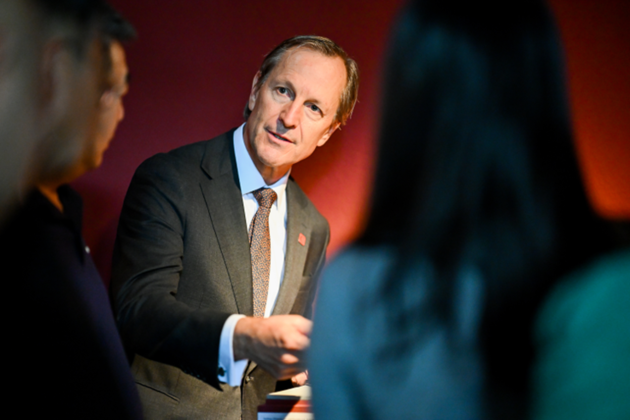
Edward Wilkinson at the Chengdu preview.
Photo courtesy of CHRISTIE’S IMAGES LTD.
NBD: Does a young collector need a large budget to begin?
Wilkinson: Not necessarily.
There are many smaller objects, including amulets and gaus, which are part of Buddhist practice and can be found at relatively modest prices. Younger collectors can begin with objects like these, discover what interests them and gradually build a collection over time.
Of course, there are also people who go straight to the top and say, “I have the money, and I want the best possible thing I can find.” But that is not the only way to begin.
NBD: What is the single most important piece of advice you would give to a young collector?
Wilkinson: Trust your instinct and ask lots of questions.
Be open to being surprised. Go and see objects, handle them when you can, listen to different opinions, read as much as possible and look at images.
But ultimately, it is a visual experience. Experiencing the object in person makes a big difference.


 川公网安备 51019002001991号