Alison Rehill-Erguven, CEO of Cenomi Centers, Saudi Arabia’s largest owner, operator and developer of shopping destinations, made the observation in an exclusive interview with National Business Daily (NBD) on the sidelines of the Capital Markets Forum Select Shanghai.
She said Saudi Arabia’s consumer market is still undergoing rapid change, with a young population, strong demand for offline social experiences and an increasingly open market creating new room for growth in retail and commercial real estate.
Rehill-Erguven brings a perspective shaped by both markets. Before joining Cenomi Centers, she was based in Shanghai as CEO of Pradera Retail Asia, overseeing retail real estate investment and management across Asia. There, she witnessed international brands learning how to understand and adapt to Chinese consumers. Today, she leads one of Saudi Arabia’s largest retail real estate platforms and is watching the process unfold in the other direction as more Chinese brands enter the Saudi market.
As that trend accelerates, a new set of questions is emerging: How can Chinese brands truly understand Saudi consumers? How should they localize? And what is the right way to enter the market?
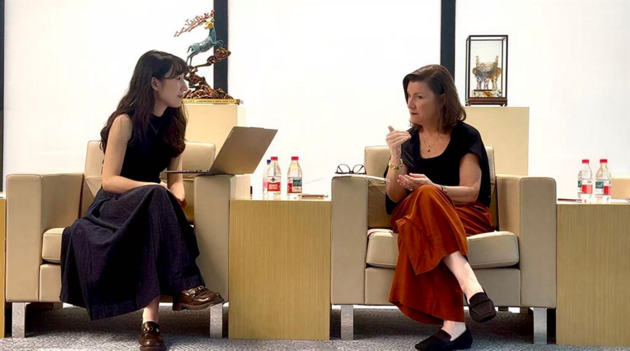
Alison Rehill-Erguven (R) Photo/Song Xinyue (NBD)
Saudi Retail Real Estate Enters a New Phase of Growth, with Lessons from China
NBD: Before joining Cenomi Centers, you served as CEO of Pradera Retail Asia and were based in Shanghai, overseeing retail real estate in China. Having worked in both China and Saudi Arabia, what would you say are the biggest differences in consumer behavior and in the way retail real estate is operated?
Alison Rehill-Erguven: I think there are differences in terms of the countries and the cultures, but there are also a lot of similarities.
Saudi Arabia, and this part of the world, the Middle East, is very much a mall culture. It’s a shopping-center culture.
First and foremost, that’s because of the heat. It’s very hot, so that air-conditioned, organized environment is preferable. Secondly, Saudi Arabia has historically developed around a different urban model, where high streets play a smaller role than in cities such as Shanghai. We don’t have something like Xintiandi. So the mall becomes a very important place for the community, for gathering and for being with family. It’s also a very young culture. I think around 60% to 65% of the population is under the age of 35, so you have a very large share of the population that is young, dynamic and wants to be out.
China, by comparison, has a much more diverse retail landscape. You have shopping centers competing with beautiful high streets and organized retail environments such as Xintiandi. You also have a very large online-shopping market. I think China has among the highest levels of online-shopping penetration in the world, whereas Saudi Arabia’s penetration is still much lower.
Saudis like online shopping, but going to the mall, going to a shopping center and being with family is part of life. It’s part of the community.
There are also similarities. Both countries have young populations. Both are well traveled and well educated. People are young, dynamic and very technologically savvy, while both societies also retain a strong cultural identity, traditions and a strong sense of national pride.
When I first arrived in Saudi Arabia, I remember thinking, “I recognize this dynamic. I just lived this dynamic for five years.”
NBD: Are there any lessons from China’s retail real estate market that you think are particularly relevant to Saudi Arabia today?
Alison Rehill-Erguven: When we developed the joint venture in 2016 and I became CEO in 2017, it was a really dynamic time to be in China. I had already been in the business for more than 20 years, but I almost felt like I was relearning my business.
The way the Chinese were looking at retail was very different. They were integrating technology, creating an omnichannel environment that connected online and offline, and removing friction from how people paid and spent through tools such as WeChat. It was an incredible period. That was when Hema was emerging and online shopping was expanding very quickly.
Saudis are also extremely technologically savvy, so we’re already adopting some of those learnings in the Cenomi business today.
We recently relaunched our loyalty program, which is completely online- and app-based, and we’re adding AI to it as well. The goal is to reduce friction for Saudi consumers and create a more seamless online-offline, omnichannel experience. There are definitely lessons to be learned from the Chinese market.
Chinese Brands Are Accelerating Their Entry into Saudi Arabia, but Localization Is the Next Test
NBD: Chinese brands have already begun expanding into Saudi Arabia. From the perspective of a shopping mall operator, what stage do you think Chinese brands are currently at in the Saudi market?
Alison Rehill-Erguven: I still think they’re probably at the beginning phase of entering. I wouldn’t even say the middle yet, because I know how many Chinese brands I think would resonate really well with the Saudi consumer.
There are already some Chinese brands in the market. Balabala is here. Huawei is in our asset at Jeddah Park. We’ve just signed MINISO LAND at Westfield Riyadh, and we also have MINISO stores across the portfolio. We’ve also done some activations with BYD through its partnership with Al-Futtaim. So we have had, and will continue to have, connections with Chinese brands, and we’re very open to more Chinese brands coming.
There are opportunities beyond consumer brands as well. We’ve had conversations with Chinese technology companies, including partnerships involving equipment and digital screens. There are also opportunities through investment and financing to further strengthen the relationships between Saudi Arabia and China, and between our company and Chinese companies.
NBD: Cenomi Centers has recently attracted global luxury brands including Bottega Veneta and Bulgari. When it comes specifically to Chinese brands, what are you looking for? Do you prefer established brands with a proven track record in China, or are you also open to younger consumer brands with strong growth potential?
Alison Rehill-Erguven: We’d be open to both. What we’re ultimately looking for is what we believe will resonate with the Saudi consumer. That’s going to be our first point of consideration when it comes to bringing brands in and deciding how we merchandise the mall.
You want to have global operating standards, but you still have to be local. You have to be relevant and resonate with the consumer. Otherwise, it doesn’t work.
When I lived in China, I saw a lot of brands, whether luxury or multinational, making sure they were tapping into Chinese culture and Chinese consumer identity. That could mean using local models or developing capsule collections for Chinese New Year. Some brands got it right, and some didn’t.
The same principle applies to Chinese brands coming to Saudi Arabia. If you’re going to come to Saudi, come with the lens of a Saudi consumer. Some things will translate easily. But if you can tap into the culture, Saudi music, Saudi cultural identity, the art scene and the influencer scene, and develop collections for Ramadan and Eid, you’re going to win their hearts and minds.
That would be my advice to Chinese companies, because I saw it done in China by international brands. It goes both ways.
NBD: Looking three to five years ahead, what do you see as the biggest opportunities for cooperation between China and Saudi Arabia in retail and commercial real estate? And what advice would you give Chinese consumer brands considering entering the Saudi market?
Alison Rehill-Erguven: I think there’s a tremendous amount of opportunity.
First and foremost, the two governments are working together in a very positive and collaborative way to find opportunities that benefit both sides.
For Chinese brands coming into the Kingdom today, there are essentially two ways to enter. They can come in through established franchise networks. These networks are really well run, and I would highly recommend that route if a brand wants to de-risk its entry into the market. There are large and experienced regional partners such as Chalhoub Group, Apparel Group and Alshaya Group. They understand retail and the local market very well.
If a brand wants to come in directly, that’s another option. It can work directly with local retail real estate operators such as Cenomi Centers.
So there are different routes into the market, depending on how much risk a brand wants to take and how it wants to build its local presence.
From Building Malls to Operating Assets: Cenomi Pursues a Balance Between Asset-Light and Owned Assets
NBD: Cenomi has been active on the capital side, and the market has also been watching the possibility of a REIT. From a long-term capital strategy perspective, how do you weigh different financing and growth tools? Where does a REIT sit among your options, and how does it relate to the company’s asset-light strategy?
Alison Rehill-Erguven: We’re looking at lots of different optionality for the company. We’re going through a strategy revision right now. Most importantly, we’ve worked really hard over the last couple of years to create more flexible financing options.
One example is the SAR-denominated sukuk. We raised our first local sukuk in Saudi riyals at the end of last year with Al Rajhi, and it was incredibly successful. It beat our expectations.
We had more than 10,000 investors in that product. So it was a new form of capital for us, and it was really exciting to do it in our home market of Saudi Arabia.
We remain active in the U.S. dollar bond markets. We also have a syndicated secured loan package that combines regional and local banks, and we continue to work on those banking relationships.
A REIT is a possibility, but we haven’t landed on any specific strategy yet.
Another vector for us is our capital-light strategy and the partnership we’ve signed with Saudi Downtown Company, or SDC, which is a PIF entity.
We’ve signed our first city with them, Al Khobar. That gives us a capex-light and asset-light avenue for growth.
It allows us to grow without taking on the same balance-sheet burden, and that gives us more flexibility and optionality as we continue to expand.
NBD: Asset-light models are already well established in global real estate. What particular opportunities and challenges do you see in applying that model in Saudi Arabia?
Alison Rehill-Erguven: I think it’s a very interesting opportunity for us. You have the government and government entities building really large projects, which create opportunities to bring in specialist partners with deep expertise across different components of those developments. That’s where specialists like us come in.
Being the largest shopping destination owner, operator and developer in the country and having expertise in retail real estate, we should be a partner of choice when it comes to unlocking the maximum amount of value from the retail components of those projects. So I think the asset-light approach is definitely one of the avenues of growth for us.
SDC was the first. We recently announced a second city. We signed Al Khobar first, and now we’ve signed Al Madinah. We’re also having conversations with several other PIF entities in a similar fashion.
But it’s also about balance. It’s not about moving entirely toward an asset-light or capex-light model. We’re a vertically integrated company. We have development, leasing, marketing, operations and asset-management capabilities. With a capex-light model, we can monetize that team and those skills.
At the same time, we also have a balance sheet of owned assets that are just as important. I think the focus for us is about shareholder value creation, the balance sheet, making sure we're prudent about that, and the cost of capital as well, which creates this balancing act that we're in.


 川公网安备 51019002001991号