“The market is going through significant volatility, but we are betting on the long term.”
Saleh Al Khabti, President of Acwa China, told National Business Daily (NBD) in an exclusive interview on Sept. 3 that the company expects to invest at least $30 billion in China by 2030. The interview took place on the sidelines of CMF Select Shanghai 2026.
China’s renewable energy sector extended its rapid expansion in the first half of the year, with renewable power generation accounting for a record 41.2% of total electricity generation for the first time. By the end of June, total renewable power capacity stood at 2.455 billion kW, accounting for more than 60% of the nation’s overall installed capacity.
As that capacity has expanded, the basis on which investors evaluate it has shifted. New capacity alone is no longer the primary measure of growth. Investors are now weighing how much renewable power the grid can absorb, how market-based electricity prices are evolving, and whether projects can deliver sustainable returns over the long term.
For global capital, that raises a fundamental question: what makes Chinese renewable energy assets attractive today?
Saleh Al Khabti brings a particular vantage point to that question. Before joining Acwa, he served as Saudi Arabia’s deputy minister of investment. He also held senior positions at Aramco Asia’s China office, including roles in business origination and joint venture development, where he led key downstream transactions. His mandate has changed accordingly. Where his earlier work focused on bringing global capital into Saudi Arabia, he is now examining where and how tens of billions of dollars should be deployed inside China — with technology increasingly central to that calculation.
“The core competitiveness of China’s AI and technology sectors lies in the sustainability of their growth,” Saleh Al Khabti told NBD.
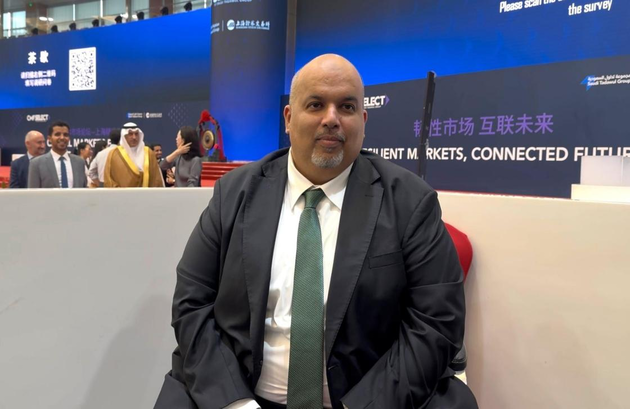
Saleh Al Khabti Photo/Song Xinyue (NBD)
“The Market Is Going Through Significant Volatility, but We Are Betting on the Long Term”
As China adds wind and solar capacity, the way renewable energy assets are valued is also evolving. Resource quality and installed capacity were once among the primary criteria for assessing a project. Today, with electricity pricing becoming increasingly market-driven and renewables accounting for a growing share of the power system, returns depend on a broader set of factors, including local power demand, grid conditions, and the system’s capacity to absorb renewable generation. Saleh Al Khabti said China’s renewable energy market is still evolving, but that Acwa is taking a long-term view.
NBD: China’s renewable energy sector has gone through significant changes over the past year. From the perspective of global long-term capital, has the attractiveness of Chinese renewable energy assets changed? What areas will be most important to watch over the next year?
Saleh Al Khabti: If you look at the global economic landscape, China remains one of the world’s most dynamic markets — whether in terms of potential growth in electricity demand, the strength of its macroeconomy, or its long-term growth prospects.
More importantly, China has a high degree of policy continuity. It has set clear dual carbon targets, with the goal of peaking carbon emissions before 2030 and achieving carbon neutrality before 2060. The policy framework surrounding those goals has been highly consistent, providing strong support for the development of renewable energy.
Overall, China is a market with significant long-term growth potential, and a stable policy environment is one of the key foundations for that growth. The questions the industry now needs to examine are where the next sources of incremental growth will come from, how business models will evolve, and how the Chinese market itself will adjust.
The market is going through significant volatility at the moment, but we are betting on the long term. By 2030, we expect our assets under management to reach $250 billion, with at least $30 billion potentially invested in China.
NBD: Looking at specific investment opportunities, what types of assets are you most interested in? Acwa has previously said it is interested in wind power, energy storage, and pumped hydro projects in Yunnan. What is the investment logic behind that strategy?
Saleh Al Khabti: China has very distinct structural characteristics. The eastern part of the country is the center of electricity consumption and has enormous power demand, while regions such as Inner Mongolia, Qinghai, and Yunnan have exceptional conditions for energy production.
What we want to do is find the optimal balance between resource availability and end-user demand, thereby maximizing investment returns. We approach that process prudently and progressively.
Take pumped hydro storage as an example. We see significant strategic value in incorporating this type of asset into Acwa’s broader energy portfolio and technology capabilities. Whether we are deepening our presence in existing markets or entering new ones, flexibility and peak load management capabilities are essential.
China is both a source of innovation and an excellent testing ground for the commercial deployment of large, utility-scale technologies, including pumped hydro and concentrated solar power. Traditional utility projects still account for the largest share of our current portfolio. At the same time, we see substantial opportunities in gas-fired power generation, concentrated solar power, pumped hydro storage, and battery energy storage. These technologies can all play a role in maintaining grid stability, and they represent some of the key areas where we see incremental investment opportunities in China.
“The Core Competitiveness of China’s AI and Technology Sectors Lies in the Sustainability of Their Growth”
When asked why global capital continues to allocate money to Chinese assets, Al Khabti returned repeatedly to a single theme: growth.
In July of last year, China’s monthly electricity consumption exceeded 1 trillion kilowatt hours for the first time. During the first seven months of 2026, electricity consumption by China’s internet data service sector reached 59.3 billion kilowatt hours, up 43.3 percent year on year — far outpacing the growth rate of electricity consumption across the broader economy. AI models, chips, and computing power ultimately translate into physical data centers, and those facilities require a continuous and reliable supply of electricity at massive scale. From the perspective of an energy company, that gives artificial intelligence a straightforward identity: a major new electricity customer.
NBD: From your personal perspective, what is the core competitive advantage that makes Chinese AI and technology companies attractive to global capital?
Saleh Al Khabti: The core competitiveness of China’s AI and technology sectors lies in the sustainability of their growth.
China has an exceptionally strong base of potential demand. It has a huge population whose purchasing power and level of prosperity continue to increase. That in itself makes the market highly attractive to capital.
If you look around the world, how many economies can sustain stable growth at this scale? And how many have the ability to manage policy through such a complex industrial and economic transition? Over the past 15 years, China has been transforming the structure of its economy, moving away from a model highly dependent on exports toward one that is more market-driven and focused on stimulating domestic demand and improving living standards. I think China has managed that transition extremely well.
That is attractive to a utility company such as Acwa as well. We are involved in desalination and have worked to improve water security in many countries, and we now want to bring those capabilities, experience, and innovations to China. In some more advanced areas, we are also developing large-scale green hydrogen projects. We are currently working with Chinese chemical and energy companies to design a project that would be twice the scale of the facility we currently operate at NEOM, while also achieving greater efficiency. These opportunities are extremely valuable to us, and they allow us to continue developing mutually beneficial relationships with Chinese partners with whom we have worked for many years.
NBD: How will the rapid expansion of AI data centers reshape the business model of energy companies?
Saleh Al Khabti: AI is fundamentally a power-intensive industry — in that sense, it is similar to industries such as copper smelting or aluminum refining. We therefore see AI and other energy-intensive industries as potential channels for direct electricity sales in the future.
We are already engaged in in-depth discussions with a number of companies in these sectors and hope to turn those discussions into concrete project investments as soon as possible. This will be one of our highest priorities going forward.
In July of last year, China’s electricity consumption in a single month reached a level roughly equivalent to Japan’s annual electricity consumption. That gives some sense of the scale of China’s electricity demand and its market. China today remains a market of dream and opportunity.
China-Saudi Cooperation Is Moving Deeper Into the Value Chain
UUnder Saudi Arabia’s Vision 2030, infrastructure including renewable energy, desalination, and green hydrogen has become an important pillar of the kingdom’s economic transformation. As one of Saudi Arabia’s leading energy companies, Acwa has long expanded beyond its home market, with operations across the Middle East, Africa, Southeast Asia, and other regions. China has been a central partner throughout that global expansion.
China has one of the world’s most comprehensive renewable energy supply chains, with mature manufacturing and engineering capabilities across solar power, wind power, and energy storage. At the same time, as economic ties between China and Saudi Arabia deepen, the way Chinese companies participate in Saudi and Middle Eastern energy projects is also changing. Their role is expanding from equipment exports and EPC services — covering engineering, procurement, and construction — into project development, investment, and financing. The relationship, in other words, is moving deeper into the energy value chain.
NBD: Chinese companies have traditionally participated in Acwa’s global projects mainly as equipment suppliers and EPC contractors. Some are now beginning to invest directly as equity partners in overseas renewable energy assets. In your view, what new stage is the international expansion of Chinese renewable energy companies entering? Can their advantages in cost, supply chains, and engineering be translated into capabilities in global project development, capital investment, and long-term operations?
Saleh Al Khabti: Today, more than 99 percent of the renewable energy equipment we procure comes from China. Of our 111 projects globally, Chinese companies are involved in roughly half. Since 2008, the value of projects involving Chinese EPC contractors and core equipment suppliers has exceeded $50 billion, and our procurement from China will continue to increase over the next three years. More than 50 percent of our EPC contracts are also delivered by Chinese companies.
The reasons are clear. Chinese companies have outstanding engineering and delivery capabilities, highly competitive cost structures, and the ability to provide long-term reliability. Chinese partners have played an important role in Acwa’s ability to expand into 16 countries, and as we continue entering emerging markets, their importance to our business will only increase.
On investment and financing, we have also maintained very strong relationships with Chinese financial institutions. Financing and investment support from Chinese banks and financial institutions has exceeded $12 billion. In 2026 alone, the figure has already reached at least $1 billion. We have a high level of confidence in China’s regulatory environment and financial system.
The Chinese market has welcomed Acwa in an open and fair manner. We will continue to expand our portfolio of assets in China while identifying additional original equipment manufacturers and strategic partners.
NBD: How do you see the potential for greater connectivity between the Chinese and Saudi capital markets?
Saleh Al Khabti: Much of this progress has been made possible by the strong support of the leadership of both countries. China’s Belt and Road Initiative and Saudi Arabia’s Vision 2030 are highly complementary and have created broad areas of shared interest and cooperation. Acwa’s presence across 16 countries, particularly our expansion in markets along the Belt and Road, is a strong illustration of the value created by that strategic alignment.
The Shanghai Stock Exchange and Saudi Tadawul Group are now strengthening their cooperation, which further raises our expectations. Greater connectivity between the two capital markets means Chinese financial institutions will have easier access to high-quality opportunities involving Acwa and the broader Saudi market. We are extremely optimistic about that prospect.


 川公网安备 51019002001991号