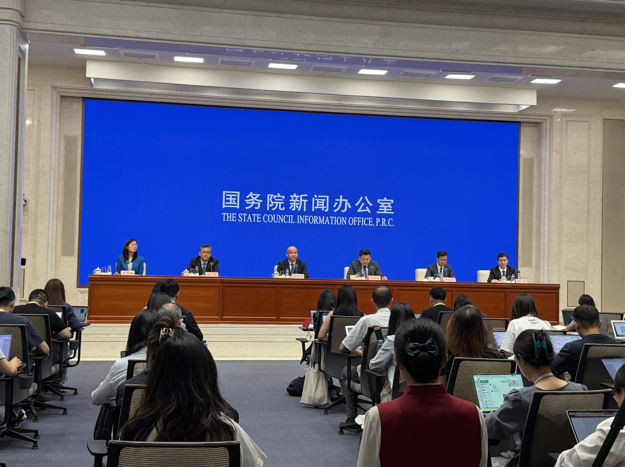
Photo/Zhou Yifei (NBD)
China’s Ministry of Industry and Information Technology (MIIT), alongside multiple government departments, recently issued China's first national guideline on boosting the high-quality development of time-honored industries such as silk, tea and porcelain.
At a State Council Information Office press conference on September 7, officials outlined strategic initiatives to modernize traditional craftsmanship by leveraging artificial intelligence and empowering time-honored brands.
Addressing the convergence of digital technology and traditional heritage, Vice Minister of Industry and Information Technology Xie Yuansheng detailed a three-pronged framework based on data foundations, AI modeling, and scenario applications.
The ministry advocates constructing specialized "industry brains" within key clusters to collect, annotate, and standardize implicit artisanal knowledge—such as tea fermentation temperature curves, ceramic glaze formulations, and traditional Chinese medicine processing specs—thereby transforming personal mastery into reusable digital assets.
Furthermore, AI foundation models will decode complex traditional mechanisms to construct comprehensive industry knowledge graphs, standardizing production while driving innovation; in silk design, AI-assisted tools can generate thousands of pattern variations in minutes.
To bring these capabilities to scale, MIIT encourages leading enterprises to build "future factories"—such as smart pharmacies and digital kilns—utilizing computer vision for tea sorting and real-time algorithm adjustments to optimize kiln temperatures, ensuring strict quality tracing and dynamic scheduling.
Complementing technological upgrades, the Ministry of Commerce is strengthening support for "China Time-Honored Brands," over 40 percent of which operate within historical classic sectors such as silk, tea, traditional medicine, and arts and crafts.
Zhang Xiang, an official within China's Ministry of Commerce, highlighted four priority areas: refining supportive policies to link classic brands with cultural heritage sites, enhancing evaluation standards that emphasize product quality and cultural innovation, maintaining a dynamic management mechanism with strictly enforced entry-and-exit criteria to ensure brand integrity, and establishing a comprehensive monitoring system to track business operations and credit profiles for sustained growth.


 川公网安备 51019002001991号