On July 23, 2026, at the International Congress of Mathematicians, University of Toronto mathematics professor Jacob Tsimerman accepted his Fields Medal and immediately announced his upcoming transition to OpenAI.
Prior to receiving the Fields Medal, Tsimerman had already engaged deeply in AI safety research.
On August 7, in an exclusive interview with National Business Daily (NBD), Tsimerman revealed that he expects to officially start his role at OpenAI before the end of this summer.
His move to AI research and joining OpenAI is not driven by a desire to build more powerful frontier models, but rather stems from concerns regarding AI risks.
During the interview, he shared his perspective: AI is among the most critical and dangerous technological variables of our time, pushing its capability boundaries while human understanding of its underlying mechanisms remains limited, stressing that AI has no natural safety stop gap.

Jacob Tsimerman celebrated as he took the stage to receive the Fields Medal at the International Congress of Mathematicians. Photo/VCG
On Joining OpenAI — "Building a Healthy AI Safety Ecosystem"
NBD: Have you officially started your work at OpenAI yet?
Jacob Tsimerman: No, not yet. Things are still being finalized, but I expect to officially start by the end of the summer.
NBD: What led to your decision to join OpenAI after receiving the Fields Medal? What considerations were behind this choice?
Jacob Tsimerman: Artificial intelligence is, I think, the most important problem of our time. It has a lot of promise, but also a lot of risks. I’ve thought this for some time now.
I think it could use a lot more theoreticians working on it, a lot more economics people working on it, and a lot more governance people working on it. So I'm hoping to bring myself and hopefully other mathematicians to do some good.
It's important to have a healthy AI safety ecosystem. It's important to have third-party organizations besides the labs and some public organizations as well in the government who are looking into model evaluations, safety, and coordinating research. And I think it's important for the labs to have AI safety internally, which they do already.
I thought hard about exactly where to join for myself personally. The part of my background that's most lagging as a mathematician is software engineering, and I thought a lab would be a particularly good place for me to learn—that was the defining factor.
But again, I want people to join all three of these categories that I outlined. I don't think research talent should be concentrated in any one of them.
NBD: In recent years, top AI labs have actively hired mathematicians and philosophers. What do you think lies behind this trend?
Jacob Tsimerman: I think it's true that AI has been largely an empirical science so far. There are some exceptions, but by and large, that is the case.
One of the problems with it being mostly empirical is that we lack understanding. We lack a foundational understanding as to how these systems think, why they do what they do, and we're not able to predict what they're going to do especially well. The idea of bringing more theory into the subject is that if we can understand something better, we can hopefully predict it, adjust for it, control it, and mitigate its risks.
I think mathematicians are starting to understand and tap into the fact that this is a very serious problem that needs to be addressed urgently because things are moving so quickly.
To that end, I made a website that's supposed to help mathematicians get into AI safety, learn how the field works, and point them in useful research directions.
On Catastrophic Risks — "AI Has No Natural Safety Stop Gap"
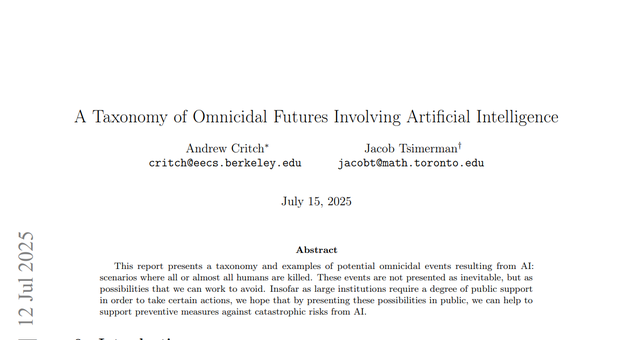
The paper *A Taxonomy of Omnicidal Futures Involving Artificial Intelligence* is co‑authored by Jacob Zimmerman and Andrew Krich.
NBD: The AI industry is caught in an intense race centered on scaling compute and commercial execution. What critical risks are being magnified by this high-pressure, competitive environment?
Jacob Tsimerman: As everyone recognizes, as AI capability develops, corresponding risks go up. As the models become smarter, they can do more things that are potentially negative as well.
Recently, there was a letter signed by a thousand employees from frontier labs called "Pacing the Frontier." Employees basically expressed concern and suggested that we need to have a system in place for potentially slowing down, pausing, or managing in some other way the speed of developing these systems.
The basic idea is that systems getting smarter is good because we can use them to accomplish more tasks for the benefit of humanity. But if we can't mitigate the risks, it could become incredibly dangerous.
NBD: Recently, reports surfaced regarding models from AI labs escaping sandbox environments or breaching external systems. What level of risk do these events expose, and what potential consequences could follow?
Jacob Tsimerman: What we're seeing with these incidents is that if we create agents that are more intelligent than humans and can think faster, the risks are potentially catastrophic.
As outlined in the paper I co-authored, advanced AI could enable humans—whether individuals, small groups, or large institutions—to cause great harm. The systems themselves could also become misaligned; they could have their own goals, or they could enact our goals in ways counter to what we intended.
The potential risks are quite high and could result in significant catastrophe. There are risks at every level: risks where humans have to worry about our civilization, down to economic and social impacts, all of which are very significant.
I co-wrote that paper to focus on catastrophic, civilizational risks—not to cause fear-mongering or inspire panic, which aren't productive, but so that we understand the potential risks are very high and treat them with corresponding seriousness.

Jacob Tsimerman
NBD: Regarding AI catastrophic risk, what do you consider the biggest public misconception?
Jacob Tsimerman: The biggest misconception is that because of how these systems are designed, there is some natural limit on their intelligence or on the set of tasks they could accomplish.
You often hear people say that because all they are doing is predicting the next word or token like an auto-complete, they will never be able to do higher-level tasks. But at this point, we have significant evidence that this isn't the case. Whatever task you can imagine, these systems can potentially do.
The main thing I would urge the public to realize is that there is no natural stop gap here. We could make systems that are smarter than humans at planning catastrophe and at executing it—as well as at beneficial uses. If people are relaxed because they think the system will never be able to do X, Y, or Z, I don't think that's the case.
NBD: On the path to Artificial General Intelligence (AGI), do critical scientific bottlenecks remain?
Jacob Tsimerman: It's very possible there is no remaining scientific bottleneck. It's very possible that if we continue doing what we've been doing, we will reach AGI.
Many experts in the field now share the opinion that AGI is coming very soon.
The reason I am entering AI safety is not to reach AGI faster, but to make sure that once we reach it, we understand what's going on well enough to maintain sufficient control, use it for the benefit of humanity, and avoid serious risks.
On Mathematics in the AI Era — "AI Will Become Superhuman at Math"
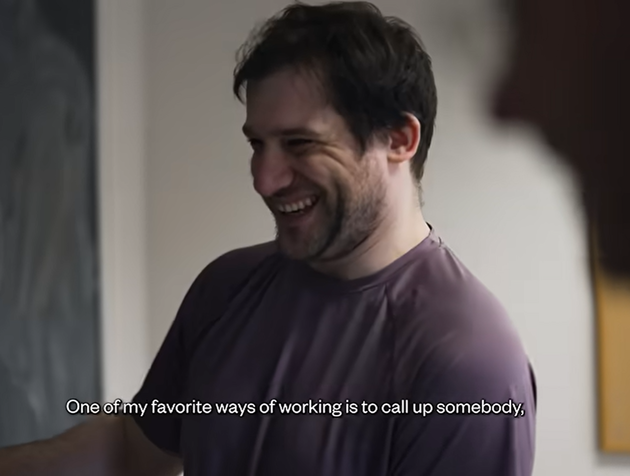
Jacob Tsimerman
NBD: You have suggested that AI may soon surpass humans in mathematical reasoning. How do you see the core role and unique value of human mathematicians evolving in the future?
Jacob Tsimerman: That is a great question and a conversation we should be having. Mathematics research as it exists today for humans is not going to be around anymore in the way it exists now. AI systems are rapidly becoming superhuman at math, and in a matter of a few short years, they will be strictly superhuman.
However, we still want humans understanding mathematics and to have a place for them to engage with it in various ways.
Furthermore, we need to think about how we channel all that new mathematical capability into something productive for humanity. Right now, the pipeline between pure math discovery and real-world application is very long—it can take decades before a math theory is applied in society. If AI systems become sufficiently advanced, they could make that conversion process a lot shorter, leading to exciting and productive outcomes.
NBD: How do you evaluate the trajectory of open-source AI models and global developments in AI?
Jacob Tsimerman: It's clear that there are very powerful open-source models, including in China and Europe. It is important to pay attention to both the open-source ecosystems and the frontier labs, as significant risks are present across both paradigms and merit careful study.
NBD: What is your advice for ordinary people on handling employment and navigating life in the age of AI?
Jacob Tsimerman: I suggest that people engage directly with the systems that exist—get experience, use the models, understand what they're doing, and integrate them into your own workflow. Whatever way things shake out economically, these tools will be important partners in our workflows, so not learning them puts one at a disadvantage.
Politically and publicly, I encourage people to become informed, read about AI, become genuinely invested, and communicate that interest to public representatives. We need society and large organizations talking about this much more, and we need policymakers to understand that the public cares about this story because it affects all of us.
Editor’s note: The interview has been reordered and lightly edited for clarity and written presentation, without altering the substance of the responses.


 川公网安备 51019002001991号