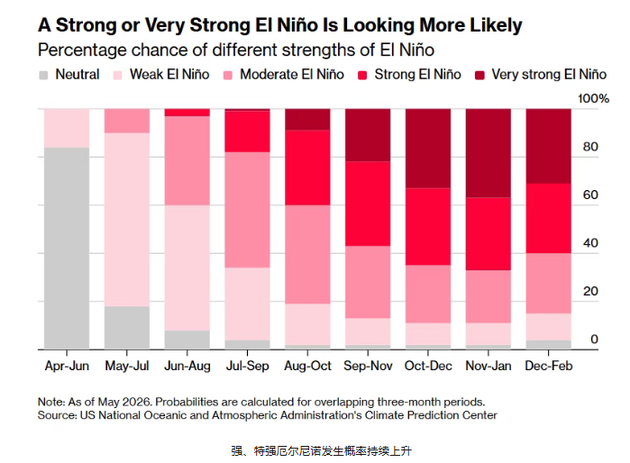
On August 4, the China Meteorological Administration reported that latest monitoring indicates the El Niño state continued to strengthen between June and July 2026. Multiple meteorological agencies assess that this El Niño event could set a 150-year record and potentially push 2027 to become one of the hottest years on record.
Under the influence of this global climate "amplifier," risks of extreme heat, drought, and heavy precipitation have risen significantly, exacerbating uncertainty in global agricultural production.
Agricultural commodity markets have already reacted: in July, futures prices for soybeans, maize, wheat, and cotton rose by 3.91%, 6.24%, 8.60%, and 6.37% respectively.
Dr. Maximo Torero, Chief Economist of the Food and Agriculture Organization (FAO) of the United Nations, stated in an exclusive interview with National Business Daily (NBD) that while global food supply and demand remain generally capable of supporting current needs, structural risks are accumulating. He highlighted that particular vigilance is required regarding the systemic impacts when trade restrictions compound climate shocks.
Dr. Maximo Torero joined the FAO in January 2019 as Assistant Director-General of the Economic and Social Development Department and was later on appointed as Chief Economist. Prior to joining the FAO, he served as Executive Director at the World Bank Group for Argentina, Bolivia, Chile, Paraguay, Peru, and Uruguay from November 2016.

Maximo Torero Photo/VCG
Quantifying Super El Niño Impact Remains Premature — Rice Most Fragile, Wheat Faces Highest Yield Loss Pressure
On August 4, during a press conference hosted by the China Meteorological Administration, Jia Xiaolong, Deputy Director of the National Climate Center, noted that the Niño3.4 index reached 1.60°C in June and consistently exceeded 2.0°C starting from the second pentad of July. A strong to super El Niño event of the eastern-Pacific type is expected to form through summer and autumn, peaking in autumn/winter before gradually decaying by the spring/summer of 2027.
The World Meteorological Organization (WMO) also projects that global average temperatures from 2026 to 2030 will very likely remain at or near historical record highs.
NBD: The market's most pressing concern right now is how severe an impact this El Niño cycle will have on global grain production. Is there already a clear estimate of yield reduction?
Maximo Torero: It is still too early to estimate yield losses attributable specifically to El Niño. Outcomes will depend on its intensity, duration and coincidence with critical planting, flowering and grain-filling stages. Therefore, no scientifically defensible global percentage attributable to El Niño is yet available.
NBD: What percentage drop in overall global production is expected for wheat, soybeans, maize, and rice due to this El Niño cycle?
Maximo Torero: No scientifically defensible global percentage attributable to El Niño is yet available. Current FAO forecasts, which combine weather, area, inputs and other factors, indicate wheat production down about 4.3 percent, rice down 1.8 percent, maize close to last year’s level and soybean production still increasing. These figures must not be presented as El Niño losses.
NBD: Among the four major staple crops (wheat, soybeans, maize, rice), which currently faces the most fragile supply chain and highest risk of yield reduction?
Maximo Torero: Rice is currently the most fragile from a food-security and trade perspective. Its international market is relatively thin, price shocks persist longer, and crops in India and Thailand face monsoon and drought risks. However, wheat currently has the largest forecast production decline, especially durum wheat, compounded by Black Sea which is operating at 1 third of its capacity restricting mobility from Ukraine and Russian Federation, and Australian risks.
"Weather Premium" May Persist for Weeks — Export Restrictions Shock Could Add 21.4 Million to Hunger
El Niño alters atmospheric circulation patterns through typical teleconnections and air-sea interactions, shifting the probability distributions of seasonal regional climates. While certain niche crops (such as California avocados or almonds) may benefit, primary production zones for rice, wheat, coffee, and palm oil face elevated risks of extreme weather and yield reductions.
Entering July, extreme weather surged across North and South America. Major crop-growing areas in North America suffered severe high temperatures, driving agricultural prices up and triggering a clear "weather premium."
In July, futures prices for soybeans, maize, wheat, and cotton rose by 3.91%, 6.24%, 8.60%, and 6.37% respectively.
NBD: How long is this market "weather premium" expected to persist?
Maximo Torero: The premium should persist until uncertainty over crop conditions is resolved, probably several weeks through the main Northern Hemisphere crop-development and harvest periods. It would last longer only if heat and drought translate into confirmed yield losses.
AMIS forward curves have so far indicated adequate supplies and temporary, rather than structural, tightening. FAO’s official July price data will be released on 7 August.
NBD: Does financial capital amplify price volatility in agricultural commodities?
Maximo Torero: Financial investors can amplify short-term price movements around weather forecasts, but sustained price increases require genuine changes in production, stocks or trade.
AMIS reported that large speculative positions accumulated in May were substantially unwound in June, while futures curves continued to signal adequate future supply. Transparency through AMIS is therefore essential to prevent uncertainty from becoming excessive volatility.
NBD: Is there any country have introduced or are likely to introduce grain export restrictions?
Maximo Torero: No major El Niño-specific grain export ban has yet been confirmed. FAO does not predict which government will impose one, but rice exporters in Asia and wheat exporters remain critical to monitor.
FAO works through AMIS, its Rapid Response Forum, GIEWS and direct policy advocacy to discourage restrictions. FAO modelling shows that export restrictions during a strong El Niño shock, based on historical data, could add 21.4 million people to those pushed into hunger.
Global Grain Stocks Can Buffer Short-Term Shocks, but Uneven Distribution May Amplify Risks
In the global food system, vulnerability manifests first in fragile regions. Based on 41 years of satellite data, risk assessments identify the African Sahel, Southern Africa, South Asia, Southeast Asia, the Central American Dry Corridor, and the Caribbean as high-risk zones, with several agricultural and pastoral areas facing over a 50% probability of drought in the coming months.
The Peterson Institute for International Economics estimated on July 20 that if this El Niño event reaches the intensity level of 1997/98, economic losses in the first year could reach ~$686 billion, potentially accumulating to $3.1 trillion over five years without immediate mitigation policy.
NBD: How severe is the impact of soaring food prices on vulnerable, import-dependent regions such as the Horn of Africa and the Middle East?
Maximo Torero: The impact could be severe even without a global shortage. The Horn of Africa and the Middle East combine high import dependence, conflict, currency weakness, limited fiscal space and already high acute food insecurity. In these settings, higher international prices, freight and fertilizer costs rapidly reduce household purchasing power and humanitarian agencies’ capacity to provide assistance.
NBD: Can current stock levels in major grain-consuming nations adequately buffer against the impacts of this harvest shortfall?
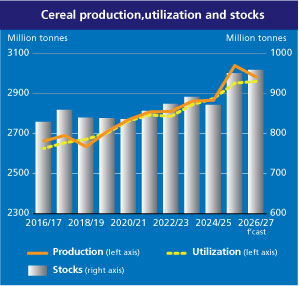
Maximo Torero: Current global stocks can buffer a moderate or short-lived shock, but not a prolonged simultaneous failure across several producing regions. The global cereal stocks-to-use ratio is about 32 percent; wheat and coarse-grain stocks are expected to increase, while rice stocks may decline by 2.7 percent but remain the second highest on record. The principal problem is that stocks are unevenly distributed and may not be accessible to low-income importers.
NBD: How significantly are secondary climate impacts, such as drought at the Panama Canal, affecting global grain shipping costs and efficiency?
Maximo Torero: The Panama Canal is not currently a major constraint: it is operating efficiently, at around 38 daily transits, with no restrictions forecast through the end of 2026. The greater risk may emerge in 2027 if El Niño reduces watershed rainfall. Broader grain and oilseed freight costs nevertheless remained about 24 percent above a year earlier in June, reflecting multiple shipping disruptions rather than Panama alone.
NBD: With drought and extreme heat driving up irrigation and fertilizer costs, is there a major risk of widespread land abandonment by farmers?
Maximo Torero: Widespread global land abandonment is not the baseline scenario. The more immediate responses are likely to be lower fertilizer application, delayed planting, crop substitution and temporary fallowing of marginal land. Risks increase substantially when input disruptions last three months or more and begin affecting the following production cycle.
Clearly, the combination of the Strait of Hormuz which results in significantly lower input use, and now El Niño brings a significant challenge to farmers with significant lower margins and potential lower yields.
NBD: Facing increasingly frequent extreme weather, what are the most effective "climate-resilient agriculture" practices and technologies the FAO is currently promoting?
Maximo Torero: FAO is prioritizing:
Early warning systems and anticipatory action through its riskmonitor.fao.org;
Drought-, heat- and flood-tolerant, short-cycle seeds;
Crop diversification and rotations, including legumes;
Efficient irrigation, water harvesting and improved water management given the impacts could be on droughts but also on floods even within countries;
Soil health, conservation agriculture, agroforestry and integrated pest management;
Livestock feed, water and vaccination before shocks;
Digital climate services, precision agriculture and agricultural insurance; and
Resilient storage, transport and diversified trade connections.
These measures must be locally adapted rather than applied as a uniform technology package.


 川公网安备 51019002001991号