When artificial intelligence begins deeply embedding into the core production systems of modern enterprises, token expenditure ceases to be a mere line item on a balance sheet—it becomes a matter of corporate survival.
As of June 2026, a fundamental shift is underway within the global AI infrastructure layer. From cryptocurrency giant Coinbase establishing Chinese large language models (LLMs) as the default toolkit for its engineering teams, to San Francisco-based automation startup Lindy migrating away from frontline U.S. providers because its API bills "exceeded its entire employee payroll," overseas businesses are systematically pivoting toward Chinese alternatives.
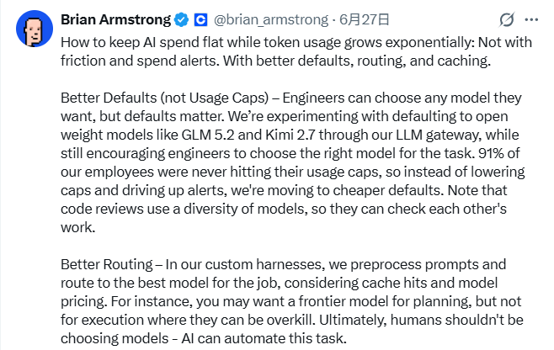
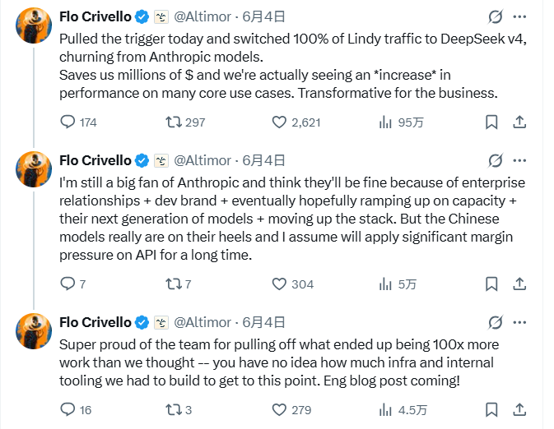
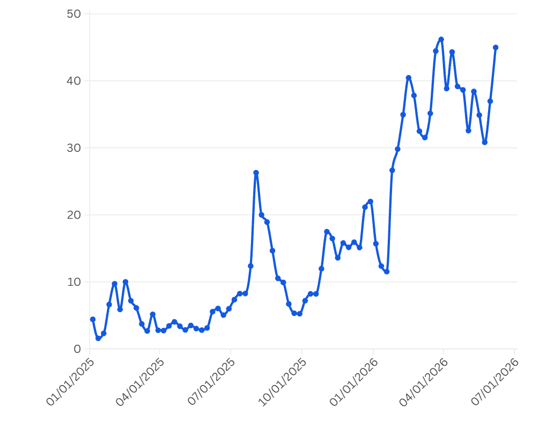
Data from OpenRouter, a prominent AI model aggregator, underscores the scale of this migration. The share of tokens consumed by U.S. enterprises utilizing Chinese AI models has skyrocketed from a marginal 4.5% in early 2025 to peaks as high as 46% by mid-2026.
Interviews conducted by National Business Daily (NBD) with executive leadership across an array of North American and European enterprises—including Lindy, Estonian data harvesting firm Floxy, automotive intelligence developer VINspectorAI, Canadian law firm Substance Law, and British online education platform ExpertEdge—reveal that migrating workloads to Chinese models has slashed inference costs by anywhere from 30% to 95%.
This commercial realignment is being driven by a critical convergence: while the performance gap between top-tier U.S. and Chinese models has narrowed to a negligible 1% to 4%, Chinese variants are being offered at price points 60% to 90% lower than their American counterparts.
For Lindy, a 25-employee startup focusing on high-frequency AI Agents for workplace automation, the transition was born out of financial necessity.
Flo Crivello, Chief Executive Officer of Lindy, told NBD that switching from Anthropic's Claude to DeepSeek-V4 compressed the company's inference costs by roughly 95%, translating to millions of dollars in annualized infrastructure savings.
Crivello noted that DeepSeek-V4 maintained stable metrics and identical call success rates, with only a minor, acceptable increase in end-to-end latency. He emphasized that in high-volume inference scenarios, once a model's quality lands within an acceptable operational threshold, cost becomes the ultimate deciding factor, adding that most startups simply cannot afford to pay a premium for brand equity.
This economic reality is echoed across the Atlantic.Aimen Hallou, Chief Technology Officer of the Estonian data aggregation firm Floxy, informed NBD that his company previously relied on OpenAI's GPT-4o to parse and standardize billions of characters of high-frequency text daily. Finding those baseline costs unsustainable, Floxy migrated the pipeline to DeepSeek-V3, realizing a 92% drop in core inference expenditures.
Similarly, Bogdan Nicholas, co-founder of VINspectorAI, reported that his firm offloaded structured data extraction and vehicle identification number (VIN) decoding tasks to Zhipu AI's GLM model family six months ago, capturing a 30% reduction in costs while fully satisfying their structural formatting criteria.
However, financial relief is not the sole catalyst for this infrastructure migration.
For some enterprises, operational autonomy outweighs immediate pricing advantages. Oli Huggins, Chief Executive Officer of the UK-based digital education provider ExpertEdge, stated to NBD that an abrupt U.S. export restriction in June caused Anthropic's Claude Fable 5 to go offline globally with minimal warning.
Huggins observed that when a company's core operations depend on closed, external models, corporate continuity remains vulnerable to regulatory and unilateral decisions. By running open-source models on in-house hardware, his firm has successfully insulated itself from external geopolitical and corporate volatility.
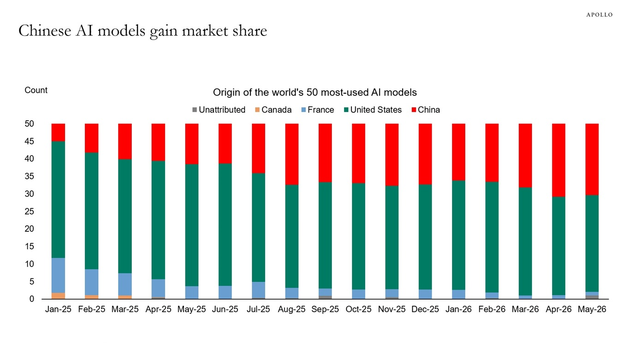
Market analysis suggests this dynamic represents a broader maturity in enterprise AI strategy.
Hu Yanping, a distinguished professor at Shanghai University of Finance and Economics, told NBD that after an initial experimental phase of organic employee adoption, global tech firms have entered a strict phase of token optimization.
Hu indicated that as premium Western closed-source model pricing trends upward, the industry has begun confronting the limits of "token economics." He argued that the competitive edge of Chinese LLMs lies in their structural versatility, aggressive cost efficiencies, and rapid open-source deployment cycles, which are uniquely optimized for specific enterprise workflows like Agent execution, tool calling, and multi-model collaboration.
The immediate velocity of this adoption is visible in platform telemetry.
According to OpenRouter, Chinese models secured the top six spots for weekly volume on the aggregator platform by early July 2026, with DeepSeek-V4-Flash maintaining a seven-week streak at the top of the charts.
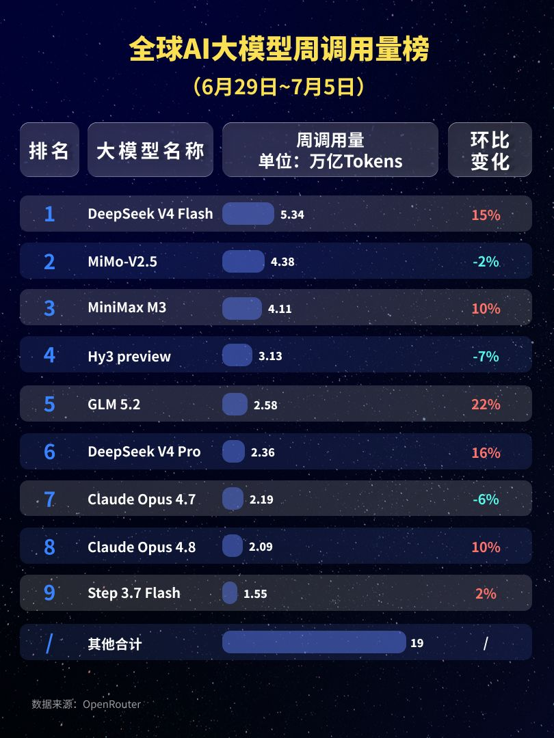
Data from frontend deployment platform Vercel mirrored this momentum; DeepSeek's token volume market share on the platform surged from 1% in April to 17% in May, while Zhipu AI's GLM-5.2 witnessed a 27-fold spike in daily token consumption within its first full week of launch, expanding its active customer base by a factor of 80.
Industry experts anticipate that this momentum will intensify as open-source ecosystems mature.
Wang Tiezhen, former Asia-Pacific Ecosystem Lead at Hugging Face, pointed out to NBD that when enterprise users realize they can access frontier capabilities comparable to ChatGPT 5.5 or Claude Opus 4.8 at a fraction of the cost—combined with localized data privacy and zero risk of arbitrary service suspension—the migration from closed to open-source architectures becomes irreversible.
Wang added that advanced synergy between open-source models and optimization frameworks like vLLM and SGLang is lowering technical barriers to entry, converting open-source AI from a technical preference into a profound industry strategy.
Ultimately, this landscape shift highlights a broader democratization of technology. As Hu Yanping concluded, the open-source paradigm minimizes deployment risks, allowing enterprises to blend cloud and local architectures while fine-tuning models to fit proprietary tech stacks. By insulating developers from external geopolitical shifts and enabling smaller firms to build tailored applications atop robust open-source baselines, a self-sustaining positive feedback loop is solidifying across the AI supply chain.


 川公网安备 51019002001991号