The release of Kimi K3 has created what some in Silicon Valley are calling a “DeepSeek 2.0 moment.”
Russ Salakhutdinov, a professor of computer science at Carnegie Mellon University and a former director of AI research at Apple, posted a message on X congratulating the team. His post soon prompted a broader discussion in the United States:
Why did a talent like Yang Zhilin not remain in the country?
Salakhutdinov was Yang’s PhD adviser at Carnegie Mellon University. Yang later founded Moonshot AI, the company behind Kimi.
On August 1, Salakhutdinov spoke with National Business Daily (NBD), in an exclusive interview. He said Yang completed his PhD in only four years and produced foundational research with extraordinary academic impact. His two most-cited papers, Transformer-XL and XLNet, have each received more than 20,000 citations.
With a research record of that caliber, Yang could easily have pursued postdoctoral research at a top institution before becoming a university professor. Instead, he wanted to build his own company. He did not participate in the conventional academic or corporate job market and even passed up an opportunity from Apple to return to China and pursue entrepreneurship.
“He told me at one point that if he didn’t even try, he would regret it,” Salakhutdinov said.
On Kimi K3’s capabilities, however, Salakhutdinov said more real-world use would be needed before the industry could determine how it truly compared with other leading models. What he clearly welcomed was Kimi’s open-weight approach.
“I think a world where there are more and more open-source models is a better world,” he said. “Hopefully, we will not end up in a world where everything is closed source.”
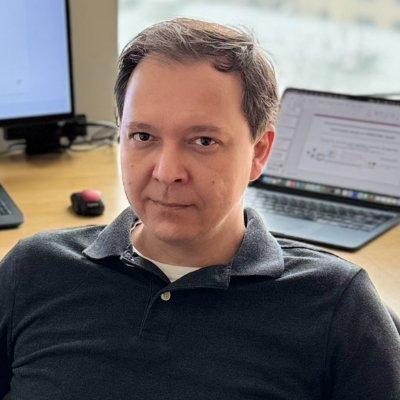
Russ Salakhutdinov
On Kimi K3: “A World With More Open-Source Models Is a Better World”
On the evening of July 27, Moonshot AI officially released the full model weights of Kimi K3 on the global open-source platform Hugging Face, together with a detailed technical report.
Hugging Face CEO Clem Delangue said Kimi K3 accumulated more than 4,000 likes and topped the platform’s trending rankings within 30 minutes, marking the fastest growth of any model release on the platform to date.
Although Kimi K3 has attracted considerable attention overseas, it faces intense competition from other Chinese open models in terms of global usage.
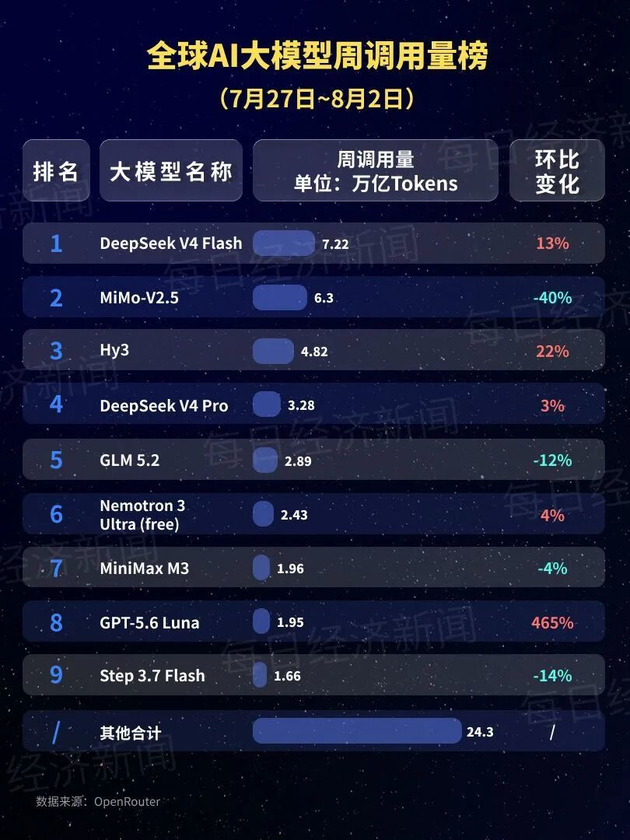
According to the latest OpenRouter data, Kimi K3 processed 1.42 trillion tokens during the week from July 27 to August 2, its first full week after the open-weight release. That represented a 16% increase from the previous week, but placed the model only 10th in OpenRouter’s weekly global model-usage rankings.
The five most-used models that week were all developed in China: DeepSeek-V4-Flash, Xiaomi’s MiMo-V2.5, Tencent’s Hy3, DeepSeek-V4-Pro and Zhipu AI’s GLM-5.2.
NBD: Compared with other leading frontier models, what do you see as Kimi K3’s most distinctive characteristics?
Russ Salakhutdinov: I have tried it, although not extensively. It is a good model.
What is unique about Kimi is that they open-sourced it—or, more precisely, provided open weights. Anybody can take the model, host it, tune it, fine-tune it, adapt it or use it to generate data. I think that is what is unique about Kimi.
Based on the tests people have done so far, users will still have to work with it and see how good it is relative to models developed by other teams.
But I think Kimi was one of the earlier open models to reach frontier-level performance. It came close to some of the top models, which is not easy to do.
At the same time, it is still early to say. Once these models are released, people will tune them and make them more intelligent.
I expect to see models coming from US laboratories, Chinese laboratories, India and Japan. All of them will continue to show more and more intelligence.
The remaining differences will increasingly come down to nuances such as how fast a model is, how intelligent it is and how cheaply it can be operated.
NBD: How do you view the current debate in the United States over open-source and closed-source AI?
Russ Salakhutdinov: I am actually very pro-open source. The open-source community has done a great deal for the development of AI.
A lot of the work we do at Carnegie Mellon is about studying these models, building on top of them and developing new algorithms and techniques. If you have access to open-source models, it really helps us build better and safer models.
In a world where everything is closed, you do not have access to the model. It becomes very difficult to study it, build on top of it or develop new technology.
At Carnegie Mellon, for example, we look at Google’s Gemma models, Meta’s Llama models and models from DeepSeek. Because these models are open, they help us conduct research.
I am very happy that we are starting to see more and more models being made available. Technically, open source and open weight are not exactly the same thing. But the important point is that the models are being made accessible so that researchers and developers can use them.
I think a world where there are more and more open-source models is a better world.
Some people are rightly concerned about safety, guardrails and the misuse of these models. Those concerns are real. We have to think about people using models to hack others, for example.
We will have to figure out how to put the right guardrails around these models so that people can use them safely. But hopefully, we will not end up in a world where everything is closed source.
NBD: When do you think artificial general intelligence, or AGI, will be achieved?
Russ Salakhutdinov: I tend to be a little more conservative.
I saw a similar situation with self-driving cars in 2015 and 2016, when people said we would have fully self-driving cars within two years.
The problem is that we can go from zero to 80% very quickly. We can go from 80% to 90% quickly as well. But going from 90% to 99% is very difficult.
With AGI, it sometimes feels as though we already have it, because people are using AI in so many areas. It definitely makes coding much more efficient. It makes writing more efficient, and it makes many tools and tasks more efficient.
But when people think about true AGI, I believe it goes beyond text and images. It also extends into robotics and AI operating in the physical world—in the real world.
In those areas, there is still a great deal of room for progress.
“Zhilin Was Probably One of the Strongest Students at Carnegie Mellon”
Yang was born in Shantou, Guangdong Province, in 1992.
In 2011, he was admitted to Tsinghua University’s Department of Thermal Engineering. He later transferred to the Department of Computer Science and Technology and graduated at the top of his class in 2015.
Yang then moved to the United States to pursue a PhD at Carnegie Mellon University, where he was jointly advised by Salakhutdinov, who later became Apple’s first director of AI research, and William Cohen, then a distinguished scientist at Google.
A computer science doctorate at Carnegie Mellon commonly takes around six years to complete. Yang finished his in four.
During his doctoral studies, he interned at Google Brain and Meta and was a core contributor to two influential research projects, Transformer-XL and XLNet.
NBD: How did Yang’s academic research during his PhD lay the foundation for the creation of Moonshot AI and Kimi?
Russ Salakhutdinov: When Zhilin was at Carnegie Mellon, he was always passionate about language.
A lot of the research he was doing focused on language—understanding language, making predictions and conducting sentiment analysis. Much of his work was driven by language.
As we know, the early large language models came from scaling up Transformer architectures. That was exactly what he was working on during his PhD.
His joint work with Google on XLNet and Transformer-XL involved models designed for pretraining on large-scale language data.
The ability to scale up and pretrain these models is a difficult engineering effort, and Zhilin was always interested in that space.
Some students are more interested in deep mathematical understanding. Some are interested in robotics, computer vision or other areas. But he was always interested in Transformers and language.
When ChatGPT emerged, I think he could see that this was something he understood deeply and that he could build as well.
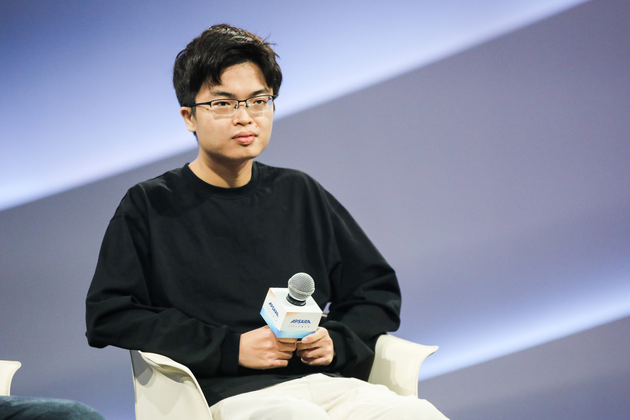
Yang Zhilin Photo/VCG
NBD: What was your strongest impression of Yang when he was a PhD student?
Russ Salakhutdinov: Students usually enter the program with a master’s degree or some work experience.
But when Zhilin joined, he was pretty young. He had just come out of Tsinghua as an undergraduate. He also finished his PhD in only four years, which is quite unusual for a PhD student.
Zhilin was probably one of the strongest students at Carnegie Mellon.
After a couple of years, by his third year, he had become very independent and autonomous. He would come up with his own ideas, develop his own research direction and think about the problems he wanted to solve.
What is also remarkable is that his two most-cited papers now have more than 20,000 citations each. They are Transformer-XL and XLNet.
It is very unusual for a PhD student to produce papers with that many citations.
The work he did at Carnegie Mellon was fundamental. It was not just one paper; it was a series of papers. That speaks to both his technical ability and his capacity to carry out foundational research.
NBD: You studied under Geoffrey Hinton, and Yang later studied under you. Do you see any continuity in research philosophy across these three academic generations?
Russ Salakhutdinov: I think so.
When I was a student of Geoffrey Hinton, Geoff was always passionate about neural networks and deep learning—even at a time when they did not work particularly well. I think he instilled that knowledge and commitment in all of his students.
Although Hinton never specifically focused on language, he was always working on neural networks and trying to understand how to make them work.
I inherited some of that. Throughout my career, I have also worked on deep learning and deep neural networks across different areas. Hopefully, some of that transitioned to Zhilin as well and contributed to his research abilities.
So yes, I think there is a continuity.
Obviously, each student chooses what they want to work on based on what they are passionate about. I have students who are deeply interested in robotics and others who are passionate about multimodal learning.
The important thing is to help a student find the right area—the field they are truly passionate about.
Zhilin was passionate about language and about all the architectural nuances involved in language models.
Yang Turned Down Apple: “If I Don’t Even Try, I Will Regret It”
Yang’s entrepreneurial journey began in 2016, when he co-founded Recurrent.AI, an enterprise AI company, with several partners.
In 2020, the company raised $12 million in a funding round led by Sequoia China. It later worked with Huawei Cloud on the development of the Pangu large language model.
In 2023, Yang embarked on his second startup journey, establishing Moonshot AI with Zhou Xinyu and other co-founders.
NBD: Most PhD graduates with top-tier research credentials would either pursue academic careers or join major technology companies. What was Yang thinking at the time?
Russ Salakhutdinov: What was interesting about Zhilin was that, when he was graduating, he never went on the job market.
A lot of students conduct a job search and try to find a position. Zhilin did not do that. He had already started a company with several co-founders, Recurrent.AI, and he really wanted to go back to China and continue building the company.
When he was graduating, he basically said, “I want to go and build a company.”
He told me at one point, “If I don’t even try, I will regret it.”
I was a little surprised, to be honest. People with his caliber of research usually go on to conduct postdoctoral studies at top schools and then become professors.
Some of my former students are professors at Princeton and MIT. Those are top institutions, and usually someone with Zhilin’s research record would take that route.
But he wanted to go and build his startup.
NBD: Did Apple also express an interest in hiring Yang?
Russ Salakhutdinov: When he published the XLNet paper, which was jointly developed with Google, the work established new benchmarks. It was significantly better than what had been available before.
When the paper came out, I was at Apple. A senior executive reached out to me and said, “Congratulations on the results of the XLNet paper.”
The executive then asked whether Zhilin would consider joining Apple.
I explained that he wanted to build a startup and was planning to return to China. The executive said Apple also had offices in Beijing and that, if Zhilin was interested, the company could explore that possibility.
The point is that, had he wanted to pursue the opportunity, it would not have been a problem.
But he did not even try going on the job market.
NBD: Did you try to persuade him to reconsider?
Russ Salakhutdinov: Yes. I was very surprised, and I asked him whether he was sure.
Building a startup is very different from conducting research, and it is very risky. But he wanted to try.
He told me, “I’ll try it. If it doesn’t work, I’ll go and become a professor.”
He later returned to China and worked on Recurrent.AI. He also spent some time as an assistant professor at Tsinghua University, which again speaks to his abilities and leadership.
Becoming a professor at Tsinghua is not easy. It is one of the top universities, and you have to be very strong academically.
NBD: Had Yang remained in the United States and joined Apple, Google, Meta or another major technology company, do you think he could have become a senior executive?
Russ Salakhutdinov: Absolutely.
With his technical skills, I am sure that, had he joined a top technology company in either the United States or China, he would have become a very strong senior leader.
What is unique about him is that he has the ability to conduct research and think deeply about problems, but he is also good at low-level coding.
He is technically strong in coding and mathematics, while also being able to think about bigger ideas. I am sure he would have been very successful wherever he decided to go.
At the time, I was trying to encourage him to remain in academia and become a professor. I was probably biased because this was before ChatGPT, around 2019.
AI was beginning to show some signs of where it might go, but it was nowhere near where we are today.
“He Is One of the Very Few Founders Who Combines Strong Technical Ability With Entrepreneurship”
Moonshot AI recently completed a Series F funding round that raised its valuation to $35 billion, seven times the $4.3 billion valuation it received in December last year.
NBD: From a PhD student to the founder of a high-profile AI company, what has surprised you most about Yang’s journey?
Russ Salakhutdinov: What surprised me the most was his business ability and his entrepreneurial skills.
When he was at CMU, he was very technical and highly focused on research. It is a very technical environment, so it was difficult at the time to see the full extent of his business and entrepreneurial abilities.
A lot of students are extremely talented technically, but they do not necessarily think about business or entrepreneurship. Building a company requires a very different set of skills.
I co-founded a company that I am running right now, and I do not know whether I will succeed. I might not succeed, because it is a very different skill.
Zhilin is one of the very few founders who is a good entrepreneur but, more importantly, is also a very strong technical person.
I think the people in his company will respect him greatly because he is not just a businessperson.
He can talk about GPU optimization with technical staff. The last time I had an in-depth conversation with him, perhaps a year and a half or two years ago, we talked about long context and several other research ideas.
He remains very technical. I can speak with him directly about research ideas and different architectural choices.
I saw the advantages of this kind of technically grounded management quite extensively at Apple. When you spoke with senior vice presidents or directors, they were technical. They had engineering degrees and understood the underlying technology.
To run a company, you obviously have to be a good businessperson. That is very important. But Zhilin is also a very good technical person, and that is what makes him unique.
NBD: Do you currently have other Chinese students? Do you think any of them could become entrepreneurs like Yang?
Russ Salakhutdinov: Everyone is different.
A number of students who have gone through my laboratory have started companies. One of my former master’s students was Jimmy Ba, who later became one of the co-founders of xAI. Another brilliant student started a robotics company.
At the same time, many outstanding students pursue academic careers and become professors at institutions such as MIT, Princeton and Duke. Another former student of mine, Ruosong Wang, is now an assistant professor at Peking University.
It is a diverse group of students, and they make different career choices.
What is unique about Zhilin, I think, is his entrepreneurial and business ability. That is a special capability.
Carnegie Mellon is one of the best universities in the world, and we attract top students from many countries. We have students like Zhilin, as well as exceptional students from Peking University, Tsinghua University and Tsinghua’s Yao Class.
They are truly top talents. But their backgrounds, interests and career decisions are diverse, and each of them ultimately follows a different path.
Editor’s note: The interview has been reordered and lightly edited for clarity and written presentation, without altering the substance of the responses.


 川公网安备 51019002001991号