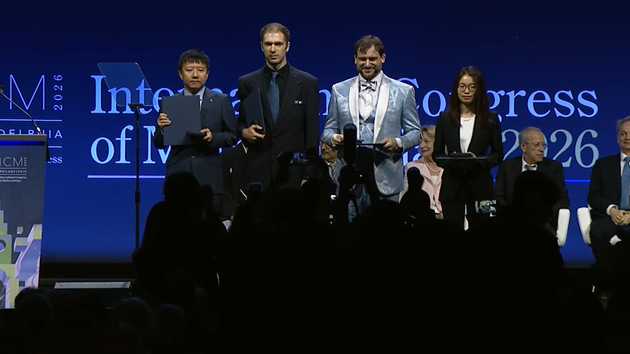
At 9:00 PM Beijing Time on July 23, the Chinese mathematics community reached a historic milestone.
At the 2026 International Congress of Mathematicians (ICM) openning ceremony, Deng Yu, an alumnus of Peking University’s School of Mathematical Sciences (Class of 2007), was awarded the Fields Medal—often referred to as the "Nobel Prize of Mathematics." This marks the first time a mathematician of Chinese nationality has won this premier international honor.
Hiraku Nakajima, President of the International Mathematical Union (IMU), stated that Deng was awarded the 2026 Fields Medal in recognition of his contributions to the field of partial differential equations.
The 37-year-old Deng is currently a professor at the University of Chicago. From a Go-playing youth who nearly turned professional to an International Mathematical Olympiad (IMO) gold medalist, and from Peking University, MIT, and Princeton to achieving a century-long breakthrough on the "Hilbert's Sixth Problem in the Narrow Sense," his life path is both representative and unique.
What does winning the Fields Medal mean to him? Looking back at his journey, how does he view his choices? What problem did his heavy 200-page paper published in 2025 actually solve?
Recently, Deng Yu accepted an exclusive interview with National Business Daily (NBD) to share his insights on academic breakthroughs, artificial intelligence (AI), the philosophy of Go, and his personal life.
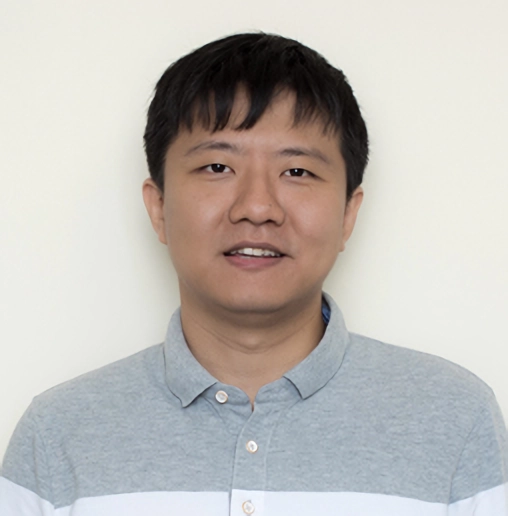
Deng Yu Photo/ Provided by the interviewee)
"The Award Recognizes Our Field; It Allows Us to Pursue Research Questions with Greater Freedom in the Future"
In 2025, Deng Yu and his collaborators used pioneering methods to achieve a landmark breakthrough in a core branch of "Hilbert's Sixth Problem in the Narrow Sense"—one of the 23 problems proposed by David Hilbert in 1900. Spanning 200 pages, the paper constructed a solid mathematical bridge between the microscopic particle world and the macroscopic fluid world.
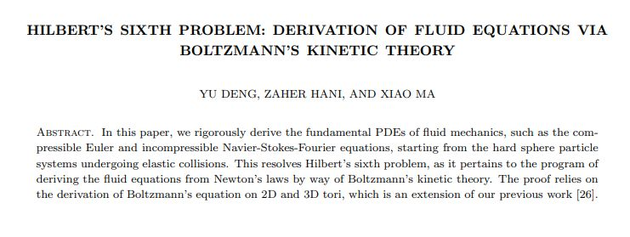
Title and abstract of the paper posted on arXiv by Deng Yu, Hani, and Ma Xiao
NBD: What does winning the Fields Medal, the highest honor in international mathematics, mean for your future academic career?
Deng Yu: The award is an important recognition for me, my collaborators, and our field of research. Furthermore, being able to choose research problems more freely without worries in the future is also wonderful.
NBD: You and your collaborators achieved a century-crossing breakthrough on "Hilbert's Sixth Problem in the Narrow Sense" and authored a 200-page landmark paper. What scientific puzzle did this research actually solve?
Deng Yu: We know that macroscopic fluids are composed of microscopic particles such as molecules and atoms, and the motion and interactions of these microscopic particles follow Newton's laws.
How to rigorously derive the dynamical equations of fluids mathematically starting from these microscopic laws? Since the era of James Clerk Maxwell and Ludwig Boltzmann, this has been a question of continuous interest to mathematicians and physicists.
My collaborators and I mainly answered this question under certain assumptions (an ideal gas and the Boltzmann-Grad limit) and (under the same assumptions) completed the logical chain: Newtonian mechanics → Boltzmann equation → fluid equations.
NBD: Today, with AI and supercomputers so advanced, is research in partial differential equations and statistical physics being transformed by technology?
Deng Yu: For now, AI does not play as large a role in partial differential equations (PDEs) and statistical physics as it does in certain other disciplines, such as combinatorics and algebraic geometry. Of course, AI is developing very fast.
As for computer-assisted proofs, significant progress has been made in recent years, solving several major problems. In short, the application of AI and computers is the future direction, but "intuition, scratch paper, and blackboards" remain indispensable today.
"The Global Breakthrough of Chinese Mathematicians Is the Result of Decades of Accumulation"
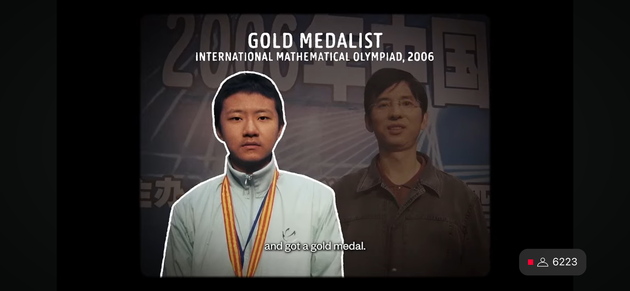
Photo/ Screenshot from the live broadcast of the award ceremony
Born and raised in Shenzhen, Deng Yu demonstrated extraordinary talent from an early age. In his first year of junior high school, he came close to embarking on a professional Go career, "just one step away from promotion." At age 17, he won a gold medal at the International Mathematical Olympiad (IMO) and was admitted to Peking University without taking the entrance exam. Two years later, he transferred to MIT and later earned his Ph.D. at Princeton.
Prior to winning the Fields Medal, he had already received prestigious honors including the Sloan Research Fellowship and the Gold Award of the ICCM Mathematics Award at the International Congress of Chinese Mathematicians.
NBD: Along the way, your academic path has been exceptionally brilliant. Was there a specific moment when you decided to dedicate your life to mathematics?
Deng Yu: It is hard to pinpoint a specific moment of decision. It was roughly after the IMO, when I felt that this might indeed be the field most suitable for me.
NBD: In recent years, a large group of top young Chinese mathematicians, like you and Professor Hong Wang, have broken through on the international stage. How do you view this phenomenon?
Deng Yu: It is likely the result of long-term accumulation. After all, Chinese mathematicians have done a vast amount of excellent work over the past years, so someone breaking into the spotlight one day is within expectations.
"The Most Important Thing Is to Enjoy Mathematics and Do What You Love"

Photo/Screenshot from the live broadcast of the award ceremony
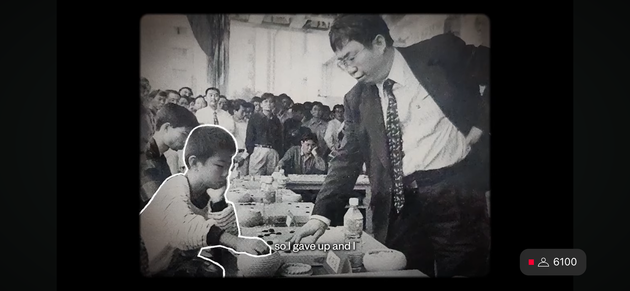
Beyond mathematical research, Deng Yu has a wide range of interests. On his personal website, he specifically notes his passion for Go, science fiction, anime, and football. In his view, these seemingly unrelated hobbies do not conflict.
NBD: You also have deep experience in Go. Is there a commonality between the "big picture vision" in Go and mathematical thinking?
Deng Yu: It is very interesting. Go requires carefully observing the current situation, finding the correct point of breakthrough, and formulating corresponding strategies. This shares logical commonalities not only with mathematics, but also with scientific research in a general sense.
Of course, Go is a two-player competition and usually has time limits—these differences are also very obvious.
Photo/Screenshot from the live broadcast of the award ceremony
NBD: You once mentioned that if you weren't doing mathematics, you might write science fiction?
Deng Yu: Yes, though it's mostly vague ideas that haven't formed into concrete worldviews or settings yet. Still, occasionally thinking about these kinds of ideas is quite fun.
Favorite science fiction works: For hard sci-fi, the *Orthogonal* trilogy; for soft sci-fi, *Otherside Picnic*.
NBD: Under intense research pressure, how do you balance these interests?
Deng Yu: Actually, it is very hard to balance. After all, I rarely have time to watch anime or read manga recently. The imagination of science fiction and the rigorous logic of mathematics can be said to have a complementary relationship, because mathematics itself requires imagination.
NBD: You mentioned you also like football. Did you watch the World Cup this year?
Deng Yu: I was very glad to see the two teams I support (Spain and Argentina) meet in the final. One match left a particularly deep impression: when Argentina was trailing 0:2 against Egypt, I left to eat dinner. When I came back and saw the score (Argentina's 3:2 comeback win over Egypt), I was completely shocked.
NBD: Finally, what advice do you have for young people currently studying mathematics?
Deng Yu: The next few years will be a period full of opportunities, and there may also be situations that cause anxiety or confusion. But overall, the most important thing is to enjoy mathematics and do what you love.
*This English version is a translation of the original Chinese interview. In the event of any discrepancy, the Chinese version shall prevail.


 川公网安备 51019002001991号