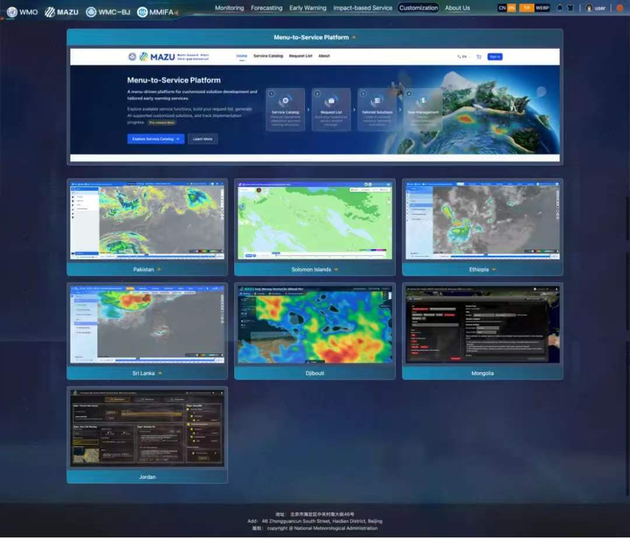
On July 17, at the opening ceremony of the 2026 World Artificial Intelligence Conference (WAIC), Chinese President Xi Jinping announced that over the next five years, China will promote the global deployment of "MAZU," a smart meteorological early warning solution, across 30 countries.
Behind this announcement lies a technology-driven race against time that involves the lives and safety of millions.
Since entering the flood season this year, China's major rivers have experienced 25 numbered floods, with 609 rivers exceeding warning thresholds. Single-day rainfall in Shenyang, Liaoning Province, broke 200 mm, as Northern China enters the most critical period of its main flood season.
Extreme weather knows no borders. In North America, record-breaking temperatures in British Columbia, Canada, sparked wildfires that forced thousands to evacuate. In Europe, southern France and multiple regions in Spain endured severe heatwaves with temperatures soaring past 40°C. From torrential rains and extreme heat to wildfires and droughts, weather warnings have never been more critical to the global public—those who see the storm first lose the least.
Yet, the reality remains stark: many developing nations, such as Pakistan, Djibouti, and Ethiopia, have yet to establish a complete meteorological observation network. Delayed warnings and a lack of actionable guidance continue to magnify preventable casualties and losses.
To address this, China is sharing its self-developed AI foundation models, Fengyun satellite data, and decades of disaster prevention and mitigation experience with the world. This is not merely an export of technology, but a practical response to the global climate crisis—filling the "vacuum zones" of global early warning systems through shared technology.
How will "MAZU" cross oceans? Where does the confidence in China's meteorological AI originate, and how did it enter the top tier globally? Between humans and machines, who serves as the ultimate arbiter of weather forecasting? On July 20, a reporter from National Business Daily (NBD) visited the China Meteorological Administration (CMA) for an exclusive interview with Su Fei, Senior Meteorological Engineer at the CMA.
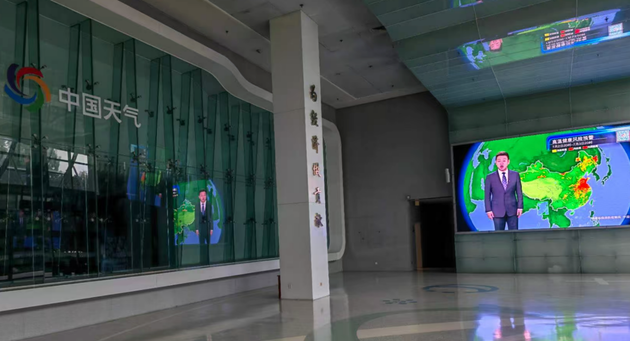
Inside CMA Photo/Wen Muxia
Why "MAZU" is Going Global: Sharing AI Trained on Complex Terrain with Data-Scarce Nations
NBD: At this year's WAIC, China's smart meteorological early warning solution "MAZU" drew widespread attention. Compared to international meteorological AI models, what are the unique advantages of China's large models?
Su Fei: Our advantages are reflected in three main areas.
First, Institutional Advantages and Top-Level Planning: Meteorology is a macro-scale field, and strategic top-level planning has been deployed at the national level. Based on forecasting timeframes, we developed a series of dedicated AI foundation models, including "Fenglei," "Fengqing," and "Fengshun."
"Fenglei" focuses on nowcasting (0–3 hours), relying on radar and satellite retrieval data to track short-term severe convection.
"Fengqing" covers short-to-medium range forecasts (24 hours, 48 hours, and 3–7 days).
"Fengshun" handles medium-to-long-range climate predictions (10-day and monthly scales). Each model serves a distinct, clear role.
Second, Self-Reliance and Controllability: Our training datasets are built on observational sequences accumulated independently in China, featuring a continuous 70-year dataset dating back to 1951. Moreover, China's vast geography encompasses diverse underlying surfaces—plateaus, basins, coastal areas, and deserts—yielding extremely rich meteorological phenomena. The core technologies are fully developed in-house, eliminating the risk of critical technical bottlenecks.
Third, High Integration and Scalability: We integrated nowcasting, short-to-medium-range, and long-range forecasting, along with service modules, into the "MAZU" framework. While many countries can only build single-scale models—focused strictly on short-term or medium-term forecasts—"MAZU" offers an all-in-one platform. Furthermore, it boasts high adaptability across sectors, seamlessly integrating into energy, transportation, finance, and agriculture.
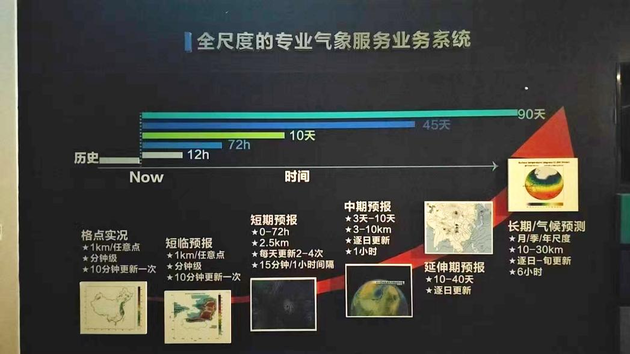
Display items in the CMA exhibition hall Photo/Wen Muxia
NBD: China's meteorological model sounds like a well-rounded "all-rounder." Why do many foreign entities lean toward niche, domain-specific models instead?
Su Fei: The fundamental reason lies in differences in foundational data. Scientific research and observational capabilities vary widely from country to country. China and Europe possess dense ground observation networks, extensive radar arrays, and comprehensive satellite coverage, creating a complete data chain. However, many developing countries stumble at step one—sparse weather stations, a lack of radar coverage, and no satellite data access. Without sufficient "data input," how can you train a model?
This is precisely where "MAZU" adds value. It utilizes data from Fengyun meteorological satellites to derive localized observational products, which are then fine-tuned using a small amount of local ground data. This effectively "transfers" the predictive capabilities of China's models to the host nation. Even if it doesn't immediately achieve a 90% accuracy rate, providing a reliable 60%+ forecast is already a monumental leap forward.
NBD: Why is "MAZU" primarily targeted at developing nations?
Su Fei: Nations in the "Global South" are the most vulnerable to meteorological disasters and have the weakest early warning capabilities. The United Nations has called for "Early Warnings for All," and meteorology serves as the first line of defense in disaster mitigation. Our primary goal in expanding abroad is to help these nations establish early warning capabilities, fulfilling our responsibility as a major country.
Although the European Centre for Medium-Range Weather Forecasts (ECMWF) remains a global leader in numerical weather prediction, China's meteorological AI models have previously ranked first in international evaluations, placing us firmly in the top tier globally. This gives us strong confidence in going global. Combined with our vast territory, complex terrain, and diverse disasters, these extreme conditions force the creation of high-quality training data. Supported by sustained investment, China's meteorological AI foundation is rock solid.
NBD: Have you encountered challenges with regional adaptation during this global rollout—such as major discrepancies between local climates and your training data?
Su Fei: Absolutely. However, our strategy is not simply to "hand over a pre-trained model and call it a day." Instead, we conduct additional rounds of training and optimization using local meteorological data. "MAZU" doesn't necessarily reach peak performance the moment it lands; it undergoes a process of continuous iteration—filling initial gaps first, then refining accuracy as local data feeds in.
Feedback from Pakistan has been very positive, as it helped fill many previous blind spots in early warnings. We also recently delivered version 2.0 to Djibouti. Overall, most deployments are newly initiated or in a transitional calibration phase, which naturally takes time.
From "8-Hour Computations" to "Real-Time Mapping": AI Replaces the Heart of Weather Forecasting
NBD: Floods have arrived early and intensely this year, placing significant pressure on Northern China during the peak flood season. Against this backdrop, what tangible improvements has AI brought to weather forecasting?
Su Fei: Traditional weather forecasting relies on physical modeling—using supercomputers to solve atmospheric motion equations to simulate the state of the atmosphere. Running global datasets through this process often takes hours. By the time calculations are complete, the weather situation may have already shifted.
With AI integration, operational efficiency has drastically improved. By mining historical data, AI can generate a weather forecast in minutes. That is the first major breakthrough: timeliness.
The second enhancement is accuracy complementary to human experts. AI acts as a vital tool for forecasters rather than replacing them, taking over repetitive tasks so forecasters can focus on analyzing complex atmospheric conditions and formulating service strategies.
The third aspect is cost reduction. Establishing a supercomputing center previously required astronomical investments. Now, combining AI models with GPU computing power drastically lowers forecasting costs, enabling us to offer a wider variety of products and broader coverage.
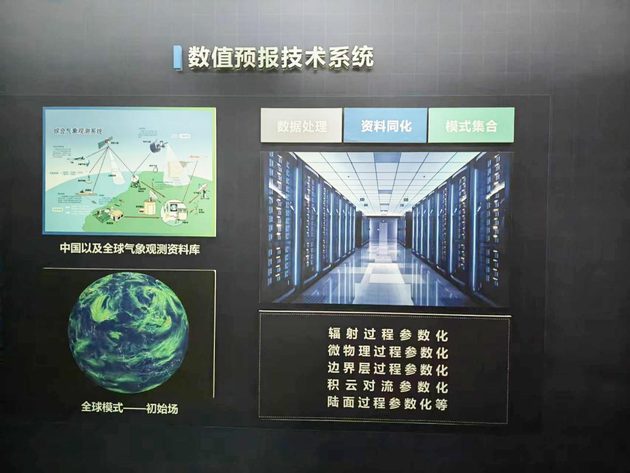
Display items in the CMA exhibition hall Photo/Wen Muxia
NBD: AI appears to outperform traditional numerical prediction in many areas. Why do we still need physical models?
Su Fei: Because AI has inherent limitations; we cannot rely on it alone. Between 2024 and 2025, the China Meteorological Administration evaluated mainstream domestic AI models and identified two notable shortcomings:
1. Underestimating Extreme Weather: AI models consistently tend to underestimate the intensity of extreme weather events.
2. Blurry Small-to-Medium Scale Details: For instance, in localized severe convective events, AI-generated imagery often lacks clarity regarding internal structure, movement paths, and development cycles.
Therefore, I believe the future lies in hybrid models—combining physical numerical predictions with AI. Physical models ensure compliance with atmospheric laws and maintain interpretability, while AI models enhance speed and computational efficiency. Their synergy is key to pushing forecast accuracy higher.
NBD: Missed warnings and false alarms are major risks in meteorology. Does AI increase these risks?
Su Fei: It can, which is why the industry places great emphasis on mitigating AI "hallucinations." We have established robust correction mechanisms. First, AI outputs are never released directly to the public; they must be cross-referenced and corrected against numerical prediction results based on physical equations. Second, final conclusions must be reviewed and approved by senior forecasters.
Weather is unique. While seasons follow a repeating cycle, every year brings new variables. Experienced forecasters carry decades of accumulated empirical knowledge in their heads that AI cannot currently replace.
Numerical prediction is inherently subject to the butterfly effect—tiny initial perturbations can lead to massive deviations, and AI is equally incapable of 100% accuracy. That is why experienced chief experts are indispensable for final analysis and adjustments; this human-machine collaboration is vital.
From "Tracking Typhoons" to "Evacuating 48 Hours Ahead": Technology Buying Time to Save Lives
NBD: How much loss has been mitigated since introducing AI models?
Su Fei: To explain why it works, the most crucial change is the update frequency. Traditional numerical forecasts might update every eight hours, whereas AI-assisted systems can update as fast as every ten minutes. Higher frequency means capturing smaller-scale, rapidly evolving weather systems—such as sudden tornado formations or rapidly intensifying convective clouds—that were previously easy to miss.
NBD: So "MAZU" is more than just a forecasting tool; it is a full-lifecycle warning system?
Su Fei: Correct. It is fundamentally an end-to-end early warning network spanning five essential steps:
Monitoring via Fengyun satellites,
Computing via AI models,
Evaluation by forecasters,
Issuance of warning messages, and
Grassroots response ("call and response" mechanisms).
Our meteorological duties are clear: first, providing weather forecasts and disaster mitigation services for the public; second, supporting major events. Large models currently support daily operations as well as high-stakes events like the National College Entrance Examination (Gaokao), municipal games, and major national milestones.
NBD: Looking ahead, what will the ultimate form of meteorological AI look like?
Su Fei: A hybrid architecture combining physical models and AI will be the primary direction for the next decade. The two are complementary: physical models ensure forecasts conform to fundamental atmospheric principles and remain interpretable, while AI accelerates processing and uncovers complex nonlinear features in historical data that humans cannot easily identify.
Our ultimate goal is a comprehensive, general-purpose meteorological foundation model—a single model covering nowcasting, short-to-medium range, and long-range forecasting, capable of generating tailored versions for energy, transportation, agriculture, and other industries. "MAZU" is moving in this direction, though universal foundation models require continued technological breakthroughs.
NBD: Some view meteorology as a traditional industry. Will AI disrupt it entirely?
Su Fei: It won't disrupt it; it will reshape it. Today, we employ ensemble forecasting methods—comparing outputs from the Meteorological Administration's own models alongside Fudan University's "Fuxi" and Huawei's "Pangu." We rely on whichever model demonstrates stability, using bolder predictions as reference points for cross-correction. This level of integration was unimaginable in the past due to high computing costs, data silos, and incompatible systems.
As AI lowers technical barriers, the entire industry landscape is shifting: more entities can participate, more vertical scenarios can be addressed, and more developing countries can cross the threshold into effective disaster early warning. Technology itself may be neutral, but when it allows a remote village to receive a flash flood warning two hours earlier, or helps a cargo ship navigate away from a forming typhoon eye—in those moments, technology shows its human value.
This aligns with President Xi Jinping's statement at WAIC about "safeguarding millions of homes and protecting peace across the seas." Behind these figures—30 target countries, 5,000 training opportunities, and a series of international AI application cooperation centers—lies a collective effort by Chinese meteorologists to bridge the global early warning divide using technology built over decades. Storms will not wait, but technology empowers us to save more lives when they strike.
(National Business Daily reporter Wen Muhua also contributed to this report.)


 川公网安备 51019002001991号