"When I walked around the floor earlier, my immediate impression was that this year’s exhibits are richer, and the application of AI in products has progressed even further compared to last year." On November 6, at Hall 3 of the 9th China International Import Expo (CIIE), Xu Honglai, President of Lattice Semiconductor Asia-Pacific, shared his observations with NBD (National Business Daily).
Behind this intuitive impression lies a microcosm of the shifting semiconductor landscape driven by AI compute demand. As data center buildouts and AI accelerate globally, market analysts at AskCI Consulting project that the global FPGA (Field-Programmable Gate Array) market will reach $14.05 billion by 2026 and approach $19.22 billion by 2030.
As the world's third-largest FPGA supplier, Lattice has charted a distinct course. Rather than engaging in direct head-to-head competition with industry giants like AMD in the mid-to-high-end tier, Lattice focuses on low-power, small-form-factor FPGAs. The company continues to expand its reach across Edge AI, industrial vision, automotive electronics, and data centers. Financial reports show that in Q3 of this year, Lattice's FPGA revenue grew by approximately 90% year-over-year, with data center AI demand acting as a primary driver.
However, faced with the surging demand brought by AI data centers, Lattice is no longer content to remain merely a vendor of low-power FPGA silicon. The company is actively penetrating the server control and security chip arena, seeking a second growth curve and broadening its competitive envelope in the AI era.
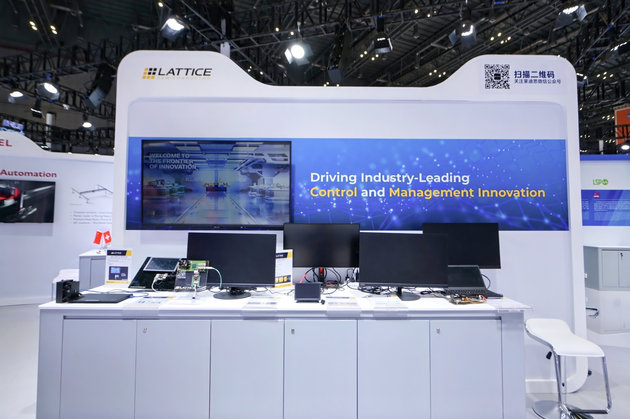
At this year's CIIE, Lattice put three core product lines center stage: vision sensing, data center platform management, and AI-assisted design. Earlier in September, Lattice officially launched its AI-driven FPGA development tool, Lattice Prompt, alongside security control products tailored for the post-quantum cryptography era.

Xu Honglai Photo/Provided to NBD
In a market structure characterized by high global concentration and duopoly dominance—paired with rapid catch-up efforts by Chinese domestic FPGA vendors—how far can Lattice's differentiation strategy take it? As competition expands beyond raw chip performance, can Lattice leverage AI to unlock new growth vectors? Will the established market structure dominated by industry titans be disrupted?
Cloud Business Serves as the Primary Engine; Can AI Tools Break Through the FPGA Development Ceiling?
NBD: The AI-driven FPGA development tool, Lattice Prompt, was launched in September. Does it impose high computational requirements? If the cost of large language models (LLMs) rises, will it impact your gross margins?
Xu Honglai: The core factor here is inference rather than training; the LLMs are pre-built, so customers do not need to train models themselves. Our AI tool connects with various LLMs rather than locking customers into a single provider. Customers are free to select models that best match their cost targets, so I do not expect costs to be particularly high.
Furthermore, I don't foresee a material impact on our gross margin. This tool boosts development efficiency for our customers, helping them bring products to market faster. The value it delivers far outweighs the cost of model utilization.
NBD: The memory market continues to face tight supply and rising prices. Will this affect your future cost structures?
Xu Honglai: A small portion of our portfolio is co-packaged with memory devices, which may experience some impact, but the volume is limited.
The more pronounced effect is on our customers' system-level Bill of Materials (BOM). For example, data center clients must procure CPUs, HBM, and DDR memory simultaneously. If any single component is constrained, the procurement and deployment timeline for the entire system gets pushed back.
We have also seen smartphone and industrial customers run into DDR supply constraints. A customer whose original design uses DDR3 or DDR4 might now only be able to source DDR5—or vice versa. We adapt our controllers and relevant IP blocks based on the components our customers can acquire, helping them complete system adaptation. While we cannot control DDR manufacturing capacity, we prioritize interface compatibility in new product development to offer customers greater supply chain flexibility.
NBD: As AI accelerates toward the edge, what new opportunities is Lattice seeing for its FPGAs?
Xu Honglai: AI applications broadly split into cloud and edge domains. Over recent years, a significant portion of our growth has come from the cloud. Domestic cloud service providers, server manufacturers, and ODMs widely deploy our FPGAs along control pathways. This includes power sequencing, thermal management across CPUs, GPUs, and add-in cards, as well as leak detection in liquid cooling systems.
On the edge, I prefer to frame this within the realm of Physical AI. Take robotics as an example: a robot incorporates cameras and various sensors. We can deploy FPGAs to ingest these signals first, performing data aggregation and pre-processing before routing them to the GPU via Ethernet or PCIe. This offloads compute-heavy pre-processing from the GPU and stabilizes data transmission, enabling faster downstream decision-making. Several relevant projects have already achieved volume production, and we are actively collaborating with both domestic and international robotics clients. Beyond that, FPGAs can also handle direct AI processing, such as super-resolution demonstrations.
"The Chinese Market is Fast-Paced and Highly Competitive; Customers Evaluate Far More Than Chip Specs"
NBD: How do you view the growth trend of the Chinese market within your Asia-Pacific revenue? Will you increase investment in local R&D, local supply chains, and domestic ecosystem partnerships going forward?
Xu Honglai: China is a vital market for Lattice across the Asia-Pacific region and globally. Our growth in China reflects customer trust in our solutions as well as the rapid expansion of China's AI and smart hardware sectors. This growth relies on the comprehensive competitiveness of China's talent pool and business environment.
For long-term development, we focus on helping customer projects reach production and providing the necessary support. We aim to continue co-developing application solutions and conducting joint validation with Chinese customers and ecosystem partners.
NBD: Chinese domestic FPGA vendors have made rapid progress in recent years. In the face of localization pressures, how has Lattice adjusted its strategy in the Chinese market?
Xu Honglai: The progress of domestic FPGA companies highlights the innovation vitality of China's semiconductor ecosystem. Today, customers evaluate far more than basic chip specs—they also look at power consumption, real-time responsiveness, security features, development tools, and timely engineering support. We aim to integrate these capabilities and collaborate across different computing platforms, rather than defining our edge through broad notions of "technology generational gaps" or locking customers into a single processor ecosystem.
The Chinese market is fast-paced and intensely competitive. We consistently track the localized needs of Chinese customers. By bolstering local field application engineering (FAE) support, deepening ecosystem partnerships, and conducting joint validation, we ensure rapid responsiveness and deliver solutions tightly tailored to real-world deployment scenarios.
NBD: From your perspective, which sectors in China are displaying unique growth trajectories?
Xu Honglai: China offers a rich variety of application scenarios. We are closely monitoring automotive electronics, industrial automation and robotics, communications infrastructure, and AI data centers. However, each industry presents distinct challenges:
Automotive electronics prioritizes sensor and display connectivity.
Industrial systems demand deterministic motor control and sensor processing.
Communications platforms require secure connections and precise synchronization.
AI infrastructure centers on root-of-trust boot operations and platform management.
Photo/Provided to NBD
"Data Centers Drive Strong Growth, But I Am Paying Closer Attention to Physical AI as a Future Growth Point"
NBD: Other major vendors are also pushing into Edge AI. How do you view the evolving landscape and competition in the FPGA market?
Xu Honglai: The core advantages of FPGAs lie in their flexibility, programmability, rapid response times, and low latency. FPGAs allow customers to validate new ideas rapidly and transition straight to volume production.
Our fundamental edge remains low power consumption. Our choice of manufacturing processes and architectural designs revolves around this principle. At the same time, we align closely with market demand. Emerging fields like Physical AI, humanoid robotics, and smart factories demand lower latency, faster response times, and robust security controls—requirements that directly shape our future product designs and solution roadmaps.
The competition we face goes beyond traditional FPGA vendors to encompass alternative architectural routes. Moving forward, our strategy is twofold: continue strengthening our core low-power positioning while staying close to the market to anticipate current and future customer pain points. While data centers currently generate substantial revenue growth, I am personally paying closer attention to Physical AI as our next major growth vector.
NBD: How do you evaluate the growth prospects of FPGAs in physical AI applications like robotics? How can Lattice capture this opportunity?
Xu Honglai: I am personally very focused on Physical AI, and I am driving initiatives in this direction both internally and across our local teams. Humanoid robots require more than central decision-making ("brain" and "cerebellum"); they must also control joints and motors, which demands high precision, fast response times, and functional safety.
Take robotic joints as an example: they are typically sealed, compact systems without cooling fans. Motor control must achieve low power consumption while maintaining a minimal footprint. In the past, this was often handled by a combination of DSPs and MCUs. By consolidating these functions into an FPGA, we can shrink system volume while preserving performance and response speeds. Additionally, robots generate massive signal streams from cameras, sensors, and motors, which FPGAs are well-suited to aggregate.
Industrial smart factories represent another key vector. Future operations will evolve from executing fixed automated routines toward autonomous control. That said, the rollout of Physical AI will not mirror the rapid pace of cloud-based LLMs in data centers. It requires solving complex physical domain models and bridging the gap between simulation training and real-world environments. But as these capabilities mature, the addressable application scenarios will expand significantly.
NBD: Looking back at the evolution of China's semiconductor industry, which concepts do you view as overhyped, and which trends are poised for long-term breakthroughs?
Xu Honglai: What has struck me most is two trends: the deepening of domestic innovation and the increasingly specific nature of customer requirements. More local companies are demonstrating real FPGA products and solutions. Meanwhile, customers no longer evaluate chips in isolation—they ask how a component integrates into their broader systems, whether the software tooling and security stack are mature, and whether our engineering teams can provide timely field support. This indicates that the industry is placing much greater weight on converting technology into tangible, deployable applications.
Semiconductors constitute a vast market with immense growth potential. Over recent years, China's IC design sector has advanced rapidly, and progress has also been made in compound semiconductors, naturally attracting capital inflows. However, semiconductor manufacturing, equipment, and materials demand long-term dedication and technological accumulation. The industry ecosystem is still maturing. Long-term sustainable growth will depend on maintaining open collaboration and solidifying foundational engineering capabilities.


 川公网安备 51019002001991号