Late last year, six humanoid robots developed by Chinese robotics company Unitree Robotics took the stage at a concert in Chengdu, southwest China. Dancing alongside performers and executing backflips, drawing widespread attention and praise from Elon Musk, who called the performance impressive.
The performance sparked a broader debate about how embodied artificial intelligence (AI) could transform the entertainment industry. As robots move beyond factories and laboratories, companies are increasingly exploring ways to combine intellectual property (IP) with emerging technologies.
Among the leading players is Galaxy Corporation (Galaxy), a South Korean entertainment technology company whose roster includes K-pop superstar G-DRAGON. In December 2025, Galaxy achieved unicorn status with a valuation of approximately 1 trillion South Korean won and has been exploring plans for a public listing. Its large-scale robot theme park, described by the company as a global first, has also attracted considerable industry attention.
"The project involved an investment of approximately US$20 million. After nearly six months of operation, it has recorded around 33,000 paid visits," Choi Yong-ho, CEO and Chief Happiness Officer (CHO) of Galaxy Corporation told National Business Daily (NBD) in a recent exclusive interview, disclosing operating figures for the robot park. Choi also revealed that Galaxy plans to launch a robot girl group in January 2027 and is preparing to take its robot performances on an international tour.
As robots begin dancing to K-pop hits and staging their own concerts, could they move from supporting roles to center stage?
Choi expressed strong confidence in the capabilities of Chinese robotics manufacturers. Galaxy is already working with Chinese listed companies, including Shanghai-listed Unitree Robotics and Hong Kong-listed Star Plus Legend Holdings Limited to explore a business model combining Chinese-made hardware with South Korean software and entertainment content.
The company plans to stage a small-scale robot K-pop concert in China's Macao Special Administrative Region (Macao SAR) this December, Choi said.
But significant questions remain. Can a company built around human celebrities successfully develop robot entertainers without fragmenting its existing fan base? Can robot performances sustain paying audiences once the initial novelty fades? And given the substantial upfront investment required, can robot entertainment ultimately become a scalable, profitable business?
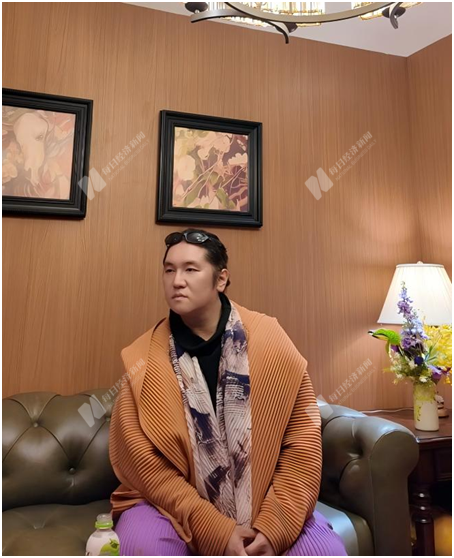
Choi Yong-ho, CEO and Chief Happiness Officer (CHO) of Galaxy (Photo by Song Xinyue)
When Celebrity IP Meets Embodied AI, Who Will Pay for AI Idols?
NBD: Galaxy represents major artists, including G-DRAGON. How do you see AI unlocking new commercial value from celebrity IP?
Choi Yong-ho: G-DRAGON himself has a strong interest in AI and physical AI technologies and has been closely following developments in robotics. He has also been appointed a visiting professor in the Department of Mechanical Engineering at the Korea Advanced Institute of Science and Technology (KAIST).
Let me give you a real-world example. G-DRAGON previously launched a canned highball beverage that sold 10 million cans in just three months. We produced an AI-powered advertisement for the product. Unlike a conventional commercial, G-DRAGON did not appear in the video himself. Instead, we used a pink astronaut character based on his own creative concept. The character embodies elements of his artistic identity and intellectual property. Using AI tools, including NVIDIA Omniverse, we brought the character to life in an advertising video to promote the product.
Traditionally, shooting commercials requires artists to spend considerable time on set. In the future, an artist may only need to authorize the use of their likeness for an AI-generated advertisement lasting 30 seconds or one minute. I believe we will see many more examples of this. Entertainment companies can also use AI to significantly improve the efficiency of content production.
NBD: AI can now compose music, generate videos and even create virtual performers. What do you think will be the biggest challenge in developing a successful idol in the future?
Choi Yong-ho: To me, an idol is still an idol. Whether it is a robot idol, a virtual idol or a human idol, what matters most is having a dedicated fan base. People who are interested in robots may become fans of robot idols. Those who prefer virtual idols will form their own fan communities, just as human idols have their own followers.
If we can bring these three forms together, we may be able to create an entirely new type of fandom. Ultimately, the biggest challenge will still be attracting fans and building and growing a loyal fan base.
NBD: Galaxy began exploring the metaverse and digital avatars of celebrities in 2022. It has since expanded into virtual idols and humanoid robots. What is your strategy for developing these businesses?
Choi Yong-ho: We plan to launch a robot girl group globally in January 2027. After that, we will introduce a virtual AI girl group, followed by a human girl group. The traditional entertainment industry usually starts with human idols, then develops robotic versions and eventually virtual characters. We want to take a different approach. Our strategy has three components: Robot, Virtual and Human. We aim to use AI to connect these three forms, allowing them to operate together as a unified group.
Chinese Hardware, Korean Entertainment: A Business Model Takes Shape
NBD: Galaxy is already working with robotics companies such as Unitree Robotics. How do you view the role of Chinese companies in this emerging industry?
Choi Yong-ho: China has highly advanced robotics hardware technologies, along with many outstanding technology companies and talented engineers. South Korea’s strengths lie in K-pop entertainment content and supporting software capabilities. Combining Chinese robotics hardware with Korean software technologies and K-pop content could create a wide range of new opportunities for collaboration.
We source our robotics hardware from China, develop the supporting software in South Korea and integrate K-pop content into the experience. By bringing these elements together, we hope to take our robot entertainment model to global markets. That is also a key reason behind our partnerships with Unitree Robotics and Star Plus Legend.
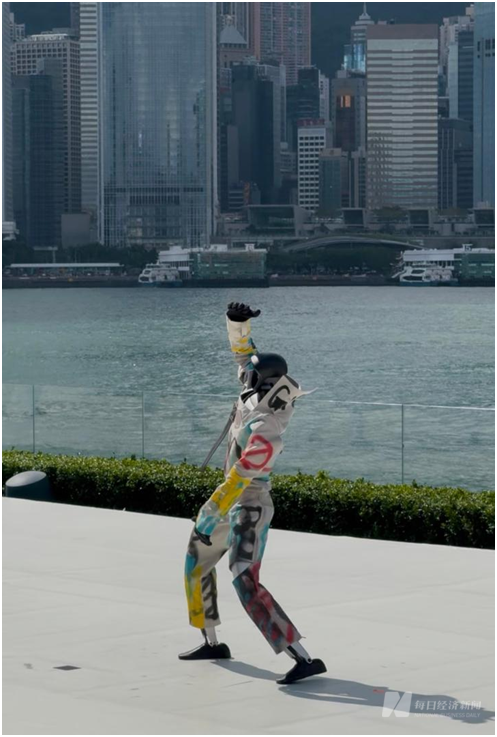
Unitree humanoid robots perform a K-pop dance. (Photo by Song Xinyue)
NBD: What progress has Galaxy made in its partnership with Star Plus Legend? And what is the latest status of the joint venture previously discussed by the two companies?
Choi Yong-ho: Star Plus Legend is a shareholder of Galaxy Corporation and one of our important partners. Discussions concerning the joint venture are still progressing. We hope this arrangement will help us establish and localize our business operations in the market. In robotics, we are combining Galaxy’s technology with Star Plus Legend’s robotic dog projects. We are also jointly preparing a robot fashion show. Our goal is to bring robotics hardware and entertainment content together and explore more commercial applications.
Beyond the Technology Showcase: Robot Parks, Concerts and Fashion Shows
NBD: Galaxy Robot Park in Seoul, described as the world’s first large-scale robot theme park, has attracted considerable attention. Could you share its investment size and visitor numbers so far?
Choi Yong-ho: Galaxy Robot Park covers approximately 16,500 square meters, with an investment of around US$20 million. The park has been operating for nearly six months and has received more than 50,000 visits, including approximately 33,000 paid visits.
Visitors can watch robot K-pop concerts and taekwondo performances, as well as operate robots themselves. The robots can also make pizza and ice cream, draw portraits and play the piano.
NBD: What are your plans for the next stage of development at Galaxy Robot Park?
Choi Yong-ho: Our core target audience is children aged three to ten. We want children to gradually build connections with robots through direct interaction, and perhaps even come to see them as friends.
We are continuously developing new robot entertainment programs. Starting December 25 this year, we plan to make our robot magic show a regular weekend attraction. We are also preparing to introduce a robot zoo around Christmas, featuring various animal-shaped robots. By next spring, we plan to expand our range of robot entertainment offerings and introduce more interactive experiences.
NBD: Are you considering expanding large-scale robot theme parks into more countries?
Choi Yong-ho: We are discussing different options with our partners. Replicating a large-scale facility like Galaxy Robot Park in South Korea requires considerable space. Finding suitable locations and completing construction can take a long time. That is why we are also exploring more flexible formats, such as robot concerts that can be staged regularly in different locations.
NBD: Which countries and regions are likely to host Galaxy’s robot entertainment events first?
Choi Yong-ho: We are particularly interested in bringing K-pop and Chinese pop music together, using robot performances to encourage exchanges between different musical cultures. We plan to hold a small-scale robot K-pop concert in China’s Macao Special Administrative Region this December, with further performances planned in cities such as Dubai and Tokyo. In addition, we are preparing a robot fashion show that combines visual AI with entertainment technology, which we plan to stage in China’s Hong Kong Special Administrative Region (HKSAR). Meanwhile, we are in the process of establishing a holding company called Galaxy Universe in the United States. We plan to accelerate our global expansion starting next year.
In the past, people often talked about the Korean Dream. But our ambition is to move beyond that, toward an Asian Dream and ultimately a Global Dream.


 川公网安备 51019002001991号