The World Economic Forum's Annual Meeting of the New Champions, also known as 'Summer Davos', runs 23–25 June 2026 in Dalian, China, under the theme 'Innovating at Scale'.
It convenes more than 1,700 leaders from business, government, science and the fast-growing companies driving the next phase of global growth, with a strong focus on Asia.
Artificial intelligence, sustainable growth and Asia's economic prospects emerged as defining themes at the meeting, where delegates debated not only the future of technology but also the forces reshaping the global economy.
The Convergence of Art and Science
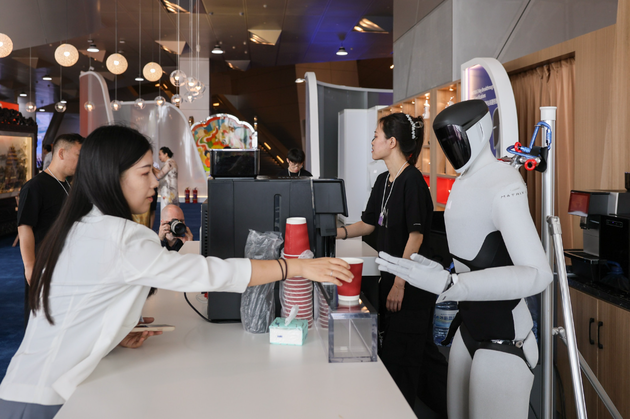
At the exhibition center, a large crowd gathered around an interactive installation titled "Do Nothing with AI." Combining a brain-computer interface (BCI) with embodied robotics, the piece translates a participant’s emotional state into a unique robotic dance.
Stacey Vanek Smith, a senior writer for Bloomberg Businessweek, told National Business Daily (NBD), "In a way, it shows human-like qualities, while remaining highly creative and uniquely charming."
Bernadette Hall from Science Gallery International explained the philosophy to NBD: "The creators wanted to design a technology explicitly for mindfulness. Once you put on the headset, the robot responds to your brainwaves in real-time. The calmer you become, the more the robot mirrors that peace by initiating a meditative dance. It senses which movements effectively slow down your brainwaves."
Hall noted that while the hardware resembles an industrial arm capable of construction or autonomous manufacturing, it was programmed here for meditation. "We work so intensely with almost no downtime. This technology uses advanced tools to help people discover a true state of rest by doing absolutely nothing. When people are lonely, they might be more susceptible to it. But then again, who is to say you won't fall in love with an AI? For that individual, it could be deeply meaningful."
Smith, an active user of ChatGPT, DeepSeek, and even a digital "lobster" pet, agreed that AI provides substantial day-to-day utility in her professional life.
Photo/World Economic Forum
Shifting Focus to Sustainability and Market Fundamentals
Beyond the interactive exhibits, global leaders engaged in deep macroeconomic dialogues, with AI, sustainable development, and global economic uncertainty emerging as the definitive keywords.
Pranjal Sharma, a veteran economic policy expert and author, told NBD his primary goal was to observe China’s latest technological milestones firsthand, particularly in AI.
"I am eager to engage with China's tech leaders," Sharma stated. "China has developed several world-leading AI models and is clearly at the forefront. Other nations can learn significantly from China’s development model."
Sharma also expressed high confidence in Asia's broader trajectory: "I firmly believe this will be the Asian Century. The development across the region is incredibly exciting."
Sustainable growth also commanded significant attention. Ben Simpfendorfer, Partner at Oliver Wyman and Chair of the Oliver Wyman Forum Asia-Pacific, told NBD his focus centered on urban innovation and balancing rapid growth with climate resilience.
"Cities are complex ecosystems; you cannot look at any single factor in isolation," Simpfendorfer remarked. "With the rising frequency of extreme weather events, building sustainable cities is a necessity. Furthermore, long-term urban prosperity depends entirely on talent, particularly in tech and innovation. A city's ability to precisely attract the right talent and cluster high-value enterprises is the absolute core of modern urban strategy."
Meanwhile, Smith directed her attention toward the underlying logic of current market investments, raising a pivotal question: Is the market being driven by economic fundamentals or by anxiety? "There is widespread optimism regarding the AI sector right now, but whether this boom is backed by solid fundamentals is a subject of intense debate in the United States," she pointed out.
Looking at the broader global economy, Smith concluded that the current era is defined by starkly opposing forces. "We are in a very contradictory phase. Geopolitical conflicts, volatile oil prices, and high inflation continue to drive up production and living costs globally. Yet, at the exact same time, frontier technologies like artificial intelligence are injecting powerful new momentum into the global economic recovery."


 川公网安备 51019002001991号