On July 23, 2026, the quadrennial International Congress of Mathematicians (ICM) will open in Philadelphia, USA. The full list of winners for the prestigious Fields Medal—often referred to as the "Nobel Prize of Mathematics"—will be officially unveiled at the ceremony.
Chinese mathematician Deng Yu, currently a full professor of mathematics at the University of Chicago, is not only an invited speaker at the congress but also widely considered a top contender for this year’s Fields Medal.
From winning an International Mathematical Olympiad (IMO) gold medal in 2006 to being admitted to Peking University in 2007, and later solving a core branch of Hilbert's Sixth Problem in 2025—a problem that had stumped the mathematical community for 125 years—the 37-year-old professor, who also enjoys Go, sci-fi, anime, and football, stands on the cusp of making history for Chinese mathematics.
On the eve of the congress, National Business Daily (NBD) conducted an exclusive interview with Deng Yu’s doctoral advisor, Alexandru Ionescu, Professor of Mathematics at Princeton University. Professor Ionescu is a member of the American Academy of Sciences and Letters, a Fellow of the American Mathematical Society, and a recipient of both the Sloan Research Fellowship and the Packard Fellowship in Science and Engineering.
Having witnessed many mathematical prodigies throughout his career, Professor Ionescu spoke candidly about his former student: "Most likely he's going to get the Fields Medal, and it's very well deserved."
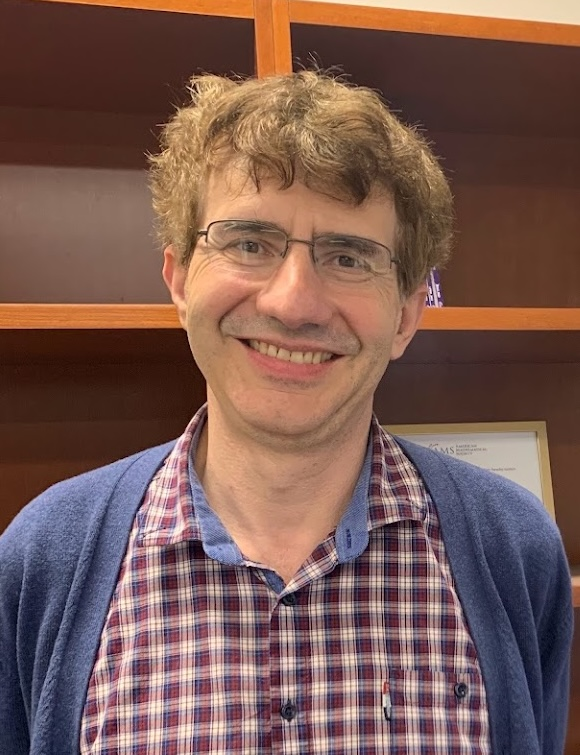
Alexandru Ionescu Photo/Provided to NBD
"Deng Most Likely Will Win the Fields Medal—It Is Very Well Deserved"
What brought Deng Yu global recognition in the mathematical community was a major breakthrough achieved in 2025 alongside his collaborators: for the first time with rigorous mathematical logic, they successfully bridged the derivation from microscopic particle systems to the macroscopic Boltzmann equation, solving the core branch of the restricted Hilbert's Sixth Problem.
At the 2026 ICM, Deng has been invited to deliver a 45-minute lecture in the Partial Differential Equations (PDE) section. Four years ago, his doctoral advisor Alexandru Ionescu was also an invited speaker.
NBD: The global mathematical community is abuzz with speculation that Deng Yu may win the 2026 Fields Medal. As his advisor, how do you evaluate his current standing in the international math community?
Alexandru Ionescu: He is extremely well regarded. Everybody knows him. I think there is a very good chance—most likely he's going to get the Fields Medal, and it is very well deserved. Everybody has a very high opinion of him. I would love to bring him to Princeton, for example.
NBD: Deng Yu and his collaborators achieved a century-defining breakthrough regarding Hilbert’s Sixth Problem. How do you evaluate this 200-page work?
Alexandru Ionescu: There have been several people in France working on this. Deng and his group got into it from a different perspective. They brought in a wave kinetic equations framework, which actually helped them solve the problem. In order to make significant progress in a field that is well established, you have to bring a different perspective, and that’s what they brought. It’s an amazing piece of work they've done, and I think it has been very well celebrated.
As for applications, the problem itself is about the derivation of macroscopic equations starting from Newtonian mechanics—starting from the molecular or atomic level and deriving equations for the entire ensemble system. It is an important problem to understand why fluid equations are valid and how they relate to Newtonian mechanics.
NBD: You were an invited speaker at ICM 2022, and now Deng Yu is invited for ICM 2026. How do you feel about this academic heritage between advisor and student?
Alexandru Ionescu: It is an honor for anybody to be invited as an ICM speaker. Of course, it’s very deserving for him to be invited. Regarding our relationship, we have a very close collaboration. We wrote a paper when he was a student, we wrote a paper two years ago, another paper last year, and we are writing a paper now. So we've had a pretty long collaboration.
NBD: Have any of your other students been invited to speak at the ICM?
Alexandru Ionescu: I’ve had several other very strong Chinese students, but he is actually the first one who was invited as an ICM speaker. One of my other Chinese students actually worked with him on this Boltzmann project that he’s done now, and at least two other very strong Chinese students as well.
NBD: As Deng Yu stands on the cusp of this potential milestone in his career, what would you like to say to him?
Alexandru Ionescu: I will go to the congress on Thursday and hope to see him and congratulate him. It is a very well-deserved honor, and it's very impressive what he's been able to do.
"Our Collaboration Has Never Stopped; We Are Writing a Paper Right Now"
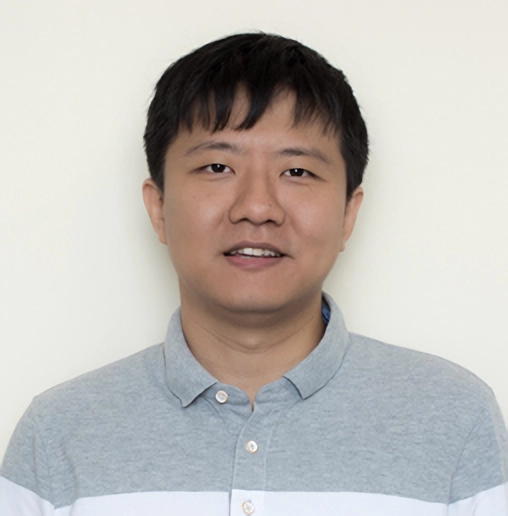
Deng Yu Photo/ Provided to NBD
NBD: Do you still remember your very first meeting with Deng Yu?
Alexandru Ionescu: I don't remember it very well, but I think I probably met him when he visited Princeton before enrolling. Usually, prospective students visit before deciding. I was very happy when he said he decided to come to Princeton, because of course he had other options as well.
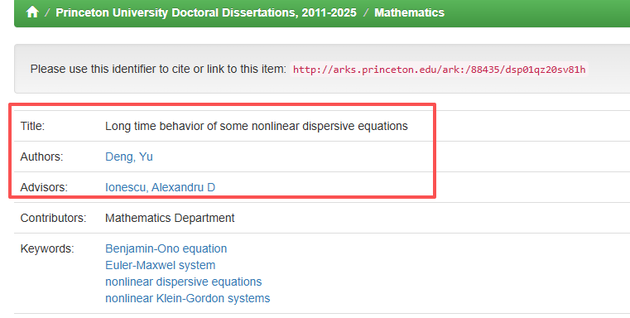
NBD: You advised his doctoral thesis, Long-time Behavior of Nonlinear Dispersive Equations. How did this work lay the foundation for his academic trajectory?
Alexandru Ionescu: They are different topics to some extent. The work he is most well known for now is probabilistic work, in which one has to propagate a certain form of randomness. The work he did with me was not about probabilistic situations—it’s a different field.
However, there is a common theme: there is a certain method used to make the right choice of what you can propagate in order to close an argument. Understanding what type of norms you can propagate for global regularity results has a parallel to the kind of work he’s doing now in understanding how to propagate chaos.
NBD: Alongside mathematics, Deng Yu is passionate about Go, sci-fi, anime, and football. Did you notice these diverse hobbies during his time at Princeton?
Alexandru Ionescu: I actually didn't know about these things when he was at Princeton. We didn't talk about them back then.
Now I know because he has been visiting Princeton several times. I know about his interest in Go, and I also like Go—it’s a very interesting game, and he is probably very good at it.
When he visits now, we mostly talk about mathematics, but sometimes we talk about Go, food, and Chinese tea.
NBD: Do you still maintain frequent academic contact with him?
Alexandru Ionescu: Yes, he visited about one month ago. We are still writing papers together. We wrote a paper last year, one two years ago, and we are writing a new paper right now. We are still working together.
"We Are Witnessing a Golden Generation of Chinese Mathematics"
NBD: In recent years, young Chinese mathematicians like Deng Yu and Wang Hong have made breakthrough contributions. From your perspective, how do you view the rising standing of Chinese mathematicians globally? Are we witnessing a golden generation?
Alexandru Ionescu: Yes, I think we are witnessing a golden generation. There are lots of very, very strong young Chinese mathematicians—the ones you mentioned, but also many others who are extremely strong. It is a rising group of mathematicians.
NBD: You have advised several Chinese PhD students. What is your overall impression of them?
Alexandru Ionescu: First of all, the students I've had were very strong to begin with—they understood math very well from the start. For example, another student of mine also competed in the International Mathematical Olympiad, which gave him a lot of experience in problem-solving. He is now a professor in Spain, and another former student is now at Tsinghua University in Beijing. Their starting level was already very, very high, and then through hard work, that is how they built their success.
NBD: Most of them completed their foundational education in China before coming abroad?
Alexandru Ionescu: Yes, that's true. Deng Yu, for instance, started in China and then transferred to MIT. I actually did the exact same thing myself, so I know we had the exact same path.
Whether they came directly from China or transferred from Chinese universities to US undergraduate programs before coming to Princeton for their PhD, at least up to high school, they all received their foundational education in China.


 川公网安备 51019002001991号