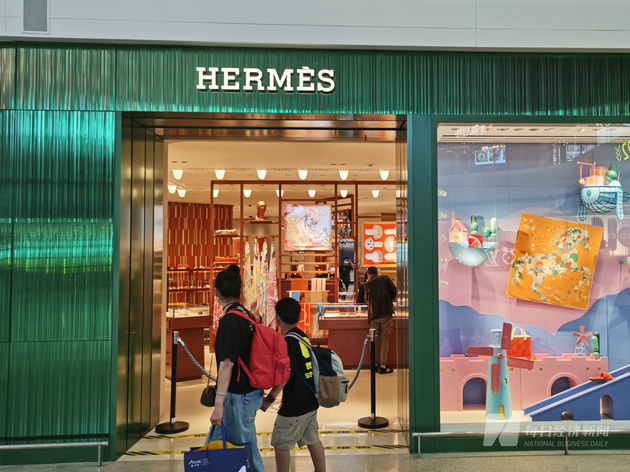
Photo/Zhang Jian (NBD)
Prices of some pre-owned Hermès bags have nearly halved, with premium ratios falling by 110 percentage points, and the company's market capitalization has erased 1.2 trillion yuan from its peak.
The resale multiples on Hermès luxury handbags have been shrinking.
Bernstein's latest report released on November 23 shows that in Q4 2026, the resale prices of the 12 Hermès Birkin and Kelly bags tracked by the firm have fallen to roughly 1.3 times their reference retail prices, down from the peak of 2.4 times recorded in Q2 2022. Based on this calculation, the premium ratio has dropped from 140% to 30%. Meanwhile, Bernstein cut its sales growth forecast for Hermès' directly operated stores in Q4 2026 to 3.2%.
The unraveling of the scarcity myth is also reflected in its share price.
As of the close on November 25, Hermès shares stood at €1,252 apiece, a cumulative drop of about 56% from the all-time high of €2,847 on February 14, 2025. Its market capitalization has shrunk from around €298 billion at that time to roughly €131 billion now, wiping out approximately €167 billion (equivalent to 1.2 trillion yuan). Its forward price-to-earnings ratio has also declined from around 49x to 26x, well below the 10-year average of roughly 45x.
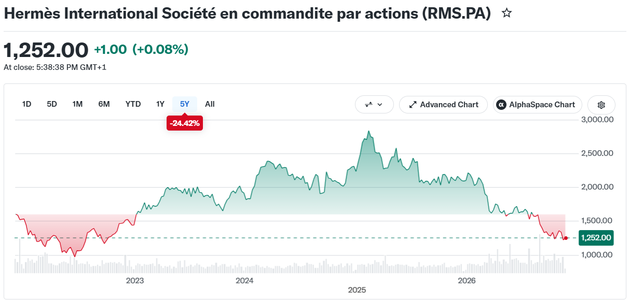
Hermès' share price over the past five years
Resale multiples of Birkin and Kelly bags narrow from 2.4x to 1.3x
Following its September note, Bernstein published another report on November 23 stating that the resale multiples for Hermès handbags in the secondary market has been trending downward.
The report noted that at several auctions held ahead of Q4 2026, resale prices for Birkin and Kelly bags fell to around 1.3 times reference retail prices, retreating from the 2.4x peak in Q2 2022. In other words, the premium ratio slid from 140% to 30%, returning to levels broadly seen between 2016 and 2018.
The latest report expanded the number of models in its basket to 12, including the Birkin 35 Togo, Birkin 25 Swift, Kelly 25 Swift, Kelly 28 Togo and Kelly 32 Togo, with the number of bags increased to about 3,600.
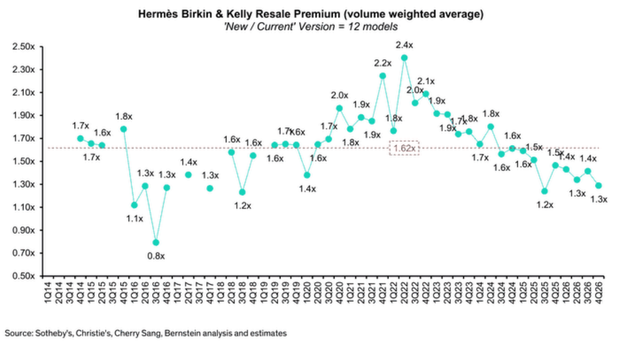
Auction multiples remain the weakest in China's Hong Kong. The report puts the resale multiple in Hong Kong at around 1x, markedly lower than roughly 1.4x in Europe and the United States, alongside greater price volatility.
Some dealers told that pre-owned brand-new unused Birkins are selling for thousands of US dollars less than their 2022 peak.
Inventory for Sale Hits 6–7 Times Pre-Pandemic Levels
The shrinking resale premium on Birkins today is tied to swelling market supply.
Reports indicate Hermès has gradually scaled up production of its artisanal goods, opening one workshop on average each year. UBS estimates the global stock of Birkins and Kellys available for resale is now 6 to 7 times pre-pandemic volumes.
At the same time, secondhand marketplaces such as Vestiaire Collective and The RealReal, plus independent pre-owned boutiques operating via online stores and social media, have put far more Birkins into circulation.
US luxury handbag reseller Fashionphile said its platform's Birkin inventory has grown 32-fold over 15 years, with 212 SKUs currently listed for sale.
This means while consumer demand for Birkins remains solid, buyers face fewer hurdles sourcing them through secondary channels. A gap has emerged between perceived scarcity at official boutiques and actual supply in the resale market.
Buyers Grow Unwilling to Accept the "Saddle-Up Purchase Game"
The contracting Birkin resale multiples may affect not just handbag sales, but consumption across other Hermès categories.
Market information cited in Bernstein's report shows some clients in the Asia-Pacific region are refusing to play the mandatory add-on purchase game when trying to secure allocated bags. Bernstein argues this dynamic compresses resale premiums and further weakens demand for Hermès’ non-leather goods.
Analysts have also observed that a key incentive for shoppers to buy Hermès non-leather merchandise was to earn eligibility to purchase the brand's iconic leather bags. When Birkins can be acquired more cheaply on the secondary market, consumers are less motivated to buy other products to qualify for allocation rights.
As dealers previously said, access to Birkin or Kelly bags is typically tied to a buyer's prior spending on other Hermès items. Customers often need to purchase apparel, scarves, footwear and other goods first; some dealers estimate the required pre-spend commonly ranges from US10,000 to US20,000.
Sales of Hermès' other categories are already softening. In Q3 2026, the group's leather goods division posted 10.8% year-on-year sales growth, while revenue from other products fell 0.7% year-on-year, compared with a 3.7% year-on-year rise in Q2. Non-leather goods accounted for 56% of the group's total revenue last year.
Bank of America analysts pointed out this marks the first decline in sales of Hermès’ non-leather lines since 2016, outside the COVID-19 period, and fading appeal of forced add-on spending could weigh on these categories.
Bernstein downgraded its growth forecast for Hermès in Q4 2026, projecting 3.2% year-on-year sales growth at the group's directly operated stores (OSG).
In addition, Bernstein lowered its Hermès target price from €1,480 to €1,325, while maintaining an Outperform rating. This target price implies around 6% upside from the November 25 closing price.
Disclaimer: The content and data in this article are for reference only and do not constitute investment advice. Please verify all information before use. Investors act at their own risk.


 川公网安备 51019002001991号