At a lively private birthday party in the United States, two silver‑grey Unitree G1 robots danced in time on centre stage, drawing cheers from guests.
Rental services for Unitree humanoid robots have sprung up overseas.
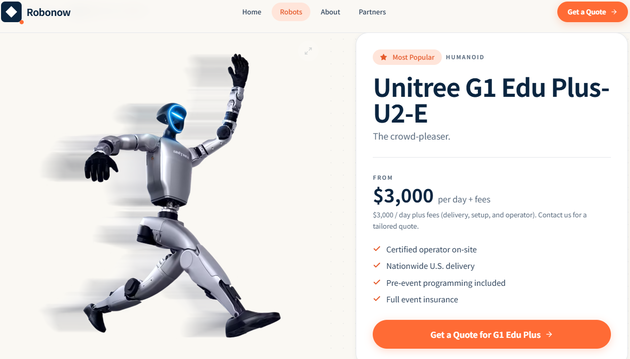
U.S. firm Robonow Global has built a fleet of more than 50 G1 units, each renting for as high as $3,000 per day. Japan‑based EmplifAI Inc. has also purchased three G1 robots for rental operations.
Yet interviews conducted by the National Business Daily (NBD) show that beyond stage performances, humanoid robots still lack genuinely practical real‑world use‑cases. They remain far from tasks such as screwing components on assembly lines or doing household chores.
This disconnect between market expectations and real‑world deployments has cooled capital‑market sentiment.
As of market close on August 25, Unitree Robotics' share price had retreated for four consecutive trading days. Its total market capitalisation fell to RMB 243.8 billion, representing an erosion of nearly RMB 200 billion from the peak valuation hit at its opening on the first day of trading.

$3,000 per day! Overseas robot‑rental boom takes hold, Unitree G1 emerges as a popular model
Morgan Stanley forecasts that as many as one billion humanoid robots could be in use globally by 2050, creating a market worth more than $5 trillion. Fuelled by this industrial excitement, the overseas humanoid‑robot‑rental track is expanding rapidly.
"We have completed dozens of event‑based orders and commercial collaborations, with 10 more confirmed bookings for events and partnerships in the months ahead. Our mission is to help robots find real work," Sean Sun, Managing Director of Robonow Global, told the NBD. Founded in March this year, the U.S. company operates a Robot‑as‑a‑Service (RaaS) platform with nationwide U.S. coverage. Its fleet is dominated by Unitree G1 E robots, of which it operates over 50 units.
The G1 E is listed on Robonow Global's website at $3,000 per rental day, excluding shipping, setup and operator fees. Asked why the G1 E suits the U.S. rental market, Sean Sun commented:
"The G1 E combines strong visual impact with a development‑oriented hardware and software architecture. It is equipped with a depth camera, 3D LiDAR and an onboard computing platform, and supports custom programming and coordinated multi‑robot performances. This adaptability is especially valuable in the rental market because each customer has different creative and operational requirements."
A similar rental wave is unfolding in Japan.
"For developers, the Unitree G1 allows a much larger number of researchers and developers to experiment with humanoid hardware before mass industrial adoption becomes possible," Hiroyuki Osone, CEO of Japanese robotics firm EmplifAI Inc., said in an interview with NBD. An AI‑engineer‑turned‑entrepreneur, Osone has bought three Unitree G1 units. He runs a G1‑rental business in Japan targeting R&D, exhibitions and demonstrations. Drawing on real‑world operational data, his team is also developing its own semi-humanoid dual-arm mobile manipulator in Japan.
What lies behind the boom in overseas humanoid‑robot rentals?
Ethan Qi, Associate Director at Counterpoint Research, told NBD that the RaaS model is highly relevant in the early phase of humanoid‑robot commercialisation. It lowers the capital outlay for enterprises wishing to deploy humanoids. Furthermore, rental‑based pricing makes return‑on‑investment (ROI) calculations more tangible, lowering adoption barriers.
Sean Sun elaborated: "Humanoid robots were attracting enormous interest, yet most organizations lacked the technical staff, operational experience, or budget confidence to purchase a robot and deploy it successfully. Rental create real-world experience and confidence."
Technology turnover is another key driver. "Robot vendors launch new hardware iterations every year," Ethan Qi noted. "If you own hardware outright, old units are hard to trade in. With rental, you can always access the latest models. Renters also do not require deep technical expertise; vendors or rental platforms handle faults and maintenance."
Still stuck in performance mode: they are not ready for factory‑floor labour
While rental markets are flourishing, a close look at what these rented robots actually do reveals they are still far from becoming genuine industrial workers. Their primary value today lies in entertainment, stage performances and science outreach rather than direct human‑labour substitution.
Sean Sun shared real‑world use‑cases with NBD. In July, two robots were deployed at a private birthday celebration, and the robots performed a programmed dance on stage to open the entertainment segment and energize the room. At another event, the robots were used to make artificial intelligence and technology education more tangible for the audience. At two high‑profile industry summits, the robots acted as tangible embodiments of AI for technical demonstrations.
The Japanese market paints a comparable picture. Hiroyuki Osone pointed out that current Japanese demand for humanoids centres mostly on research‑and‑development, AI‑robotics experimentation, technical showcases, exhibitions and entertainment performances.
"I believe it will still take some time before bipedal humanoid robots are widely deployed as practical labor in factories and warehouses. Industrial environments demand very high levels of reliability, safety, uptime, maintainability, and economic return. In many tasks today, conventional industrial robots, AGVs, AMRs, or other specialized machines are still more practical."
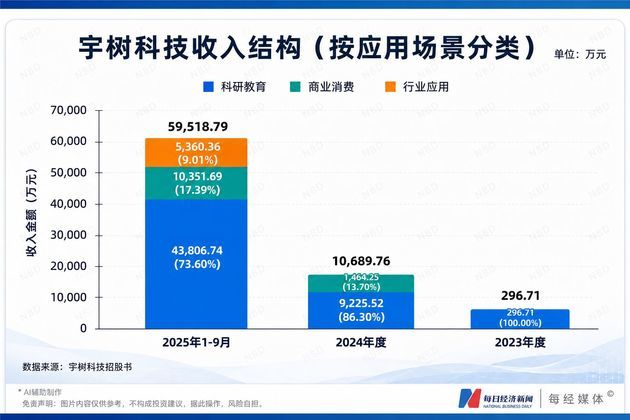
Unitree Robotics recorded global humanoid‑robot shipments exceeding 5,500 units in 2025, ranking it number‑one worldwide. Prospectus filings show, however, that more than 70 % of Unitree’s humanoid‑robot revenue for the first nine months of 2025 came from research‑and‑education clients including universities and research institutes. Industrial‑segment sales made up merely 9 %, and consumer‑market demand has not yet materialised.
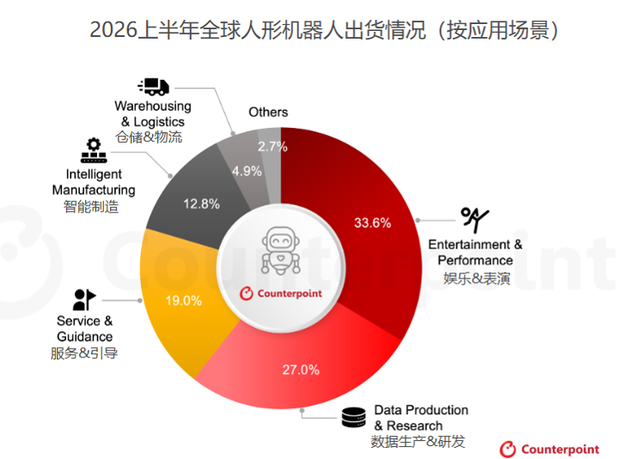
Industry analytics corroborate this pattern. According to Counterpoint Research data for H1 2026, entertainment‑and‑performance applications accounted for 33.6 % of global humanoid‑robot shipments; data generation and research represented another 27 %. Combined these two categories exceeded 60 %. Service‑and‑guidance deployments made up roughly 19 %, while less than 20 % of units found their way into smart‑manufacturing, warehousing and logistics settings.
Ethan Qi explained that robot‑hardware development has outpaced advances in machine intelligence. Entertainment‑oriented deployments gained traction first because they place relatively modest demands on autonomous capabilities. Large‑scale roll‑out within manufacturing, warehousing and other commercial sectors will require further model‑driven breakthroughs.
"Nevertheless, based on Counterpoint's industry intelligence, we expect more commercial milestones in logistics and 3C electronics during the second half of the year, with retail‑sector deployments also set to accelerate," Ethan Qi said.
A Goldman Sachs research report published August 23 identifies that logistics sorting has emerged as one of the most visible early commercialization directions. Companies are now discussing concrete metrics like throughput (e.g., 1,300-1,800 parcels per hour), success rates (95% to 98%), and working-hour assumptions (e.g., 10+ hours daily, three-shift support, 4-5 year design life). This segment is projected to enter small-batch volume ramp by late 2026 and larger-batch ramp in 2027, driven by measurable ROI.
Home‑environment deployments present even greater challenges than industrial use‑cases, owing to high personalisation heterogeneity and substantial deployment costs. “Household settings involve human occupants plus large variation across individual homes. Counterpoint believes large‑scale humanoid‑robot adoption in consumer households will likely arrive no earlier than 2030,” Ethan Qi commented.
Real bottleneck lies in "the last few centimetres or even millimetres": the humanoid‑robot "ChatGPT moment" may take two‑to‑three years at minimum
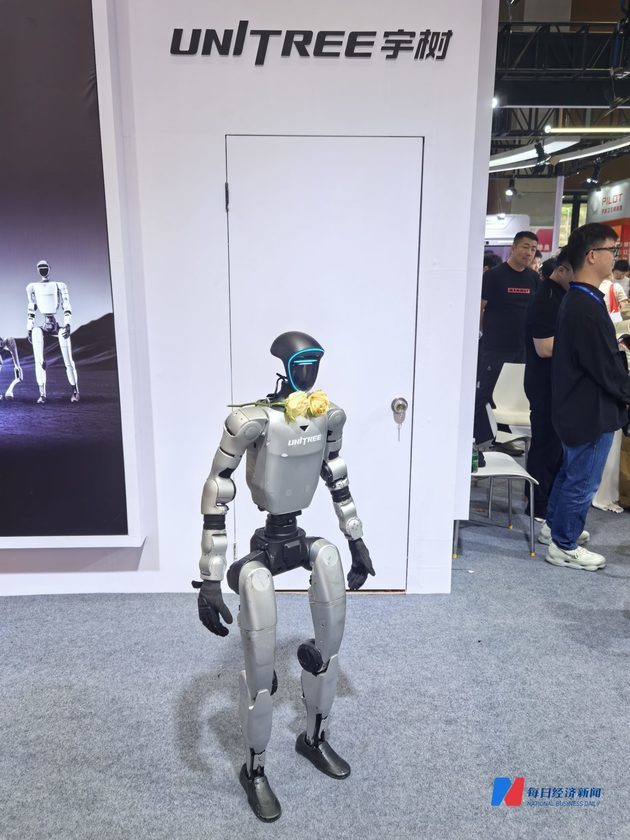
Photo/Yin Xuexiang (NBD)
The rental‑market snapshot mirrors core commercialisation bottlenecks facing the humanoid‑robot industry.
On August 20, the day after Unitree Robotics' IPO, founder and Chairman Wang Xingxing delivered a speech at the World Robot Conference 2026. He acknowledged that for general‑purpose robots to truly enter households and everyday production workflows, critical progress in embodied‑AI generalisation capabilities is indispensable. Insufficient generalisation of embodied intelligence remains the dominant industry bottleneck today.
He offered a vivid metaphor: AI models generally get high‑level goals correct for tasks such as locomotion and object handling. The real pain‑points emerge in "the last few centimetres or even millimetres". Robots struggle to correct tiny deviations and achieve sufficiently precise alignment with the physical world, dragging down task‑success rates. According to Wang, language models process digital encodings with minimal information loss, whereas every input‑output cycle for physical robots introduces potential offsets and information degradation.
These observations contextualise investors' cautious stance toward Unitree's stock price. Wang noted that humanoid robots will reach their equivalent of the "ChatGPT moment" only when they can walk into unfamiliar environments and complete most assigned tasks from instructions alone. In his assessment, this inflection point could arrive in as little as two‑to‑three years, or may take five to ten years.
A recent report by Goldman Sachs observes that the humanoid‑robot industry is in a phase of continuous model refinement, with priorities including scaling‑up model parameters, enhancing multimodal perception, and gathering more real‑world operational data.
Asked when an industry‑wide inflection point might materialise, Ethan Qi told NBD that timing hinges on genuine breakthroughs for general‑purpose embodied‑AI foundation models. "No firm timeline can be given, yet the next several years will prove decisive. Vendors need not wait for fully‑mature general‑purpose models before scaling commercial deployments. A more pragmatic path is to achieve zero‑to‑one, then one‑to‑one‑hundred breakthroughs within discrete vertical use‑cases. Real‑world applications generate data and practical experience that in turn advance general‑purpose‑model capabilities; these two tracks will progress in tandem."
Disclaimer: The content and data presented in this article are for informational purposes only and do not constitute investment advice. Please verify all information before making financial decisions. Use at your own risk.


 川公网安备 51019002001991号