When Tesla Inc. unveiled its second-generation Roadster at SpaceX’s testing grounds in Texas on October 15, the vehicle performed a series of aerial maneuvers—including inverted ramps and airborne flips—that Chief Executive Elon Musk described as the "pinnacle of the human driving era."
While video footage indicates that the Roadster’s current "flight" duration remains brief, its performance specifications have drawn intense industry focus: a top speed exceeding 400 km/h and a wheel torque of 10,000 Nm. Delivering such extreme performance requires a braking system capable of withstanding severe operating conditions, establishing advanced braking technology as a critical structural bottleneck for flying vehicles.
Industry insiders briefed on the matter told National Business Daily (NBD) that carbon-ceramic brake discs are highly likely to be included in the Roadster’s specification sheet.
The announcement has injected fresh momentum into the carbon-ceramic brake industry. Long dominated by overseas giants such as Brembo S.p.A., the market is now experiencing accelerated penetration by Chinese manufacturers.
According to public disclosures, several A-share listed companies—including KBC Corporation, Changhua Holding Group, Beijing Bei Mo Gao Ke Friction Material and Aofu Environmental Technology —have established strategic footprints across full-disc manufacturing and precision metal components, positioning themselves to capture market share in this emerging sector.
Lightweighting Meets Extreme Engineering
Carbon-ceramic matrix composite (C/SiC) brake discs—composed of carbon fiber reinforcement and a silicon carbide ceramic matrix—were historically reserved for supercars priced in the multi-million-yuan segment, such as high-spec models from Ferrari, Lamborghini, and Porsche. The demanding performance profile required by supercars closely parallels the engineering constraints of flying vehicles and eVTOL (electric vertical take-off and landing) aircraft.
Tesla’s second-generation Roadster is reported to offer three variants: Performance, Thrust, and Rocket. The Rocket edition—a single-seat flying specification featuring 10 thrusters—boasts a 0–96 km/h acceleration time of under 0.59 seconds and a top speed surpassing 370 km/h.
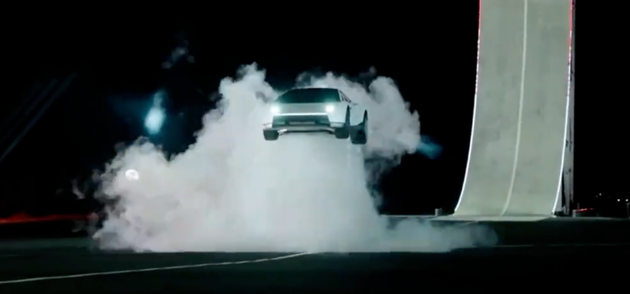
"A vehicle capable of launching and maneuvering mid-air requires maximum weight reduction. Higher safety margins directly depend on a lighter structural payload," an industry analyst noted to NBD, adding that carbon-ceramic brakes significantly mitigate thermal fade at speeds exceeding 350 km/h while delivering substantial brand premium.
Unlike traditional cast-iron brake discs weighing roughly 30 kg, a carbon-ceramic disc of equivalent diameter (430 mm) weighs approximately 8 kg—reducing un-sprung mass by tens of kilograms per vehicle. Furthermore, carbon-ceramic discs operate stably at temperatures exceeding 1,000°C and can withstand near 2,000°C in anoxic environments, effectively eliminating brake failure risks associated with extreme thermal degradation.
"Weight is the decisive variable for aerial propulsion and attitude control," Wang Hua, General Manager of the Composite Materials Division at KBC Corporation, told NBD. In June 2024, KBC Corporation announced that its wholly-owned subsidiary, KBC Carbon-Ceramic Corporation, secured a nomination contract to develop and supply carbon-ceramic brake discs for a leading domestic flying vehicle manufacturer.
Cost Reductions Drive Commercialization
Historically, high production costs served as the primary barrier to broader commercial adoption. Overseas manufacturers maintained unit prices above 10,000 yuan ($1,400 USD) per disc. Following localized technological breakthroughs, domestic Chinese long-fiber disc prices have fallen toward the 2,000-yuan threshold, with short-fiber variants expected to drop below 1,000 yuan.
"Our pricing structure is roughly one-fifth that of international incumbents," KBC Corporation stated during an NBD field study. "An entire four-disc vehicle set from us costs comparable to a single imported disc."
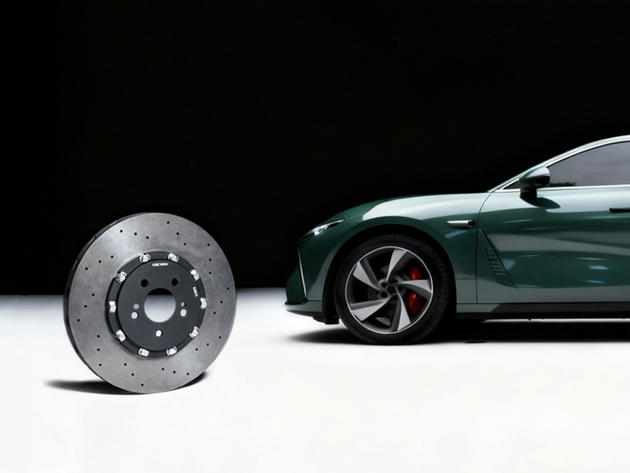
KBC Corporation’s carbon-ceramic discs
This cost deflation is accelerating market integration. According to data from Aijian Securities, the number of commercial vehicle models equipped with carbon-ceramic discs expanded from fewer than 15 to 54. The Chinese market size for carbon-ceramic brake discs is projected to reach between 7.3 billion and 11.5 billion yuan in 2026. Penetration rates among new energy vehicles (NEVs) priced above 300,000 yuan ($42,000 USD) are expanding from 5% toward 10%, with adoption beginning to reach lower price segments.
KBC Corporation’s carbon-ceramic discs have already achieved series production on high-performance models including the Xiaomi SU7 Ultra and Yangwang U9, while entering Mercedes-AMG's global supply chain framework.
Scaling Bottlenecks and Corporate Layouts
Despite domestic supply advances, scaling manufacturing processes remains a formidable technical barrier. Mass production involves multi-stage thermal processing—a single disc undergoes high-temperature furnace treatment six times.
"In the initial mass-production phase, out of 500 preform units, only 50 were qualified, representing a yield rate of just 10%," Wang recalled. KBC Corporation surmounted this through 20 years of proprietary equipment development, building a current annual production capacity of 400,000 units.
However, capacity leadership has yet to translate into significant short-term profitability. Company disclosures show that KBC Corporation’s carbon-ceramic brake disc gross margin stood at 0.64% in 2025, operating near breakeven under current production volumes. Company representatives estimate that industry-wide profitability will stabilize as annual utilization reaches 800,000 to 1,000,000 units.
Meanwhile, a broader ecosystem of Chinese suppliers is scaling across the value chain:
Changhua Holding Group announced a supply contract in July 2025 to manufacture specialized aluminum hats and structural fastener kits for carbon-ceramic brake assemblies, targeting a first-phase annual capacity of 200,000 sets for a domestic flying vehicle client.
Beijing Bei Mo Gao Ke Friction Material confirmed in its 2026 mid-year financial report that its automated production lines for carbon-carbon and carbon-ceramic brake discs have entered batch manufacturing phases.
Aofu Environmental Technology established a subsidiary in December 2025 to construct pilot production lines dedicated to automotive carbon-ceramic components.
While global incumbents like Brembo maintain a strong position in high-end OEM supply chains, domestic Chinese suppliers are establishing competitive moats through cost efficiency, localized engineering responsiveness, and close integration with the domestic EV and low-altitude aviation supply chains.
"Tesla’s validation of frontier technologies serves as a powerful catalyst for the entire supply chain," Wang noted. "It shifts industry competition from price erosion toward technological innovation."


 川公网安备 51019002001991号