A new wave of concern is sweeping across the cryptography and technology sectors, as advances in quantum computing raise urgent questions about the future of digital security.
In late March 2026, Google’s Quantum AI team released a white paper suggesting that a sufficiently powerful quantum computer could theoretically break the cryptographic foundation of Bitcoin in as little as nine minutes. The required computational resources, the report claims, are only one-twentieth of previous estimates.
The findings have reignited fears of a so-called “Q-Day” — the moment when quantum computers can crack widely used public-key cryptography, potentially undermining everything from bank accounts to social media security.
A 9-Minute Attack Window
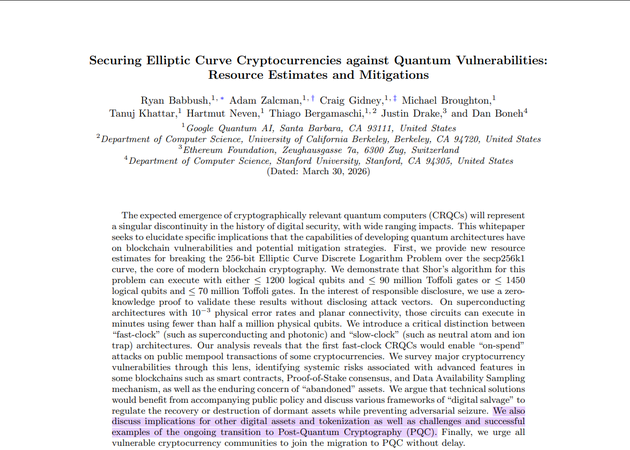
Photo/Google website
According to the report, a quantum computer with approximately 500,000 qubits could break the elliptic curve cryptography (ECC) that underpins Bitcoin.
The attack scenario is particularly concerning. When a Bitcoin transaction is broadcast to the network, it typically takes about 10 minutes to be confirmed. During this window, a quantum attacker could derive the private key from the exposed public key in roughly nine minutes—creating a race condition. Under certain assumptions, researchers estimate a 41% probability that an attacker could intercept and redirect funds before the transaction is finalized.
More alarmingly, around 6.9 million Bitcoin—roughly one-third of the total supply—are currently stored in wallets with publicly exposed keys. These funds could be directly vulnerable once sufficiently powerful quantum machines become available.
Explaining the fundamental advantage of quantum systems, Long Guilu, vice president of the Beijing Academy of Quantum Information Sciences and a professor at Tsinghua University, noted in an interview with National Business Daily (NBD) that quantum computers exhibit a form of “super-parallelism.” Unlike classical bits, which represent a single state at a time, quantum bits can represent multiple states simultaneously—allowing exponential scaling in computational power.
Industry Debate: Imminent Threat or Distant Risk?

Photo/AIGC
The report triggered swift reactions across the crypto industry. Brian Armstrong, CEO of Coinbase, stated he would personally dedicate time to strengthening Bitcoin’s resistance to quantum attacks, emphasizing that the issue “must be addressed urgently.”
Meanwhile, Christopher Wood of Jefferies has already adjusted his portfolio, reducing Bitcoin exposure and reallocating assets into gold, citing quantum computing as a potential long-term threat.
However, not all experts believe the risk is immediate. Ark Invest noted that current quantum hardware remains far from the scale required to execute such attacks in practice.
Tian Kun, a researcher at Xihe Huilian and associate professor at Kent Business School, told NBD that the threat remains “theoretically feasible but extremely challenging in engineering terms.” He emphasized that practical attacks would require advances in error correction, qubit stability, and large-scale system integration—conditions that are not yet met.
2029: A Critical Turning Point?

Long Guilu Photo/website of Tsinghua University
Despite current limitations, some scientists believe the timeline may be shorter than expected.
Long Guilu suggested that 2029 could be a realistic milestone for the emergence of quantum computers capable of breaking existing cryptographic systems. He pointed to hybrid quantum-classical algorithms proposed by Chinese research teams, which may significantly reduce the number of qubits required.
He also warned that such capabilities, once achieved, may not be publicly disclosed due to their importance for national security and defense.
A successful breakthrough would not only affect cryptocurrencies, but also threaten the broader public-key infrastructure underpinning banking systems, social media platforms, and secure communications worldwide.
The Race Toward Quantum-Resistant Security

Photo/AIGC
In response, global efforts to upgrade cryptographic systems are accelerating.
One major approach is post-quantum cryptography (PQC)—new classical algorithms designed to resist quantum attacks. The U.S. National Institute of Standards and Technology (NIST) released its first set of PQC standards in 2025.
Major tech companies are already adapting. Apple has introduced quantum-resistant encryption in iMessage, while government systems are beginning to migrate toward PQC frameworks.
Another approach lies in quantum communication technologies. Pan Jianwei and his team have advanced quantum key distribution (QKD), while Long Guilu’s team is exploring quantum direct communication—both leveraging the laws of quantum mechanics to ensure that any interception attempt disrupts the signal and becomes detectable.
Meanwhile, the Bitcoin community is testing quantum-resistant upgrades such as BIP-360, with increasing participation from developers and miners. Coinbase has also established a dedicated advisory group on quantum computing and blockchain.
As Tian Kun summarized, quantum computing is no longer a distant, theoretical concern for cryptocurrencies, but a “mid-term, systemic risk” that must be proactively managed.
While a full-scale “Q-Day” may not be imminent, the transition to quantum-resistant systems will take years—if not decades—and must begin well in advance.
The future of blockchain, experts agree, will depend on its ability to evolve—from being “quantum-vulnerable” to “quantum-adaptable.”


 川公网安备 51019002001991号