Photo/AIGC
Moonshot AI, the developer of the AGI assistant Kimi, has seen its valuation skyrocket to $18 billion, quadrupling in just three months. According to market insiders, the company is currently finalizing a new $1 billion financing round, marking its third round in less than a quarter—a record pace for China’s large model sector.
Kimi’s valuation surge is fueled by both internal product breakthroughs and a broader sector rally. Peers like MiniMax and Zhipu AI recently saw their market caps exceed HKD 300 billion ($38.5B) within two months of their Hong Kong listings, providing a robust benchmark for Kimi’s premium valuation.
Since the start of 2026, Moonshot AI has maintained an aggressive release cycle:
Kimi K2.5: Launched in late January, this trillion-parameter multimodal model features native image-text processing and a pioneering Agent cluster scheduling capability, outperforming global benchmarks in complex tasks.
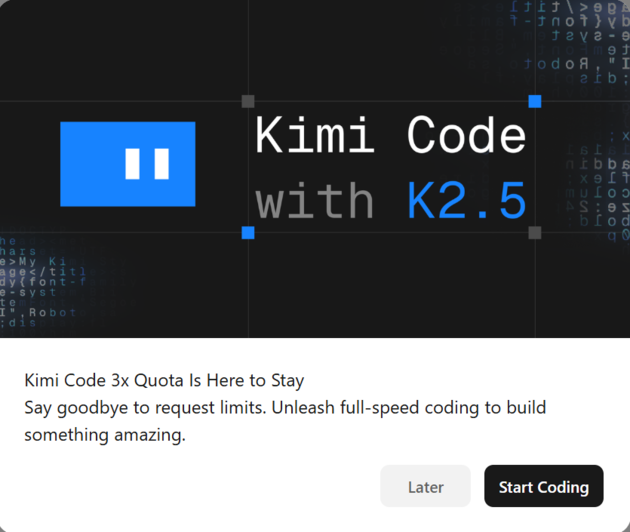
Kimi Claw: Released in February, this tool allows for seamless cloud deployment and integration with OpenClaw. It supports autonomous task execution across platforms like Weibo, WeChat Work, Lark, and DingTalk.
The launch of K2.5 and Kimi Claw has triggered a "payment explosion." Insider data reveals that earnings in the 20 days following the K2.5 launch surpassed the total revenue for the entire year of 2025.
Besides, according to Stripe data, individual subscriptions surged 8,280% month-on-month in January, followed by another 123.8% jump in February, landing Kimi in Stripe’s global top 10 list.
Despite the frenzy, founder Yang Zhilin remains focused on the primary market. Following a $500 million Series C in December 2025 and a $700 million follow-up in February 2026—backed by giants like Alibaba, Tencent, and IDG Capital—Yang stated that the company currently holds over 10 billion yuan in cash.
The funds are earmarked for "aggressive GPU acquisition" to accelerate the development of the next-generation K3 model. "We are in no rush to IPO," Yang noted, "as private funding currently exceeds what we could raise in the secondary market."


 川公网安备 51019002001991号