"I'll never sell my gold, silver, or copper."
At the dawn of a volatile 2026, "Commodity King" Jim Rogers has issued a survival guide for the global financial landscape.
A legendary investor who began his Wall Street career at 26, Rogers rose to fame in the 1980s by accurately bottoming out the Austrian stock market and famously predicting the 1987 global crash and the 2008 subprime mortgage crisis.
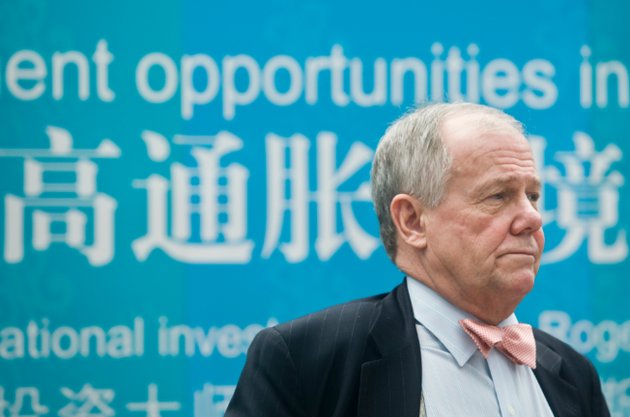
Jim Rogers Photo/VCG
In December 2025, Rogers warned that the U.S., as the world's largest debtor nation with over $38 trillion in national debt, is heading toward an abyss. He predicts the next crisis will be "the worst in my lifetime," rooted in a global "suffocation" of debt.
On February 6, 2026, National Business Daily (NBD) had an exclusive interview with Rogers. He detailed his outlook on the impending crisis, his specific hedging strategies, and the logic behind his bullish stance on metals.
Rogers revealed he has liquidated all U.S. stock holdings, pivoting to physical gold, silver, and copper as "perfect insurance policies" to be left as a legacy for his children.
On Commodities: Insurance Policy to Hold, Not Trade
NBD: Since the start of 2026, international gold prices have fluctuated wildly. What is your take?
Jim Rogers: I suggest everyone should hold some gold and silver. Throughout one's life, these metals play a vital role. If the situation doesn't goes well, it's a great "refuge"; if things go well, they can yield significant wealth if you have a good eye.
NBD: In 2025, silver surged by 147%. With industrial demand skyrocketing, has silver "decoupled" from gold?
Jim Rogers: I want to reiterate my intention: I own silver, but I do not attempt to "trade" it for short-term profit. I am happy to see it rise, but I will never sell it because of that.
I hope to own it forever and pass it to my children. Silver is more than an investment; it is a perfect insurance policy. No one wants to actually use their insurance, and that is my attitude—I hope I never have to sell it, but I must have it.
NBD: Has silver’s weight in your portfolio exceeded gold?
Jim Rogers: I don’t calculate the exact numbers daily. I own a lot of both. My strategy for years has been simple: when prices drop, I try to buy more.
I don’t care about the precise ratio; I just know that in an era of currency devaluation and high debt, physical metals provide peace of mind.
NBD: Copper prices recently hit record highs. Given its role in EVs and infrastructure, how long can this cycle last?
Jim Rogers: Copper is used everywhere today, from EVs to electronics. Its importance only grows, yet few new copper mines are opening globally.
The logic is simple: demand is surging while supply is constrained. My advice: Don’t sell your copper, your silver, or your gold.

Photo/AIGC
On the Crisis: The Trigger Starts Small
NBD: Comparing today to 1929 or 2008, what is the biggest warning signal?
Jim Rogers: The most prominent signal is that the U.S. is the largest debtor nation in history, and that debt worsens daily. History shows that when a nation falls into this level of debt, a severe crisis is inevitable.
I am a U.S. citizen, but I see clearly that my children will face serious problems. A century ago, the UK was the wealthiest, most powerful nation; 50 years later, it was "broke." I fear the U.S. is on the same path.
NBD: With U.S. debt at $38 trillion, how long can the Dollar maintain its dominance?
Jim Rogers: In 1926, the Pound was the most important currency because Britain was the global hegemon. By 1976, it had fallen from grace.
The Dollar is currently the top reserve currency, but the trouble is obvious. People are realizing the risk and looking for alternatives. The process has begun, though I don’t see a clear single winner yet.
NBD: What will be the trigger for this "worst crisis of your lifetime"?
Jim Rogers: I don’t know the exact timing, but I know the cause: debt. The trigger is usually something "insignificant"—a small company in a remote country fails, or a minor industry collapses. At first, no one pays attention, but then it snowballs.
When it hits the headlines, everyone panics. We are already seeing "sprouts" of trouble in some smaller nations.
NBD: What common trait do you see when a crisis is approaching?
Jim Rogers: Overconfidence. When everyone becomes ultra-optimistic and tells you "this time it’s different," you must be extremely worried.
When people get complacent and start leveraging up—when they say "the rules have changed"—that is the most dangerous signal.
NBD: What is your most important advice for young investors?
Jim Rogers: One word: Skepticism.
Be skeptical of everything you read and hear. When everyone looks out the window and says "the sky is blue," go check for yourself.
When everyone is happy, that is precisely when you should start asking questions and looking for alternatives.
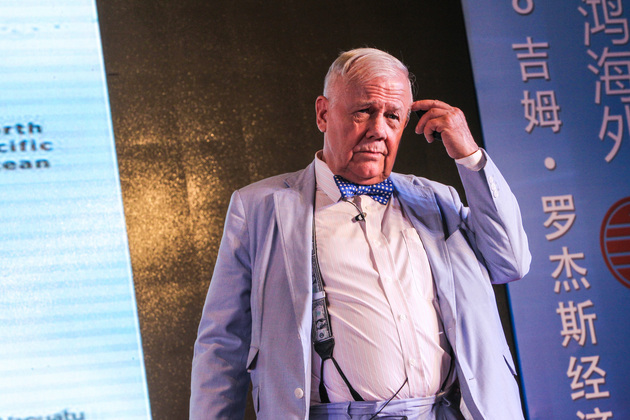
Jim Rogers Photo/VCG
On China: Unique Resilience and the Rise of Tourism
NBD: Since 1984, you have been a "China Bull." What is the core element behind that?
Jim Rogers: China is the only country in history to have reached the top multiple times. Egypt was great once; the UK was great once. China, after periods of decline, always manages to rise again. This resilience is unique.
NBD: Where is the next breakthrough for China? Are external tech restrictions a hindrance or a catalyst?
Jim Rogers: China has a massive pool of smart, educated engineers—a huge talent dividend. When a country is on an upward trajectory, almost all industries benefit.
I am bullish on Chinese tourism. Nowadays, Chinese people want to see the world, and the world wants to see China.
Regarding technology, history proves external pressure often acts as a catalyst for stronger innovation.
NBD: Why did you move to Singapore?
Jim Rogers: I wanted my daughters to speak Mandarin. It wasn't easy in New York.
I realized they needed an environment where they had to speak it. Singapore offers the perfect balance—both English and Chinese. My eldest daughter has graduated from Columbia University and is working in New York, and my youngest is about to enter university.
Disclaimer: The content and data in this post are for informational purposes only and do not constitute investment advice. Please verify all information before use. Any actions taken based on this content are at your own risk.


 川公网安备 51019002001991号