Neuralink, Elon Musk's brain-computer interface (BCI) venture, has hit a new milestone in its surgical precision. The company recently revealed its next-generation surgical robot has slashed electrode insertion time from 17 seconds to a mere 1.5 seconds per thread, while pushing insertion depths beyond 50mm to interface with a richer array of neurons—a breakthrough promising far more precise motor control and sensory feedback.
According to Neuralink co-founder DJ Seo, they expect to have 20 patients implanted by the end of 2025, with a waitlist that already exceeds 10,000 people.
To achieve more stable and efficient control, Neuralink is advancing an upgrade trial that employs a "dual implant" approach. The company's pioneer participant, Noland Arbaugh, who is paralyzed from the shoulders down following a 2016 diving accident and became the first human to receive a Neuralink brain chip in early 2024, is slated to become the world’s first recipient of this upgraded system.
In an exclusive interview with National Business Daily (NBD), Arbaugh reflects on his journey after the BCI implantation, describing how the technology is helping him reclaim his independence and why he believes BCIs will revolutionize human potential.
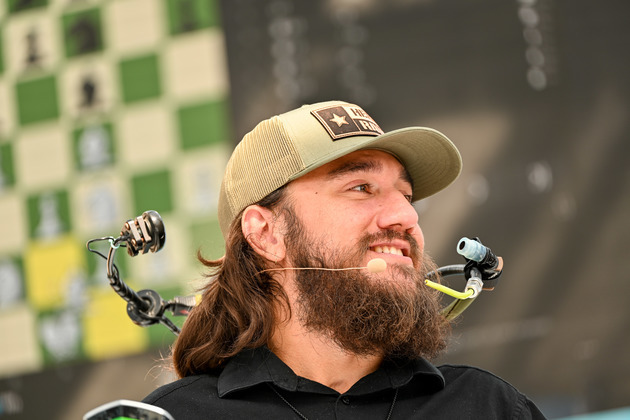
Noland Arbaugh/Provided by the Interviewee
On Independence: "Neuralink is Handing Independence Back to Me"
NBD: You've said Neuralink "changed everything". After over 20 months of living with the implant, what's the most profound change — something that fundamentally shifted the way you see yourself or the world?
Noland Arbaugh: Before my surgery, I honestly believed I would be a burden for the rest of my life. I wasn't capable of much, and no matter how hard I tried, I just couldn't seem to find work or help the people I loved the most in any meaningful way. I believed that my family would be taking care of me until I died or they just weren't capable any longer. Since my surgery, I believe there’s a path forward for me to be completely self-sufficient — or at least 90% — in the next year. For me, independence is key, and Neuralink is handing that back to me.
NBD: Elon Musk recently hinted that you might be the first person to receive a dual Neuralink implant, potentially enhancing your capabilities even further. How do you personally feel about becoming the world’s first "upgraded" human? Is there excitement, curiosity or any fear?
Noland Arbaugh: I can tell you upfront, there is not now, nor has there ever been, any fear. Excitement and curiosity describe it near perfectly, but there is one more descriptor I would use, and that’s humbling. I have been, and continue to be, extremely blessed with this opportunity and what it has done for me and my family. I want to help others, that was the reason I joined this study. Taking the good and bad, rain or shine, I know that my participation in this study will help someone down the line.
On the First Thought-Controlled Cursor: The Technology Became Real Sci-Fi
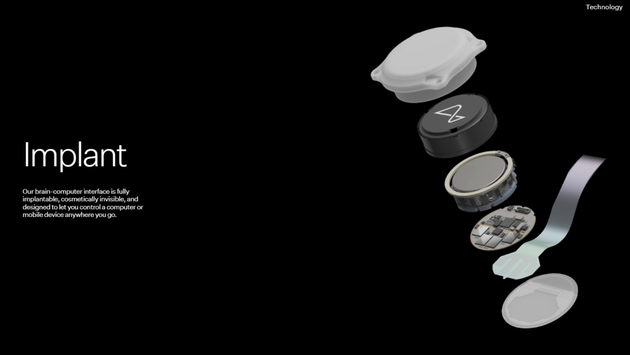
Photo/Neuralink's website
NBD: When you first realized you could control a computer purely through thought — that moment when the cursor moved for the first time — what went through your mind?
Noland Arbaugh: Honestly, my experience moving the cursor came in two waves. When I first moved the cursor, it just made sense to me. Just because I have a spinal cord injury doesn’t mean the neurons of my brain aren't firing, and the device is just registering those neurons and mapping them to outputs on a computer. Seems pretty straightforward.
But then, the second wave hit and it hit hard. Let me elaborate a bit. The device is implanted in my left brain motor cortex, specifically in the region that controls my right hand. So when I try to move my right hand, specific neurons — or groups of neurons — fire, and the device registers those signals then maps it to whatever we decide. For example, if I try to move my right hand to the left, specific neurons fire, and the more times I do that the more data we have to feed into a machine learning model, and over time we can map that to a leftward cursor movement; in the field, this is called "attempted movement".
Now, back to the second wave. There is another type of cursor control in the field called "imagined movement". This is, as you yourself might have imagined, moving the cursor by just thinking, not attempting to move any body part. When I first moved the cursor just by thinking, it blew my mind. No pun intended. I was smiling and giddy for an entire day. This went way beyond "it just made sense to me". That's when this technology became truly sci-fi and its potential and possibility became limitless in my mind.
On BCI's Impact: BCI Can't Redefine Humanity, But Will Revolutionize Human Potential

Noland Arbaugh (R)/Provided by the Interviewee
NBD: Beyond restoring lost abilities, Neuralink is now entering a phase where it could enhance human performance — such as reaction speed in gaming. Where do you think the ethical line should be drawn between "healing" and "enhancing"?
Noland Arbaugh: I am not an expert in ethics, nor do I believe I have a good answer to this question. In some ways, I'm not sure there should be a line drawn between healing and enhancing. If someone wants to enhance themselves, then by all means go right ahead. If we are strictly speaking of enhancement in terms of things such as reaction speed, cognitive function, even physical enhancement, then I have no issues whatsoever.
NBD: Neuralink is projected to gain regulatory approval for its Telepathy device in the U.S. by 2029, with plans to perform around 2,000 implants per year thereafter. From your firsthand experience, what improvements do you hope to see before this technology becomes mainstream?
Noland Arbaugh: There is so much, with every iteration it will improve. There is still room for typing to improve, for the cursor to improve, for gaming to improve, for new ideas to be cultivated, and for more areas of the brain to be explored. More than anything, what I want is for it to be implanted in as many people as possible, which I know will lead to exponential growth.
NBD: Finally, when you think about the future — perhaps five or ten years ahead — do you believe BCIs will redefine what it means to be human?
Noland Arbaugh: The short answer is no, I don't believe BCIs will redefine what it means to be human. I believe BCIs will redefine the limits of human capability, but that doesn't change who we are; it doesn't change our souls. At the end of the day, this is a technology. It is a tool that cannot redefine humanity, but it can revolutionize our potential.


 川公网安备 51019002001991号