Global bond markets are undergoing another sharp sell-off.
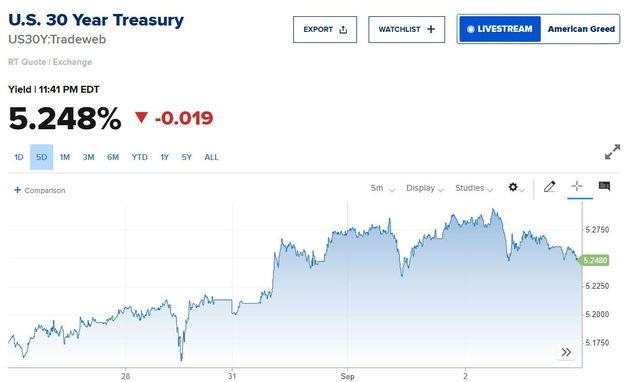
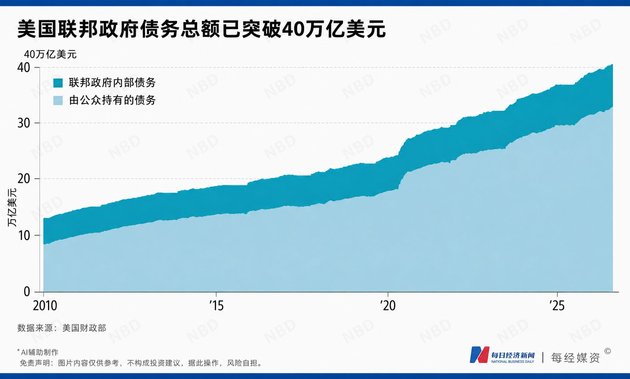
On September 2, the yield on the 10-year U.S. Treasury briefly rose to around 4.81%, approaching a three-year high, while the 30-year Treasury yield climbed above 5.28%, remaining near its highest level in almost two decades. At the same time, U.S. federal debt has surpassed $40 trillion. High debt and high interest rates are increasingly becoming two of the most important risk variables for global markets.
“This is not cyclical, this is a return to normal,” Kenneth Rogoff, who recently spoke at the 2026 Jackson Hole Economic Policy Symposium, told National Business Daily (NBD) in an exclusive interview.
One of the world’s most influential economists in the study of sovereign debt, financial crises and the international monetary system, Rogoff is a former chief economist of the International Monetary Fund and currently a professor of international economics at Harvard University. With former World Bank Chief Economist Carmen Reinhart, he co-authored This Time Is Different: Eight Centuries of Financial Folly, a landmark study tracing debt and financial crises across 66 countries over eight centuries.
For Rogoff, the issue worth re-examining is not simply why the 30-year Treasury yield has risen above 5%, but the broader consensus among economists over the past decade and more about an era of ultra-low interest rates.
He criticized the views of Nobel laureate Paul Krugman, who, Rogoff said, repeatedly argued that “debt is our friend” and that there was little reason to worry about government debt.
Rogoff sees the latest rise in Treasury yields as a normalization of interest rates — a process over which, he argues, the Federal Reserve has very little long-term control.
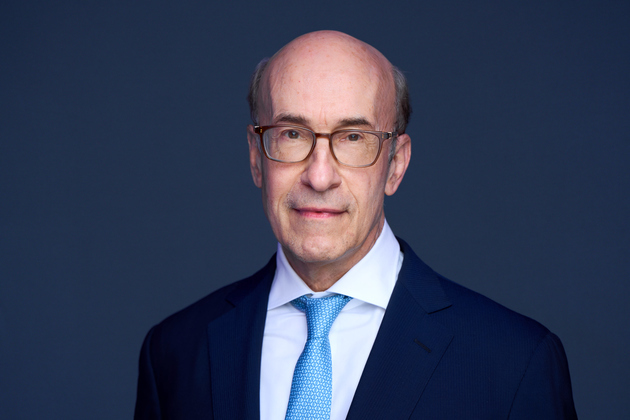
Kenneth Rogoff Photo/Provided to NBD
The Treasury Yield Surge Is Not Cyclical — It Is a Return to Normal
NBD: The yield on the 30-year U.S. Treasury recently rose above 5.3%, reaching its highest level since 2007. How do you interpret this sharp rise in long-term Treasury yields?
Kenneth Rogoff: There are many factors pushing rates up, including the epic AI buildout, geopolitical fragmentation, wars in Ukraine and Iran, and rise in global populism. Then, of course, there is the massive rise in global debt.
However, the single most important factor is the inevitable normalization of real (inflation expectations adjusted) interest rates that had collapsed after the global financial crisis.
Real interest rates are ultimately determined by global supply and demand for savings and investment, and after 2008-2009, investors became skittish, savers cautious, and regulators, if anything, overzealous. It was inevitable these effects would wear off eventually.
Indeed, the phenomenon of having periods of ultra low and ultra high interest rates for a periods has been going on for centuries, and there is inevitably reversion to mean. This would have happened sooner if the pandemic had not occurred right on top of the global financial crisis.
For those who claim the rise in interest rates is entirely the AI productivity boom, I would point out that both real and nominal rates rose sharply three years ago, long before AI investment was large.
NBD: U.S. federal debt has recently surpassed $40 trillion. Why has federal debt grown so rapidly in recent years?
Kenneth Rogoff: The global financial crisis and pandemic together contributed a large share of the rise.
However, the bigger problem is that neither party, when in power, has shown any will to rein in deficits (the amount being added to the debt each year).
Trump I ran massive deficits, Biden did the same, and now the deficit seems on track to hit over 6% of GDP, an astounding level in peacetime. Part of the problem, of course, is that the normalization of interest rates, has caused debt servicing — interest payments on the debt — to soar. But on top of that Trump has introduced massive new tax cuts.
Going forward, military spending (which is now below interest costs on the debt) is almost certainly to rise even if the Democrats win in 2028.
“Governments, Central Banks and Leading Economists Were Mesmerized by Ultra-Low Interest Rates”
NBD: We are now seeing two trends at the same time: a rapidly rising debt burden and rising long-term Treasury yields. How should we understand the relationship between the two?
Kenneth Rogoff: Per my answer to question 1, what we are seeing is more the result of a normalization of interest rates that is causing debt servicing to rise. Yes, higher debt in the US and globally is certainly one factor pushing up interest rates, but by no means the only one.
It is astounding to think how governments, central banks, and leading economists were mesmerized by the period of ultra-low interest rates in the 2010s, with leading economists and economic opinion makers fooling themselves into believing that “this time is different” and that factors such as demography, inequality and low productivity growth would keep rates low far into the future.
Nobel Prize winner Paul Krugman wrote dozens of highly influential New York Times columns about how “debt is our friend,” no one should worry about government debt hardly at all.
There were variants of this such as Blanchard’s argument that growth always outstrips interest payments, so there really is nothing to worry about.
And perhaps the most influential view was Lawrence Summers’ secular stagnation theory, which argued that without massive new government debt each year, global interest rates would remain ultra low and growth would be very slow.
The Fed Has Very Little Long-Term Control Over Real Yields
As of July 2026, the U.S. PCE price index had remained above the Federal Reserve’s 2% longer-run inflation goal for 65 consecutive months. At the Jackson Hole symposium on August 28, Fed Chair Kevin Warsh said that if policymakers could not be confident inflation was returning to the 2% target, the Fed would have to respond accordingly. Three days later, on August 31, U.S. President Donald Trump said: “In my opinion, we should have the lowest interest rate in the world by far.”
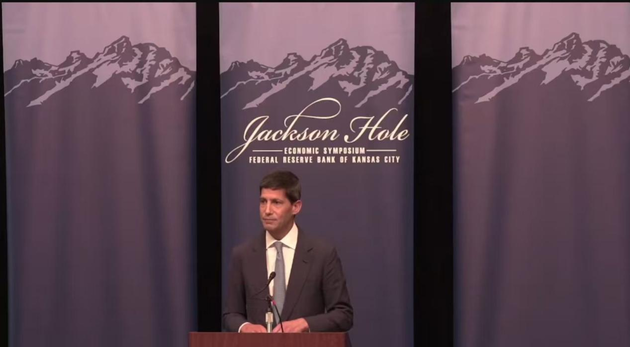
Fed Chair Kevin Warsh delivered first Jackson Hole speech.
NBD: The Federal Reserve’s policy rate and long-term Treasury yields have become increasingly disconnected. Is the Fed losing influence over long-term borrowing costs?
Kenneth Rogoff: Absolutely, yes. The long-term interest rate has two major components, the real yield (controlling for inflation expectations) as discussed above and expected inflation. Expected inflation has moved up somewhat but most of the action has been in the real yield, over which the Fed has very little long-term control.
Fiscal policy, on the other hand contributes mightily to the saving investment balance that determines the global real interest rates. However, as noted above, many factors are at play, including war, AI, etc.
NBD: If even rate cuts by the Federal Reserve are no longer sufficient to bring down long-term Treasury yields, what does that imply for monetary policy?
Kenneth Rogoff: Given that inflation expectations are reasonably well anchored, rate cuts by the Fed, if not warranted by inflation trends, will RAISE long term yields.
If the US government wants to bring down long-term yields, it needs to try having a more credible fiscal consolidation program and not just telling people that growth will solve all problems, as the Treasury Secretary has repeatedly asserted.
NBD: The U.S. Treasury has recently expanded its buyback operations for longer-dated government securities. How do you interpret this move?
Kenneth Rogoff: The buyback operations can have a small effect, by reducing the supply of long-term bonds, but since many factors are influencing long rates, the effect is not large. Buybacks, unfortunately, have the effect of shortening the maturity structure of US debt, and making the government even more vulnerable to interest rate hikes.
NBD: Over the longer term, could such Treasury interventions alter the price-discovery mechanism of the Treasury market or create new financial risks?
Kenneth Rogoff: Yes, buybacks and other gimmicks impede price discovery, and hide somewhat the reality that the US fiscal policy is unsustainable, fooling especially politicians.
The United States Could Even Face a Partial Debt Default
NBD: Do you think the United States risks entering a self-reinforcing cycle of rising debt and higher interest rates?
Kenneth Rogoff: The risk is that with high interest rates, high debt, and political paralysis, the US has become less resilient to a major shock, for example a larger war in Europe, the Middle East or Asia, or an environmental catastrophe.
The risk is the US will be forced to rely on financial repression and inflation, possibly even partial default (the Trump administration advanced that idea early on). This will in turn, accelerate the decline of dollar dominance.


 川公网安备 51019002001991号