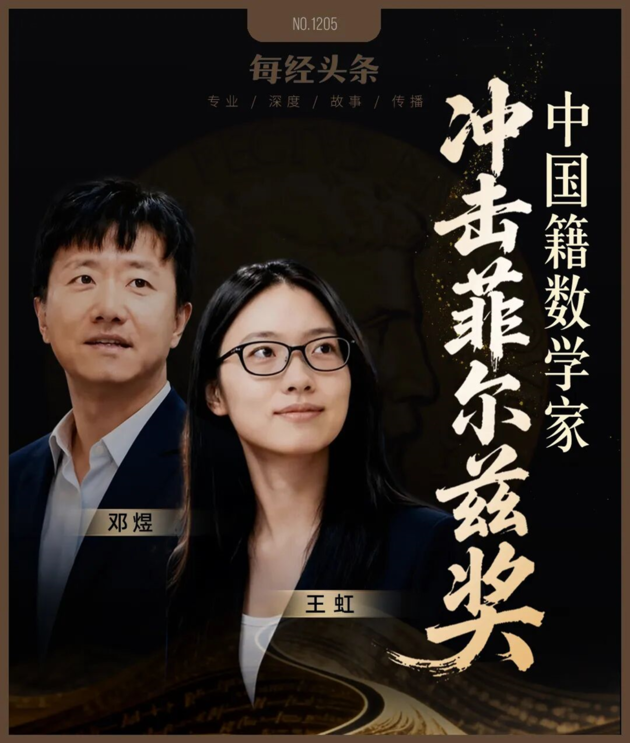
The quadrennial Fields Medal will be announced at the International Congress of Mathematicians (ICM) on July 23. Two Chinese mathematicians, Wang Hong and Deng Yu, have emerged as top contenders for this year's award. The two were classmates in the 2007 cohort at Peking University's School of Mathematical Sciences.
If they both win, it would not only end the long wait for a Chinese national to claim mathematics' highest honor, but also mark a turning point – China's transition from a large country in mathematics to a mathematical powerhouse. A new era, many say, has begun.
Multiple mathematicians predict very high probability of both receiving the Fields Medal
On July 23, the "Olympiad of mathematics" – the ICM – opens in Philadelphia, USA. The very first item on the agenda is the presentation of the Fields Medal, awarded once every four years.
Compared with the Nobel Prize, which carries a cash award of about 8 million yuan per individual, the Fields Medal's prize of less than 100,000 yuan per winner is modest. Yet in mathematics, it is globally recognized as the highest honor for young researchers. It recognizes the most original, disruptive, and potentially transformative breakthroughs, with a strict age limit of under 40, awarded only once every four years, and to at most four individuals. Over nearly a century, the total number of Fields medalists worldwide stands at only a few dozen – far rarer than Nobel laureates.
In 1982 and 2006, mathematicians of Chinese descent – Shing-Tung Yau and Terence Tao – received the Fields Medal, but no Chinese national has ever stood on that podium. Moreover, in nearly a hundred years, only two women have ever won the award.
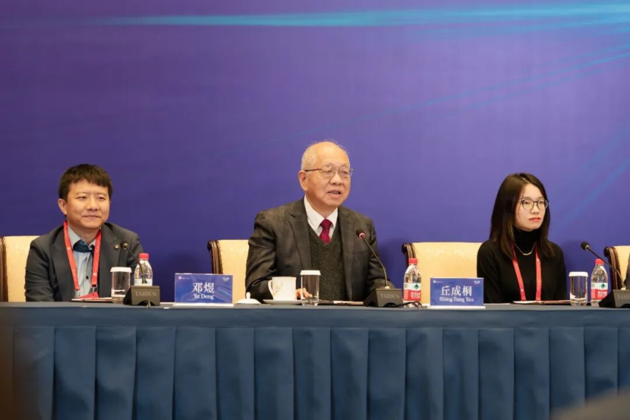
January 2026: Deng Yu (first from left) and Wang Hong (third from left) with Shing-Tung Yau at the International Congress of Chinese Mathematicians (ICCM). Photo provided by interviewee.
About two weeks before the ICM convenes, some users used web‑scraping tools to extract hidden information from the congress website, spreading the names of this year's anticipated Fields medalists – Wang Hong and Deng Yu. As of press time, the ICM organizers have not responded.
"The Fields Medal is decided several months in advance, but it is not publicized before the official announcement," a person familiar with the matter told National Business Daily (NBD).
If they win, it would mean that Wang Hong, 35, and Deng Yu, 37, have produced original breakthroughs significant enough to reshape subfields of mathematics, and have been certified as the world's foremost young mathematical researchers. The honor would not only allow them to choose tenured positions at top global universities with ample research support, but their research directions would also help define the development of fundamental mathematics for decades to come.
What research achievements have made Deng Yu and Wang Hong such strong candidates?
In 2025, Wang Hong and Joshua Zahl released a 127‑page preprint that solved the three‑dimensional Kakeya conjecture, a problem that had stood for a century. Their novel methodology could provide a fresh foundational analytical framework for signal processing fields such as radar and remote sensing. Meanwhile, Deng Yu, together with Zaher Hani and Xiao Ma, made a core breakthrough on Hilbert's sixth problem, deriving the laws of macroscopic fluid motion from microscopic particle dynamics. Zaher Hani told NBD: "For example, weather forecasts and airplane turbulence involve fluid phenomena with highly irregular and possibly singular solutions. Our understanding of such phenomena is far from satisfactory and imposes many technological limitations on our daily lives. Clarifying the connection between Newton's laws and fluid equations can help us determine what happens when fluid singularities appear or afterwards."
Asked about Deng Yu's chances, his doctoral advisor, Princeton mathematics professor Alexandru Ionescu, said in an exclusive interview with NBD: "Deng Yu has a very high probability of winning the Fields Medal." He also noted that colleagues hold Deng's academic work in extremely high regard. "I will also attend this year's ICM and hope to congratulate him in person there."
"Judging by the international mathematics community's evaluation over the past two years, Wang Hong is almost universally regarded as a top candidate for the Fields Medal," commented Chinese‑American mathematician Shen Zhongmin, who co‑authored Riemann‑Finsler Geometry with the late mathematical giant Shiing‑Shen Chern. "Personally, I have always thought her probability of winning is close to 99%. I have also always believed that Chinese women are no less capable than men in mathematics and scientific research, and Wang Hong's award would be excellent proof of that."
The Go prodigy and Dream of the Red Chamber enthusiast: Deng Yu's "atypical" path in mathematics
Born and raised in Shenzhen, Deng Yu fits the mold of a "child prodigy."
He showed remarkable talent in Go and mathematics from an early age. In his first year of middle school, he came very close to turning professional – "just a little short of promotion." At 17, he won a gold medal at the International Mathematical Olympiad (IMO), was admitted to Peking University's mathematics department without entrance exams, and two years later transferred to MIT in the United States.
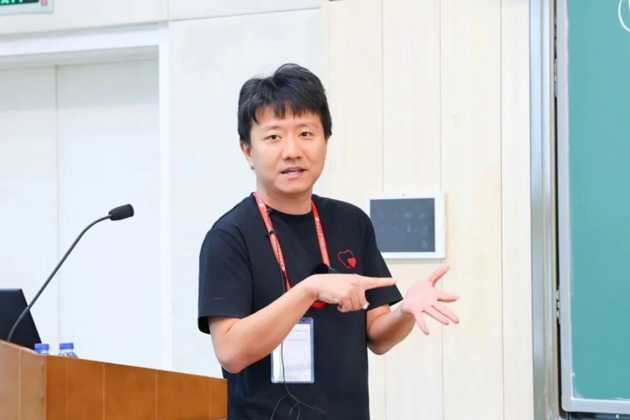
Deng Yu giving a seminar talk. Image credit: Beijing International Center for Mathematical Research.
"Most IMO gold medalists are admitted to Peking University; some transfer to MIT or other schools in their first or second year – it's a relatively established path," Yan Xiaochuan, a classmate of Deng Yu's as an undergraduate at MIT, told NBD. "MIT's scholarship policy is very generous: students with family incomes below $150,000 per year receive full scholarships automatically, without even applying. The scholarship covers tuition, room, and board, and leaves you with five or six thousand dollars a year left over. It's the same for international students."
After earning his PhD from Princeton, Deng Yu is now a professor at the University of Chicago. In 2018, Zaher Hani, who had studied under Terence Tao, approached Deng Yu at a conference.
"I knew him as a 'star graduate' from Princeton," Hani recalled. "At the time, I had only a crude result for the derivation of the kinetic equation and needed someone with a better combination of probability and PDE techniques than I was used to. I asked a couple of experts in the field for some hints, but didn't get anywhere. When I asked Yu Deng about it, he instantly recognized what was needed, provided me with the right reference in the literature, and even optimized the methodology in that reference to the context of our problem." Their collaboration snowballed from there and continues to this day.
During 2024–2025, Deng Yu, Zaher Hani, and Xiao Ma completed the rigorous derivation of the Boltzmann equation from hard‑sphere dynamics over long timescales – a key advance toward solving Hilbert's sixth problem, widely regarded as "Fields Medal‑level" work.
Zaher Hani gave unreserved praise:"Yu Deng is an amazing and outstanding talent. Allow me not to comment this week about the likelihood of him getting the Fields medal, because this is private information that I'm not allowed to disclose. In any case, I hope that all the recognition that he is getting will make it clear to people, beyond the small research community where Yu Deng operates, how outstanding his talent is. He is hard working, extremely deep, a very fast thinker, all at a level that is very rare and exceptional; a true force of nature. He surely is a national treasure and a pride for China. I'm definitely very lucky to have worked with him."
Among his collaborators is Xiao Ma, 28, who came through the "Special Class for the Gifted Young" at the University of Science and Technology of China. In an interview with NBD, Ma said: "There are many smart people in mathematics, but Professor Deng is the closest thing to a mathematical genius I have ever seen. He has immense explosive power – give him a problem and he can 'kill' it in a day or two once he gets an idea."
"I am constantly surprised how Yu Deng is able to understand a vaguely stated thought that I'm having, and is able to translate it and develop into something that is clearer, and that we can actually build on it further (or maybe just discard if it's not a good idea)," said Zaher Hani.
In Yan Xiaochuan's view, Deng Yu is not the stereotypical "bookworm." "When I organized parties and activities at school, he would come. He likes listening to Zhang Liangying's songs, loves re‑reading Dream of the Red Chamber, and can be deeply moved by a single line of Du Fu's poetry. Like any ordinary person, he inevitably procrastinates sometimes: brewing tea, nibbling on biscuits, flipping through a few pages of Dream of the Red Chamber, or opening his computer for a few games of Minesweeper or browsing Zhihu. As a real‑name user on Zhihu, he often engages in lively discussions on various topics. He writes poetry, enjoys taking walks along the Charles River by MIT, and repeatedly walks the same short stretch – which may have to do with his personal aesthetic; he has rather high standards in that regard."
Several detours, reach for dream: Wang Hong from the School of Earth and Space Sciences to conquering the Kakeya conjecture
Thirty‑five years ago, no one would have believed that a child from Shazi Town, Pingle County, Guilin, Guangxi – a place with limited educational resources – would one day write herself into the history of mathematics. Wang Hong spent her early years there, with parents who were teachers at local township middle schools.
When the third preprint on the three‑dimensional Kakeya conjecture appeared in 2025, Wang Hong became a blazing star in the academic world. Li Huihui (pseudonym), a student who attended several of Wang Hong's talks, shared with NBD: "At the 'wine party' at UC Berkeley in 2025 – an evening where mathematicians, after their academic talks, relaxed and chatted with students about non‑academic questions – one question drawn for Wang Hong was: 'Have you ever experienced impostor syndrome? If so, how do you deal with it?' It's a question many people in mathematics may ask themselves at some point – doubting whether they really have what it takes."
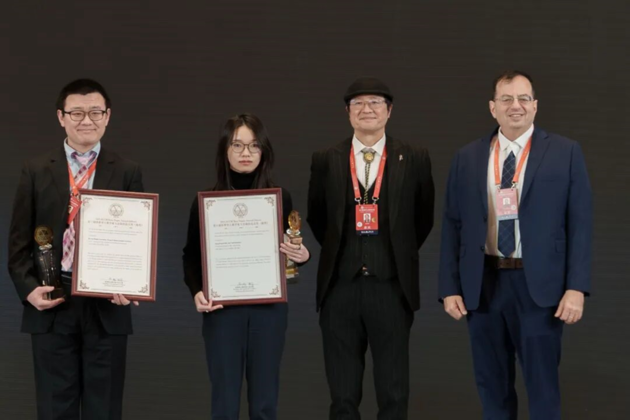
Wang Hong (second from left) receiving an award at the ICCM, with Lin Huaxin (second from right). Photo provided by interviewee.
Wang Hong's answer was "No" – which drew a knowing laugh from the audience. She then spoke candidly. Though she is now seen as a "genius above geniuses," Wang Hong said she had once been underestimated. "Never be intimidated by others. Many people just appear to be very impressive."
In fact, her story is not one of a straight path from childhood certainty, and for a long time she did not stand out conspicuously.
"Wang Hong took the college entrance exam in 2007. In terms of admissions thresholds at the time, directly entering Peking University's mathematics school was much harder than entering the School of Earth and Space Sciences. The math school is Peking University's flagship program, with most students being competition stars or special admits. Very few entered through the regular exam. Wang Hong's score was not sufficient for direct admission to the math school, so she first entered the Earth and Space Sciences school, then had to rely on self‑study and a rigorous transfer examination to pursue mathematics – a much harder road than competition admission or direct enrollment," said Olympic mathematics coach Wang Jie. "I can particularly relate to this, as I also switched from another field to mathematics. It requires immense effort and perseverance."
Sun Xin, now a professor at Peking University's International Center for Mathematical Research, was a classmate of Wang Hong's for three years as an undergraduate and overlapped with her for another three years during his PhD at MIT. According to his recollection, during the first‑year mathematical analysis core course, which was open to all, Wang Hong – then still in the Earth and Space Sciences school – attended the same class. "I recall that the active participant in the seminar was Deng Yu," Sun Xin said. "Wang Hong is two or three years younger than us and loved playing table tennis; I often saw her in sportswear."
During their PhD years at MIT, Sun Xin and Wang Hong had closer academic exchanges. "To be honest, I did not initially expect Wang Hong to pursue serious mathematical research – of course, that was due to my own biases. But during the PhD stage, her focused and dedicated temperament already impressed me deeply."
In September 2025, Wang Hong joined the Institut des Hautes Études Scientifiques (IHES) in France as its first Chinese tenured professor. In a video recorded for the institute, she said: "I love mathematics because, once you understand it, it is very clear, beautiful, and elegant. I tried to switch to architecture during my master's degree and even interned at an architecture firm in Paris, but I found that I still preferred mathematics, so I came back to it."
As Zhao Tuo, associate professor at Georgia Tech, put it: Wang Hong did not choose mathematics just once. Her sense of direction was not something she was born with – she discovered it through repeated confirmation and revision, step by step.
In the descriptions of Ma Xiao and Li Huihui, Wang Hong appears to be an introvert, but she is very good at lecturing – "explaining deep content step by step, clearly." "When I was a PhD student at Princeton and became interested in harmonic analysis, I asked Wang Hong many questions. Later, when she was a postdoc at Princeton, I specifically attended her talks – she was already a well‑known young mathematician, but she was very patient with students and listened carefully to what they had to say," said Ma Xiao. "That is a rare quality in mathematics; many mathematicians are not very good at listening."
Generations of "serious and honest" problem‑solvers – AI and rocket landings all depend on mathematical computation
Lin Huaxin, a leading Chinese‑American mathematician in operator algebras and a recognized leader in the field internationally, believes that China is already on the path from a large country in mathematics to a mathematical powerhouse – and that this is the result of decades of cumulative effort. "This is a new beginning." By way of example, among those giving talks at this year's ICM, 12 are Peking University undergraduate alumni, and four of them – Deng Yu, Tang Yunqing, Wang Hong, and Sun Xin – are from the class of 2007 alone. "This shows that Peking University's mathematics level itself has risen more than one notch over the past thirty to forty years," Lin Huaxin told NBD.
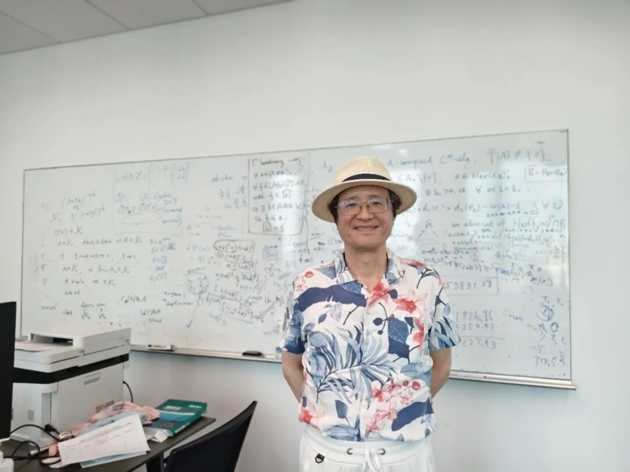
Lin Huaxin during an interview. Photo credit: NBD reporter Shu Dongni.
Zhang Ruixiang, Guo Shaoming, Ou Yumeng, Du Xiumin – among the most important scholars in harmonic analysis internationally today are Chinese mathematicians. So much so that a joke circulates among students: "If you want to learn harmonic analysis now, you can start by learning Chinese."
When Lin Huaxin first went to the United States for graduate studies, it was the early years of China's reform and opening‑up. The country was still catching up in many areas, and front‑line natural sciences – especially mathematics – lagged far behind. At a student gathering, when a local person learned that Lin was doing mathematical research, he blurted out: "You people also do scholarship?" "When our generation studied abroad, the gap between China's mathematical level and the world's top was very large. Over the decades, mathematicians studied abroad, became mathematicians, and then returned, bringing China's mathematical research up to speed and creating a cycle of training. This process is crucial because we need to know what the world is doing and participate in it; otherwise we remain in the past," Lin explained.
Since 2000, Lin Huaxin has regularly returned to China as a visiting professor under the Zijiang program to mentor students. At the end of 2024, he resigned permanently from his tenured position at the University of Oregon and returned to China full‑time, joining the Shanghai Institute of Mathematics and Interdisciplinary Sciences (SIMIS), established in 2023 and initiated by Shing‑Tung Yau as its first chairman, focusing on fundamental mathematical research and talent development. "Mathematics is, of course, everywhere. For example, in AI, if we can optimize algorithms through mathematics, we can save computing power. Whether a commercial rocket can return precisely to its launch point requires mathematical computation within error margins... All natural sciences and engineering depend on mathematics."
Yet if one emphasizes the "utility" of mathematics, it does not directly point to any immediate "function." "Whether something can be done quickly or what economic benefits it might produce – those are not considerations for mathematicians; that is different from engineering. Does solving this mathematical problem change the world tomorrow? Far from it," said Lin Huaxin.
A female mathematics PhD student changed her social media avatar to Wang Hong's picture: "The climb is certainly arduous, but because of genuine passion, even a fall reveals a scenic view." Wang Jie shared his own observation: "Last year, I took three teenage mathematics competition students, aged 14–15, to attend Wang Hong's talk in person. Of course, they couldn't understand it, but they were very interested and willing to discuss it with me."
In Zaher Hani's view, China's mathematical progress over the past few years has been remarkable. China has always been a major source of excellent students and talent for Western universities, but now it is becoming a significant center of mathematical innovation. "With Chinese mathematicians receiving the highest recognition, this will only encourage further progress and prove that nothing is beyond their reach."
"On the world mathematical stage, the United States still holds a large advantage, but China is narrowing the gap," Lin Huaxin added. "An important sign is that China is now attracting mathematicians from all over the world. For example, SIMIS hires mathematicians globally; Wang Hong's collaborator Joshua Zahl has been invited by Chinese mathematician Guo Shaoming to join Nankai University full‑time. By bringing in top talent, we sustain momentum without needing to boast constantly. Give mathematicians ample space, let them discover on their own, and don't ask what use it will have tomorrow. The younger generation of mathematicians will surpass us."


 川公网安备 51019002001991号