“AI is not merely a financial narrative. It already has substantial real-economy impact,” said Louis Kuijs, Asia-Pacific chief economist at S&P Global Ratings.
Kuijs made the remarks in an interview with National Business Daily (NBD) on the sidelines of the 2026 Tsinghua PBCSF Global Finance Forum, held in Chengdu from May 18 to 19. He discussed the Asia-Pacific economic outlook, the AI investment cycle and potential credit risks.
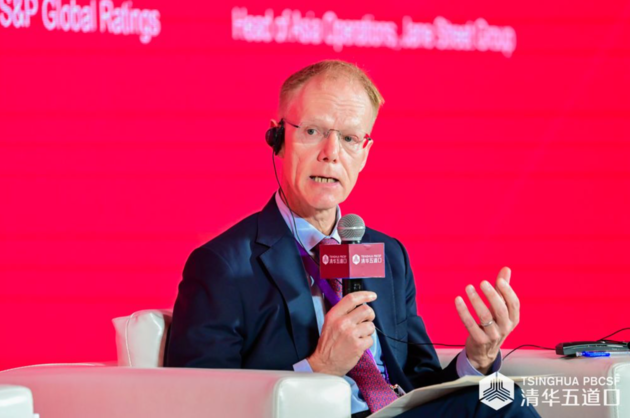
Louis Kuijs Photo/provided to NBD
According to Kuijs, one of the key differences between the current AI boom and the dot-com bubble around 2000 is that today’s AI cycle has already triggered massive real-world investment.
“One major difference from the dot-com era is that the dot-com boom was largely based on expectations about the future that often never materialized,” he said. “This time, regardless of whether AI monetization succeeds, enormous real-world investments are already happening.”
He noted that data centers are being built across the United States, with hundreds of billions of dollars invested every year, while China is also investing heavily.
That means AI has moved beyond capital-market expectations and into the real economy. The boom is already affecting infrastructure, construction, employment and credit markets. But Kuijs warned that risks could emerge if future commercial returns fail to justify current investment.
“If those investments cannot eventually be monetized, somebody will bear the losses,” he said.
Kuijs said slower-than-expected AI monetization could lead to credit problems. Some companies may struggle to service their debt, while investors may have to absorb losses. He added that large AI-related companies and hyperscalers have already issued substantial amounts of debt.
“If monetization fails to materialize, credit quality could deteriorate,” he said. “My colleagues in credit ratings would probably have to consider downgrades.”
On the Asia-Pacific outlook, Kuijs said the Middle East conflict remains an important risk factor, as it may push up costs, inflation and energy-supply concerns. These pressures have already been incorporated into their outlook.
However, he also pointed to positive factors in Asia, particularly AI-related technology exports.
“AI and what it means for exporters in Asia is really significant at the macroeconomic level,” he said. Economies including China, South Korea, Malaysia and Thailand are benefiting from the AI-related technology export boom, which is helping offset some external pressures.
In S&P Global Ratings’ baseline outlook, Kuijs does not expect Asia to fall into recession, although growth may slow due to energy shocks and weaker global momentum.
“We do expect growth to slow,” he said. “However, we do not envision a dramatic slowdown.”
He added that many Asian emerging economies still have solid long-term momentum supported by investment and productivity growth.
Kuijs also said Asia plays a crucial role in the AI cycle not only because of capital spending, but also because of its position in building AI infrastructure. Beyond advanced chips and memory chips, data centers require transformers, wiring, electrical equipment and cooling systems.
“That’s where China is increasingly benefiting,” Kuijs said. “I am sure China is exporting a growing amount of the industrial infrastructure required for AI systems and data centers globally.”
Speaking about Chengdu, where the forum was held outside Beijing and in western China for the first time, Kuijs said he had visited the city about 15 years ago and was impressed by its transformation.
“Chengdu has become a highly developed city,” he said. “But Chengdu seems able to combine economic development with a relaxed and enjoyable lifestyle.”


 川公网安备 51019002001991号