A peculiar greeting has being taken over China’s AI circles: "Are you raising a lobster?"
The "lobster" in question isn't seafood—it’s OpenClaw, an open-source AI Agent that has ignited a viral movement.
Developed by Peter Steinberger, OpenClaw is celebrated for its ability to "take over the computer and free the hands," transitioning AI from a passive chatbot to an active, 7x24 autonomous executor.

The Frenzy: From Streets to Servers
On March 6, the tech hub of Shenzhen witnessed an unusual sight: hundreds of people queued outside the Tencent Building. Tencent Cloud dispatched dozens of engineers to provide on-site installation support. Through its Lighthouse platform, Tencent has reduced the once-complex deployment process to a "one-click" 5-minute task.

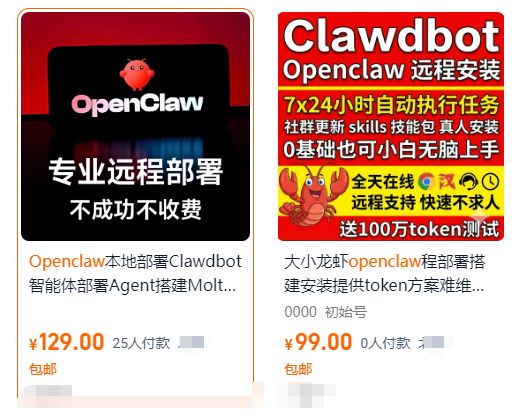
The demand is so high that a secondary market has emerged. On platforms like Xianyu and Xiaohongshu, "lobster installation" services are retailing for anywhere from a few dollars to nearly $100.
Tech Giants Enter the "Pond"
The "lobster fever" has drawn in major industry players, each with a distinct strategic logic:
Tencent Cloud: By offering free installation and a "zero-code" experience via Lighthouse, Tencent aims to capture the C-end (consumer) market and promote its proprietary cloud computing services.
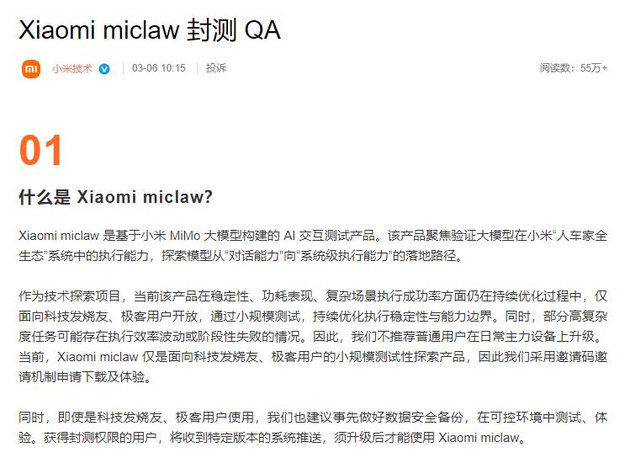
Xiaomi: On March 6, Xiaomi announced the closed beta of Xiaomi miclaw, a mobile-integrated Agent. Built on the MiMo LLM, it aims to turn smartphones into "AI bodies" that can autonomously manage schedules, commute logistics, and smart home devices.
Chen Han, founder and CEO of EvoLeap, notes that this represents a shift toward No-Code Automation. "Big labs are competing to occupy the user’s mindshare," Chen says. "Xiaomi, for instance, is evolving its 'Xiao AI' assistant into a proactive agent within its 'Human-Car-Home' ecosystem."
Innovation vs. "Security Nightmares"
Despite the hype, OpenClaw is not without its flaws. Early adopters and experts have raised two primary concerns:
Tests conducted by National Business Daily (NBD) revealed frequent failures in complex tasks like web searching and email management. Chen Han describes the experience as "initially surprising but currently unstable," making it unsuitable for "serious scenarios" like financial auditing or medical data processing.
Because OpenClaw operates with high-level system permissions, it faces "hallucination-driven" risks—such as accidentally deleting files. Furthermore, its third-party "Skill" plugins could serve as gateways for supply chain attacks or API key theft.
OpenClaw represents a pivot point in personal productivity. While "early adopters" stand to gain significant efficiency, they also bear the brunt of technical instability. For now, experts recommend "raising lobsters" on isolated cloud hosts or secondary computers to mitigate risks.


 川公网安备 51019002001991号