Photo/website of DeepSeek
DeepSeek, the Chinese AI breakout star of 2025, experienced its most significant service disruption to date between the evening of March 29 and the morning of March 31, 2026.
The outage, which lasted approximately 12 hours in its initial phase, left millions of users facing "server busy" prompts and unresponsive interfaces, sparking intense speculation across social media and developer communities.
On March 31, National Business Daily (NBD) sent an inquiry email to DeepSeek seeking clarification on the cause of the outage, but no response had been received as of publication.
Longest “Downtime” in History—Is a Major Update Coming?
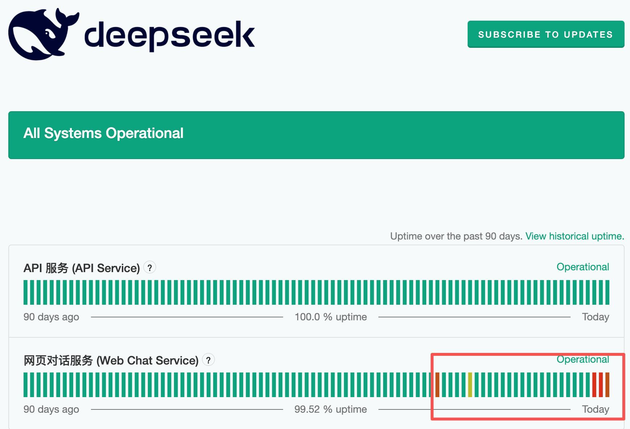
The service status page shows that DeepSeek’s WebChatService layer has encountered five incidents over the past 90 days, with the March 29–30 outage being the longest.
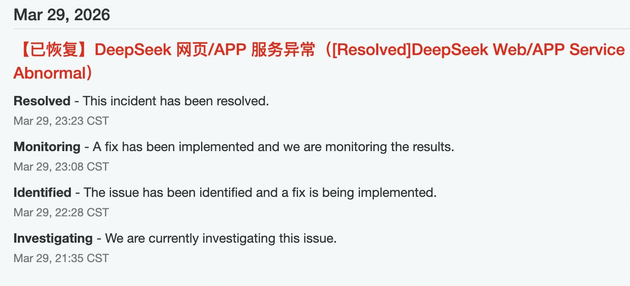
At 9:35 p.m. on March 29, DeepSeek first detected a failure caused by web and app service disruptions. This issue was resolved at 11:23 p.m. the same night.
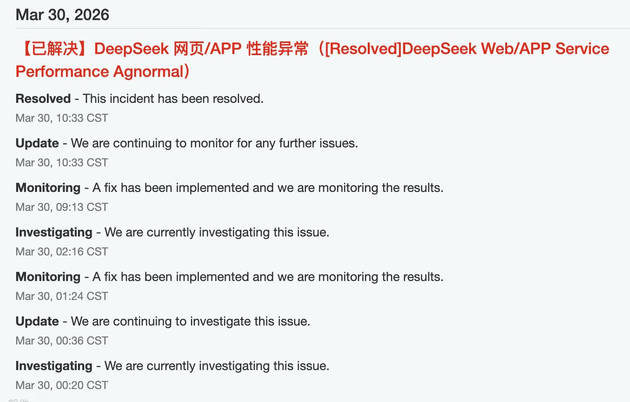
However, less than an hour later, at 12:20 a.m. on March 30, another failure occurred. This time, it was classified as a web/app performance issue and lasted for approximately 10 hours, until 10:33 a.m. on March 30. Combined, the two incidents spanned roughly 12 hours, marking the longest service interruption in DeepSeek’s history.
Just as the situation appeared to stabilize, another disruption occurred between 5:02 p.m. and 6:05 p.m. on March 31, when web/API performance anomalies once again prevented users from receiving responses. During this period, queries returned the message “please check your network and try again.” By around 6:30 p.m., the system had returned to normal.
The status page indicates that all recent failures were concentrated in the WebChatService, which serves as the front-end interaction layer between users and the model. This layer essentially functions as the “interface” delivering responses to end users. While consumer-facing users rely on this service, developers accessing DeepSeek through APIs may not have been significantly affected.
A technology company executive told NBD that their AI applications rely primarily on API calls, meaning the web/app disruptions had little impact on their operations. Even in the event of API issues, they could switch to alternative foundational models.
Meanwhile, several experienced developers on social media noted that after the March 31 recovery, DeepSeek’s output logic and coding style appeared to have changed significantly.
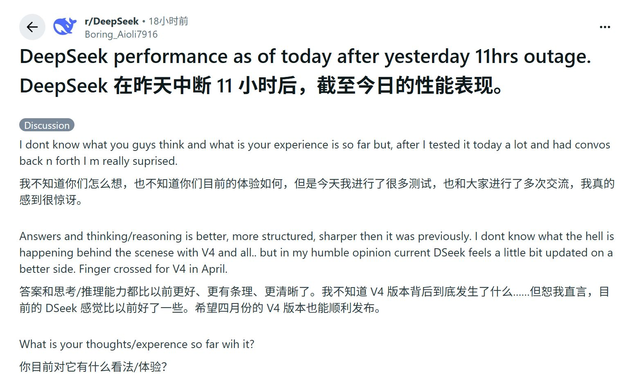
Although there have been prior reports suggesting that DeepSeek is preparing to release a new model, no official announcement has been made. This raises questions: is the current version a fine-tuned iteration of V3, or has it already transitioned to a new-generation V4?
At 6:05 p.m. on March 31, when asked about its current model version, DeepSeek responded that it was running the latest version, with a knowledge cutoff of May 2025 and support for up to 1 million tokens of context length. Notably, a 1M-token context window has long been anticipated by developers as a key feature of a potential V4 upgrade.
Hiring Surge in Agent Roles—Is DeepSeek Preparing a Bigger Move?
In February 2025, DeepSeek emerged as a standout “dark horse” among domestic large-model players, driven by explosive user growth, an innovative technical approach, and an open-source ecosystem strategy. Its monthly active users once surpassed 180 million, with new visits exceeding those of ChatGPT, marking a shift in China’s AI industry from “technology catch-up” to “model innovation.”
According to QuestMobile’s 2025 AI Application Layer Development Report released in early March 2026, China’s AI-native app market shows a clear tiered structure. Doubao and DeepSeek rank first and second with 226 million and 135 million monthly active users, respectively, followed by Tencent Yuanbao, Ant’s Afu, and Alibaba’s Tongyi Qianwen, forming the top five.
NBD also noted that on March 24, DeepSeek updated its official website with multiple job postings related to AI agents, including roles such as Agent Full-Stack Engineer, Agent Deep Learning Algorithm Researcher, and Agent Data Strategy Engineer.
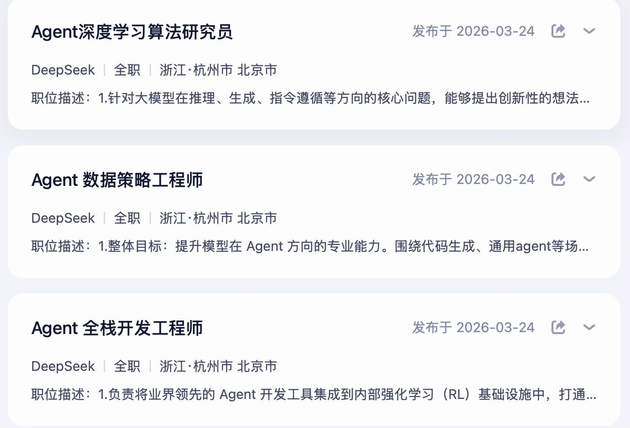
As early as December 2025, DeepSeek’s V3.2 release emphasized enhanced agent capabilities and integrated reasoning. The model introduced a large-scale agent training data synthesis approach, generating tasks that are “hard to solve but easy to verify” (covering over 1,800 environments and 85,000 complex instructions), significantly improving generalization ability.
Lin Jianlong, Vice President of Zhejiang Huatong Cloud Data Technology Co., Ltd., told NBD that AI agent technology is expected to follow several key trends. First, multimodality and long-context capabilities will become core competitive factors among large models. Models exceeding 1 million tokens and supporting native multimodal inputs will significantly expand application boundaries, enabling agents to handle more complex business scenarios.
Second, AI agents are rapidly evolving from “question-answering assistants” to “task executors.” Beyond answering queries, agents will increasingly perform specific tasks on behalf of users, driving higher levels of automation and fundamentally reshaping human-machine collaboration—from tools to “colleagues” or “partners.”
Previously, DeepSeek had been primarily positioned as a general-purpose large model, with its official description emphasizing research into world-leading general artificial intelligence technologies. The recent surge in hiring for agent-related roles has led some analysts to believe that the company is attempting to equip its powerful “brain” with more capable “hands and feet.”
Whether the recent service disruptions are linked to preparations for a major model upgrade remains unclear. However, market speculation continues to build around the possibility that DeepSeek is gearing up for a significant release.


 川公网安备 51019002001991号