“I wanted to do something unique, something that belonged to me.”
At 2:30 AM on December 28, 2025, 28-year-old David Moss sat in his Tesla Model 3 outside a Tesla diner in Los Angeles. With a few taps on the screen, he engaged Full Self-Driving (FSD) V14.2 and began a historic journey.
Over the next 68 hours (2 days and 20 hours), Moss claims his hands never touched the steering wheel, and his feet never pressed a pedal. The vehicle navigated the chaotic streets of LA, merged onto interstate highways, braved torrential rains and heavy fog, and crossed 24 states before arriving at Myrtle Beach, South Carolina.
The total distance: 2,732.4 miles (approx. 4,397 km). Total manual interventions: Zero.
This feat marks the world’s first verified zero-intervention cross-country trip using Tesla FSD, fulfilling Elon Musk’s 2016 vision of a car traversing the U.S. autonomously. Moss also became the first person globally to log 10,000 miles of continuous FSD usage.
In an exclusive interview with National Business Daily (NBD), Moss said that this challenge was about showing people the value of the tech and the goal is to reopen the world for people who cannot drive.

Photo/David Moss' social media account
A "hands-off" marathon: eyes have to stay on the road
Throughout the journey, Moss’s role shifted from driver to "supervisor." While the car handled the driving, Moss remained vigilant to monitor system prompts.
The trip was a gauntlet of real-world variables: low-visibility fog in California, thunderstorms at the Arizona-New Mexico border, and complex construction zones in the Midwest. In cities, the system managed stop-and-go traffic and identified pedestrians; at Superchargers, the car autonomously navigated to stalls and parked, requiring Moss only to plug in the cable.

Roadmap of David Moss' trip Photo/provided to NBD
“There wasn't a single close call,” Moss told National Business Daily (NBD). “Even for a human driver, that level of consistency is rare.”
He said that during the 2-day, 20-hour journey, the car maintained an average speed of about 120 km/h, reaching a top speed of 136 km/h. In total, he rested for about 12 hours. "I took a nap for an hour and 45 minutes in California, rested for about 3.5 hours in Phoenix, napped for half an hour at the border of New Mexico and Arizona, and then stayed overnight in New Mexico for a full 8 or 9 hours."
Despite the "hands-off" nature, the trip was grueling. Because FSD remains a Level 2 (Supervised) system, cabin cameras monitored Moss constantly. “I couldn't sleep, watch TV, or scroll through my phone. My eyes had to stay on the road,” he explained.
This wasn't a simple matter of "handing over the steering wheel." Instead, it required a seamless synergy between man and machine, with David Moss having to monitor every single decision made by the system throughout the entire journey.
"FSD data can be verified and I don't hold any share in Tesla"
Moss, a former LiDAR salesperson, was inspired by the legendary "Cannonball Run" endurance challenges. However, his motivation was also personal: his father, diagnosed with legal blindness due to a brain tumor, can no longer drive. Moss sees autonomous technology as a life-changing bridge for those with disabilities.
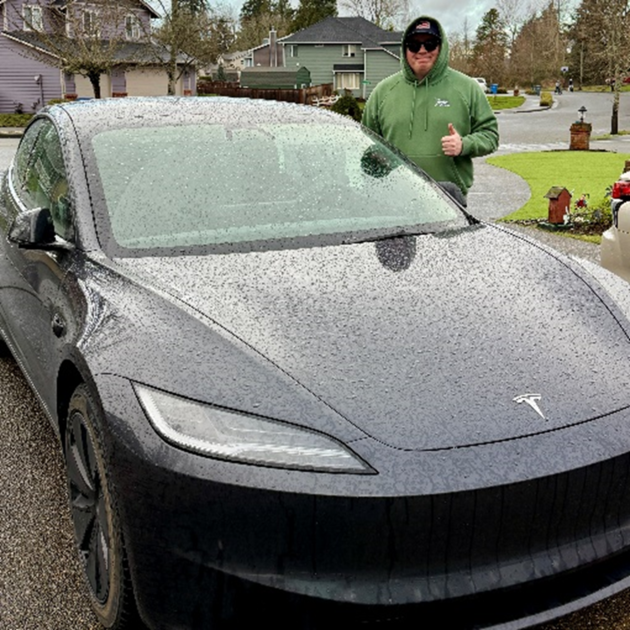
David Moss and his Model 3 Photo/provided to NBD
Moss also became the first owner in the world to be certified for driving 10,000 miles continuously using Tesla FSD.
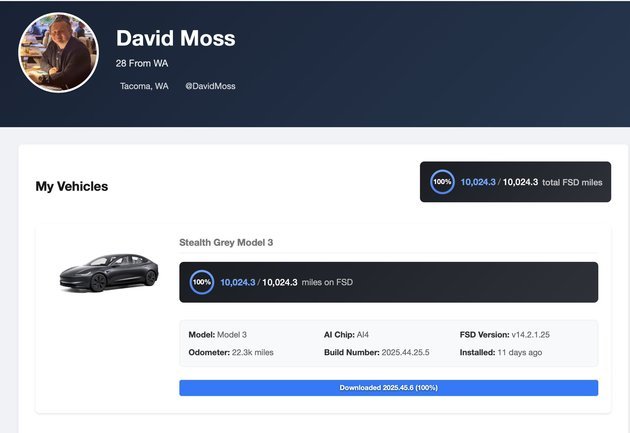
Photo/David Moss' social media account
During a previous trip on I-80 in Wyoming, Moss encountered crosswinds reaching 130 km/h. Despite this, he claimed the vehicle remained centered in its lane at 136 km/h without any drifting. "At that moment, I truly felt that an electric vehicle—with its low center of gravity and precise electronic controls—is more stable under autonomous control than when driven by a human."
Addressing skepticism, Moss noted that Tesla executives, including Musk and Ashok Elluswamy (VP of AI Software), confirmed the data. “I don’t work for Tesla, nor do I hold any shares,” Moss clarified. “I just wanted to prove the capability of the technology.”
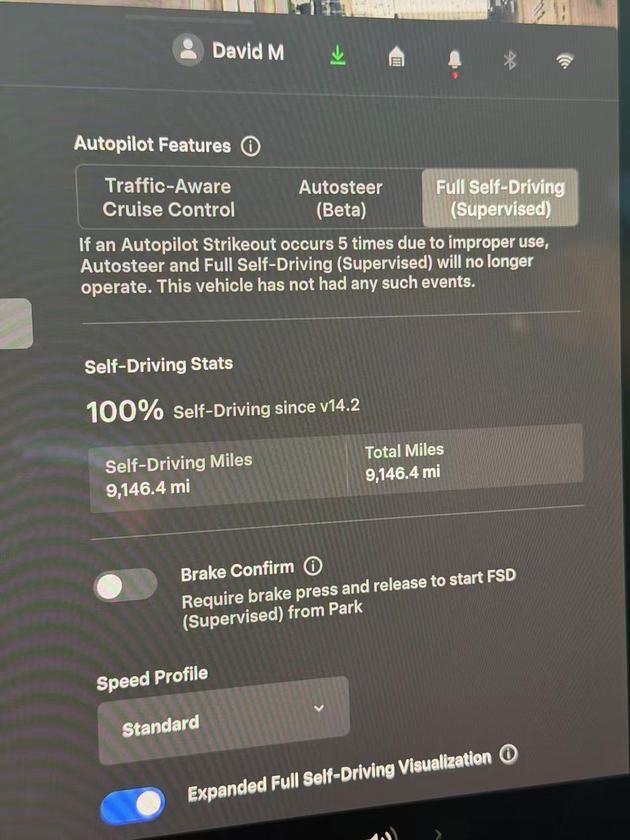
Photo/David Moss' social media account
“LiDAR isn't strictly necessary for full self-driving”
Despite selling LiDAR for a living, Moss is optimistic about Tesla’s "Vision-Only" approach.
“LiDAR isn’t strictly necessary for full self-driving,” Moss told NBD. He argues that while multi-sensor fusion (used by competitors like Waymo) provides rich data, it introduces complex "sensor fusion" problems, demands higher computing power, and adds prohibitive costs—sometimes upwards of $60,000 per vehicle.
However, the debate remains fierce. Critics argue that pure vision systems struggle in extreme lighting or weather, where Waymo’s LiDAR-equipped fleet excels. Conversely, Waymo’s reliance on high-definition maps led to a mass "stall-out" in San Francisco in late 2025 during a power outage—a vulnerability Tesla's end-to-end neural networks aim to avoid.
Tesla's "vision-only" approach is not foolproof either. In October 2025, the National Highway Traffic Safety Administration launched a new investigation into approximately 2.88 million Tesla vehicles equipped with FSD (Supervised), stating that the system may cause behaviors such as running red lights and making illegal lane changes.
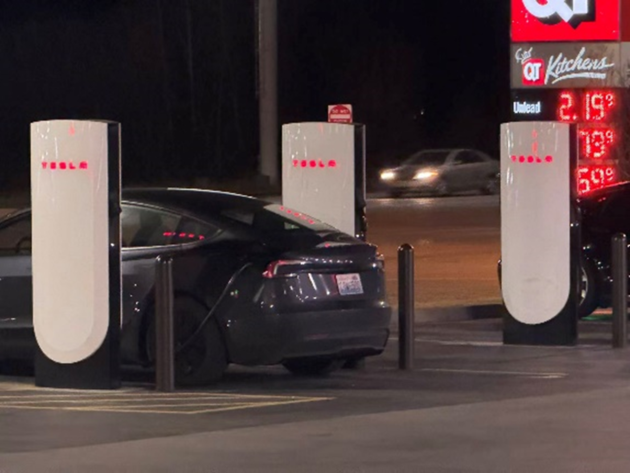
Photo/David Moss' social media account
Is ommercialization close?
While Moss’s trip is a milestone, experts warn that "zero intervention" does not equal "absolute safety." Three major hurdles remain.
The first hurdle is the long-tail risk. Solving 99% of driving scenarios is easy; the final 1%—rare "edge cases" like erratic construction or extreme weather—requires billions of miles of data to achieve human-level reliability.
The second one is regulatory disconnect. Legally, FSD is still a Level 2 system. The SAE (Society of Automotive Engineers) levels focus on liability rather than capability, leading to potential user over-reliance.
The last but not least, legislative vacuum. The U.S. lacks a unified federal regulatory framework for autonomous vehicles. Conflicting state laws and the absence of a national safety standard remain the primary bottlenecks for mass adoption.
“This challenge was about showing people the value of the tech,” Moss concluded. “Regardless of the brand—Tesla, Waymo, or others—the goal is to reopen the world for people who cannot drive.”


 川公网安备 51019002001991号