The US Supreme Court issued a 6-3 ruling on February 20, 2026, declaring the Trump administration's large-scale tariff policy illegal.
This eyecatching legal battle for rights was first launched by small businesses such as Learning Resources, a company based in Illinois.
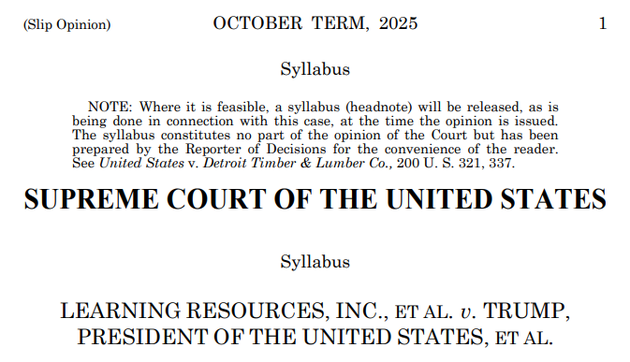
From the district court to the Supreme Court, after nearly a year of legal wrangling, Learning Resources, a maker of educational toys, not only secured justice for itself but also broke a path for the entire American business community to claim tariff refunds.
Recently, Richard Woldenberg, CEO of Learning Resources—the company that defeated Trump in court—sat down with National Business Daily for an exclusive interview. He recounted the enormous operational pressure the illegal tariffs had brought to the company and his mental journey of suing the Trump administration.
He said that Trump's large-scale tariffs were not only illegal but also morally unjustifiable, and the federal government must issue a refund.
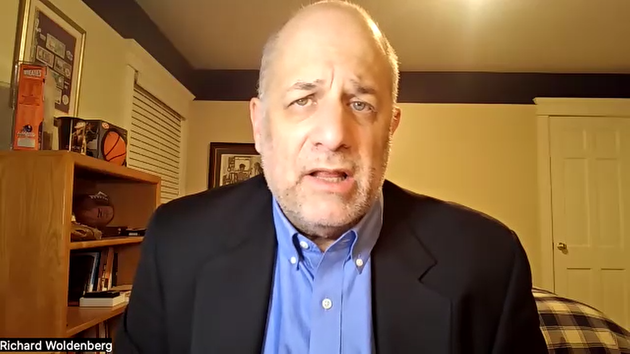
Richard Woldenberg speaking to NBD reporter
Trump's Tariffs Cost an Extra $11 Million in Payments
NBD: What direct impacts have Trump's tariffs had on your company's business? How much extra in tariffs has your company paid?
Richard Woldenberg: Our business is a mission-driven business, where we make educational products which we sell all over the world, including in China. We sell as an exporter to China, as well as importing from China.
These are tariffs imposed by my government on us as importers, and so we pay the tax when we bring products we've manufactured in China, or other places outside the US, into our country. It's a border tax.
In 2025, we paid 10 million dollars incrementally in IEEPA tariffs, and we paid another million dollars this year, so a total of about eleven million dollars. That's up from zero the year before—we did pay overall a little over two million dollars in tariffs and duties in 2024. So it raised our cost by 11 million dollars. And to make the books balance, we had to raise our prices about mid single digits in the summer of 2025. We've chosen not to raise our prices in 2026 and bear the risk of inflation.
The impact on our business was so severe, for all the reasons it would be predictable when a country imposes a massive tax on you. It took money out of our pocket, which we could have used to invest in our business. It caused us to pull back on our spending, to hire fewer people, to reduce new products, very damaging to what we try to do.

Photo/Screenshot of Learning Resources' website
NBD: How much have Trump's tariffs increased your company's costs, and has sales volume declined as a result?
Richard Woldenberg: When I said that we were facing a choice of liquidating our business into the pockets of the government or to raise prices, I was referring to the fact that the tax burden borne by our company exceeded our earnings. So if you add in our Federal tax to the Federal government, plus our State taxes, plus the duties we're expected to pay, it exceeded our profit. And so if you earn a dollar and you pay more than a dollar in taxes, you're just slowly liquidating your business into someone else's pocket. And that's not acceptable. And that's why mathematically, no business can bear all these costs.
Aside from the fact that the tax is unlawful, I consider the tax to be immoral. And the reason I've considered it immoral is that companies like us, for the reasons I just explained, have to raise our prices—we have to pass on the tax cost, because it's not mathematically possible to bear it yourself. And so the people who end up paying the tax are people who buy things subject to the tax.
Well, the people that spend a material amount of their earnings or their wealth on things subject to tariffs are generally people at the lower end of the economic spectrum. They're hardworking everyday Americans, people that buy shirts and shoes and toys and power tools and kitchen gadgets—all these things across borders from other countries. They're paying the tax with a significant part of their earnings or their savings.
But the billionaires don't, because they don't buy enough things that are subject to tariffs to materially impact either their earnings or their savings.
And so effectively the burden of paying the taxes shifts from the very, very wealthy to the far less wealthy, and that's what makes it regressive. The people who can least afford to take money out of their earnings to support the government are paying the most of this tax, and the people who can afford to pay a lot are paying nothing. And that's regressive. And that's wrong!
Moving Production Back to the US Would Be Nothing Short of "Economic Suicide"
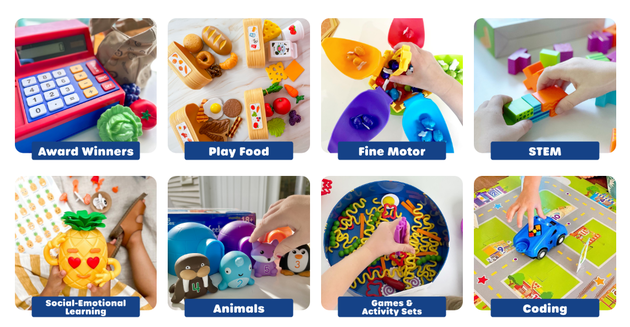
Photo/Screenshot of Learning Resources' website
NBD: Have you considered moving your production lines back to the US to avoid the huge tariff costs?
Richard Woldenberg: Telling the story of our lawsuit, my purpose was never to get people to feel sorry for me. We had to deal with challenges that were imposed on our company suddenly, without warning. But sometimes this happens in business, and so you just have to deal with it.
And at no point did I think this would put us out of business—my job is to make sure we don't go out of business. And as a mission-driven business, we're particularly motivated to stay healthy and keep helping people, but it certainly did cause significant challenges. Again, we were responding to the incentive of an enormous tax, but we did not have the alternative that made any economic sense whatsoever to move our manufacturing to the US. It wasn't like we tried to avoid it; it's just the US is not set up to make products like ours on a competitive basis.
So making our products in the US would have been economic suicide—we would have gone out of business. So the disruption was that we had to scramble around and find other ways to reduce the tax burden in order to survive, which is what we did.
There was certainly a lot of unexpected costs. When you run a private business, you accumulate capital in the business, and so this was just one of those rainy day occasions when you had to spend some of your savings, and so we did.
Fair or not fair, it doesn't really matter—that's what the money is there for. So we used our money to keep our business healthy, so that we could continue to trade as we have, and now we just move forward.
NBD: During this legal battle, you also faced personal attacks. Trump publicly referred to those who filed the lawsuit as "sleazebags". You also personally bore seven-figure legal fees. How did you cope with the obstacles encountered during the lawsuit?
Richard Woldenberg: From my standpoint, we had a lot at stake here. We have the legacy of running a private family business in different forms since 1916, so one hundred and ten years.
And as I said, we're a mission-driven business, and so we find meaning and purpose in what we do. We also have over five hundred employees who count on us, and I'd point out that we not only have Chinese suppliers, but we have Chinese customers, and we have customers all over the world. They sell into schools all over the world, including Chinese schools and American schools.
And so you realize that your company touches a lot of lives every year, and that we're hard to substitute for.
The decision to sue not only made economic sense because they were going to take an extraordinary amount of money away from us every year in the form of tax, and essentially ruin our business, but you also are protecting the role of your business in your community, which meant a lot to us.
I don't think anybody credibly thinks we're sleazebags. I don't worry about being called names. What I was appreciative of is that we have a system where we can take this legal dispute for adjudication by an impartial set of judges, and get an even-handed, appropriate decision. So we were lucky in that sense.
"The Federal Government Must Return These Tariffs It Had No Right to Collect in the First Place"
Photo/Screenshot of Learning Resources' website
NBD: What measures will you take next to recover the overpaid tariffs?
Richard Woldenberg: The process to recover refunds has not been started, it's just the early days. It was sent down to the Court of International Trade just a couple days ago. And so there are a number of companies that have filed suit to assert the rights to a refund.
From my perspective, the Supreme Court has determined that the tariffs were unlawful when imposed, which means that the Federal Government has overcollected taxes from the citizens on a very large scale. There's probably millions of people that paid IEEPA tariffs, either individuals, corporations or agents. And so the process of reversing the gears is something the government knows how to do, and there's law that governs the return of these taxes.
The problem, I think, is really just that trade law is arcane and confusing and full of gotchas. And so it's a kind of old, confusing law, and so people are not really trusting the process. In addition, the Government has not been embracing of the responsibility to return money. So they're going to have to change their mind, because legally, they have no choice—they have to return the money that they weren't entitled to collect.
So everybody is trying to pursue a different route of getting their money back. It's going to take some time. There is no doubt they owe us, and there is no doubt that they're going to pay us. When? How? That's to be determined.
"Chinese Enterprises Are Our Friends"
NBD: In your opinion, what is the greatest harm that tariffs have inflicted on enterprises highly dependent on global supply chains? Do you think the harm is temporary, or will it last a long time?
Richard Woldenberg: There's a lot of rewiring that's gone on in the global economy, and that's unfortunate. The business we conduct in China is with private businesses. Our business is connected with private family businesses generally just like us. So there's a mom and a dad and a brother and a sister; these are families that have put their capital at risk, they've developed special expertise. And in my experience, they're very hard working, they're highly skilled, they're very devoted, and they make us look great. So we love working with them, and they are our friends.
So it's been a wrenching experience to disrupt those relationships we've built up over decades, and we've worked as hard as we can under difficult circumstances to keep those relationships healthy. My hope is that, having survived the storm at least so far, we can work with our partners in China and elsewhere to rebuild.
As long as you're still in the game, you have the opportunity to improve. So I'm an optimist, and I believe that there's a good future in working internationally.


 川公网安备 51019002001991号