While gold and silver continue their record-breaking rallies, a new and more accessible metal has captured the public's imagination: copper.
In the Shuibei jewelry market—China’s largest gold hub—"investment copper bars" have become the latest viral sensation, though experts warn the trend carries more entertainment value than financial logic.
The demand for copper bars has spiked so sharply that processing plants in Shenzhen are reportedly working overtime. "We shipped several tons last night; the factory is running 24/7," one jewelry manufacturer told National Business Daily.
On e-commerce platforms and in physical stalls, 1kg copper bars are retailing between 165 yuan and 220 yuan (approx. $23–$30 USD). Despite being an industrial metal, copper is being repackaged as a "collectible" or "entry-level investment" for those priced out of the precious metals market.
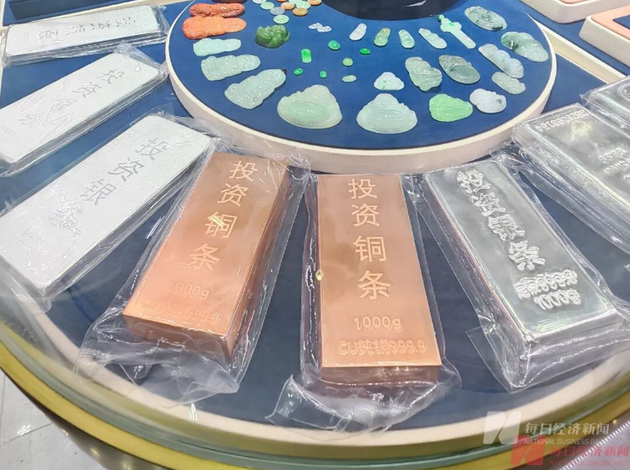
Photo/Kong Zesi (NBD)
While the buzz is significant, the financial math for retail buyers remains precarious. Analysts point out a stark disconnect between raw material costs and retail pricing.
With Shanghai copper trading near 100,000 yuan per ton, the raw copper in a 1kg bar is worth roughly 100 yuan.
At a retail price of 180 yuan, investors are paying an 80% premium.
Bo Wenxi, Vice Chairman of the China Enterprise Capital Union, notes that copper prices would need to double to 200,000 yuan per ton just for a retail buyer to break even, factoring in the near-zero liquidity for small-scale physical copper.
Financial analysts remain skeptical of copper's viability as a personal hoardable asset. Unlike gold, which serves as a global currency hedge, copper is a cyclical industrial commodity.
"Buying copper bars is essentially an 'entertainment budget' item," says Bo Wenxi. "It’s more about the significance of posting a photo on social media than actual wealth management."
Gao Chengjun, founder of Rongzhi Nonferrous, adds that while copper prices are indeed in a bullish cycle—LME copper recently hit a record high of $13,407 per ton—the volatility is immense. For individual investors lacking deep industry knowledge, chasing the "copper fever" poses significant risks.
The "copper rush" is largely a spillover effect from the explosive growth of gold and silver. As of January 2026, international gold has breached the $4,800/oz mark, driven by geopolitical tensions and global interest rate cuts. This has pushed retail consumers to seek cheaper alternatives, regardless of their underlying utility as an investment.


 川公网安备 51019002001991号